
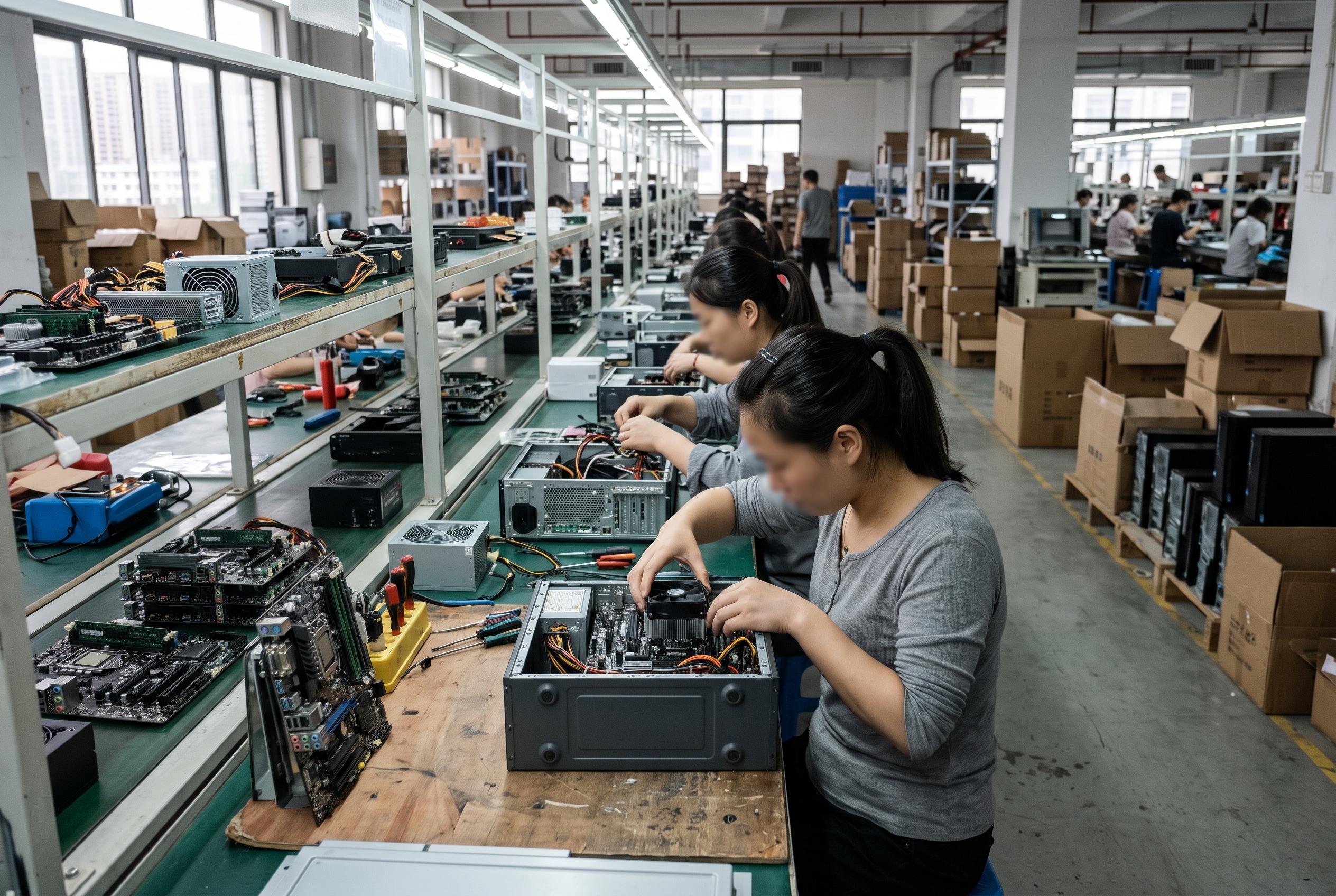
PC brands are quietly reversing part of their China-exit strategy as AI demand drives up chip prices, factory costs, and competition for manufacturing capacity. HP, Asus, Acer, and possibly Dell are looking for cheaper ways to build affordable computers, but the shift highlights how difficult supply-chain diversification has become.
AI demand has made ordinary PCs harder to build
The biggest surprise isn't that PC production is returning to China. It's why. Artificial intelligence has turned server manufacturing into the industry's hot seat, leaving everyday laptops and desktops competing for factory space, components, and attention.
According to Tom's Hardware, AI-related demand has encouraged contract manufacturers to prioritise servers and specialised infrastructure over conventional PCs. That shift has tightened capacity just as computer makers are dealing with pricier memory and processors, creating an awkward squeeze for a market that still depends heavily on affordable machines.
The result is a familiar consumer problem: higher costs, fewer easy savings, and more pressure on brands to protect prices. A budget laptop may look unchanged on the shelf, but the economics behind it have become far less comfortable.
China still offers the supply-chain shortcut
For years, PC companies worked to spread assembly across Vietnam, Thailand, and other countries in Southeast Asia. The goal was to reduce dependence on China and make production less vulnerable to tariffs or geopolitical shocks.
But a factory by itself isn't enough. As Digital Citizen notes, China has a dense network of component suppliers, trained workers, logistics providers, and specialist contractors. Recreating that ecosystem elsewhere can take years and cost more than expected, especially when companies need memory chips and other parts quickly.
Smaller Chinese manufacturers are also attractive because they may have spare capacity and more room to negotiate. TrendForce reported that HP, Asus, and Acer are among the companies exploring this route, particularly for models where every dollar of production cost matters.
Budget computers are likely to feel the shift first
The renewed interest in Chinese assembly doesn't mean every premium notebook is heading back. Industry reporting points instead to lower-priced and entry-level computers, where modest savings can decide whether a model remains profitable.
The Press Pixel reported that component inflation has sharply increased the cost of building machines in several price bands. In that environment, a contractor with local sourcing relationships can offer something overseas facilities often can't match yet: a complete, ready-to-run manufacturing network.
That's especially important when customers are already reluctant to pay more. High-end computers may absorb some price increases, but shoppers buying a basic laptop for school, home, or office work have much less flexibility. Their budgets are tight, and manufacturers know it.
HP, Asus, Acer, and Dell are watching closely
HP and Asus are already linked to the shift, while Acer is also considering additional Chinese capacity. Dell is reportedly studying the experience, although that doesn't necessarily mean a sweeping reversal of its manufacturing strategy.
According to the Times of India, some companies are turning to smaller contractors that can offer more adaptable pricing and access to domestic components. Luxshare, better known for assembling mobile electronics, has also expanded into PC manufacturing through its LuxPC Union venture, which has reportedly attracted work from major brands.
There is a practical logic here. Some phone-focused factories are facing slower mobile demand, while PC assembly offers a way to keep equipment and workers busy. It may not be the most lucrative work, but unused capacity is even less appealing.
What this means for shoppers
Consumers shouldn't expect an immediate flood of cheaper laptops. Industry forecasts cited by AmongZero suggest the PC market remains under pressure, while higher component costs could continue into the near term. Returning some work to China may slow price increases rather than reverse them.
When shopping, compare the full specification rather than focusing only on the processor name. Check memory capacity, storage type, upgrade options, warranty coverage, and battery life, since a low headline price can hide compromises that become frustrating later.
It also helps to watch timing. New production arrangements may bring more affordable models to market next year, but inventory, tariffs, and component availability can all affect retail pricing. In other words, the best bargain may come from a well-equipped current model, not necessarily the newest machine.
A tactical retreat, not a permanent U-turn
The PC industry's supply-chain strategy is becoming more complicated, not simpler. Companies are balancing political risk against immediate manufacturing reality, and AI has made that calculation much tougher.
As Tom's Hardware and TrendForce both indicate, China remains difficult to replace when speed, scale, and supplier access matter. Still, manufacturers are unlikely to abandon overseas expansion entirely. The more realistic future is a patchwork approach, with production spread across regions and shifted according to cost, demand, and trade rules.
For shoppers, that's a quiet reminder that global supply chains eventually show up in everyday prices. A laptop's journey may be invisible, but your wallet can still feel every detour.
A cheaper PC may soon come from a more complicated route.
Disclaimer: This article may have been created with AI assistance and reviewed by our editorial team. It is provided for general informational purposes only. Readers should verify information independently before relying on this content.
