
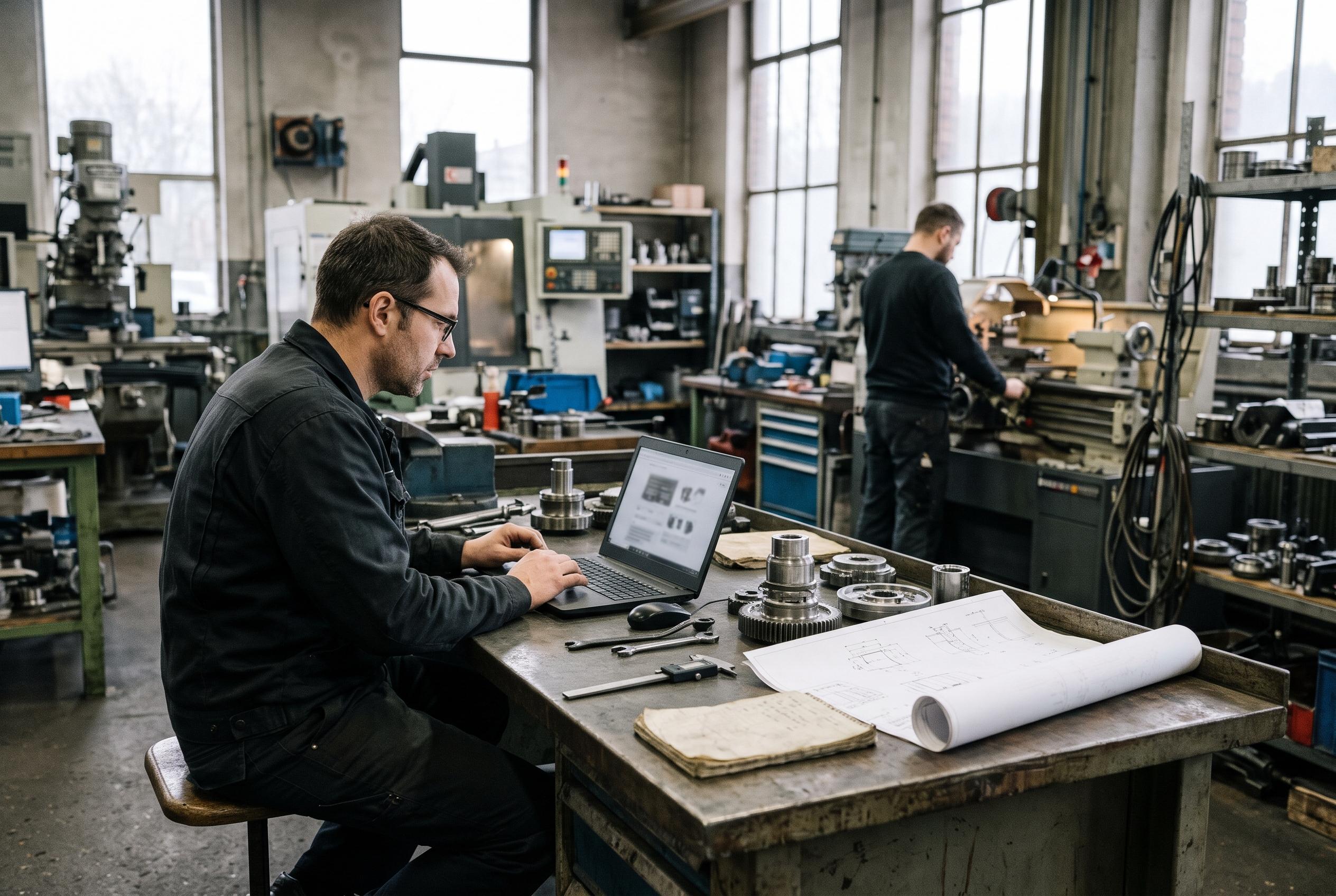
Industrial buyers are starting to describe what a part needs to do instead of hunting through catalogues for a product name. German engineering company kabkin says its Prompt-to-Product platform has already sparked more than 100 B2B projects, offering a glimpse of how AI tools could make industrial sourcing feel less like a guessing game.
Industrial sourcing starts with a problem, not a part number
More than 100 B2B product projects have begun with plain-language prompts on kabkin's platform, the Wuppertal-based engineering company says. The early milestone is notable not just for the number, but for what buyers are typing: specific needs involving movement, loads, available space, safety, cost and timing.
That approach turns a familiar sourcing habit on its head. Instead of knowing the name of a hinge or mechanism before searching, a buyer can explain the job it needs to do, then let engineers work out what might fit. The company says the milestone came before a broad paid-media or search campaign.
How kabkin's Prompt-to-Product process works
A request can include a written description, a photo or sketch, performance targets, a desired price, order quantity and deadline. For enquiries it considers relevant, kabkin says its engineers provide a free first feasibility check within 24 hours.
From there, the team assesses the request in terms of movement, forces, degrees of freedom, interfaces and constraints. The answer might be a hinge, a larger motion system, another mechanical component or a complete assembly.
The proposed route isn't always a brand-new product, either. Kabkin says it can use an existing solution, adapt one or develop something new, with optional support for design, prototyping, manufacturing, quality checks and delivery worldwide. That's a useful distinction: the prompt starts the conversation, but engineering judgement still decides what happens next.
Why a prompt could suit industrial buyers
Industrial catalogues are built around products and suppliers, while a prompt-led tool begins with the buyer's need. That can be helpful when a company knows the function it needs but lacks the right product name, in-house design capacity or specialist staff to translate the brief into a specification.
Still, a simple input box doesn't make a complicated engineering problem simple. Photos, sketches and concrete details such as load, space, quantity and deadline give engineers more to work with than a vague request. For buyers, the practical lesson is to describe the operating conditions as clearly as possible, even if the exact part remains a mystery.
Kabkin says the platform draws on more than 170 years of engineering and manufacturing experience and a library of over 15,000 hinge and kinematic solutions. That existing expertise is doing much of the heavy lifting behind the new interface.
Industrial AI is spreading beyond product design
Kabkin's launch sits within a wider push to apply AI across manufacturing and industrial business. The Next Web reported that Arda, founded by former OpenAI executive Bob McGrew, raised funding for AI in manufacturing. RapidCanvas also acquired Entytle, a company focused on industrial aftermarket software and AI agents.
Meanwhile, Aramco Digital announced a partnership with OrbitronAI focused on AI for heavy industry. The projects take different approaches, but they point to a shared ambition: helping industrial companies use software to tackle complex work, from product development to operations.
For buyers, the interesting test won't be how futuristic a prompt box looks. It'll be whether the resulting solution meets real-world demands for fit, safety, cost and delivery. Kabkin says it plans to share an anonymised Demand Market Snapshot based on enquiries, which could offer a clearer picture of what companies are asking for.
It's a small change in how a request begins, but a meaningful one if it helps good ideas reach the right engineering team.
Disclaimer: This article may have been created with AI assistance and reviewed by our editorial team. It is provided for general informational purposes only. Readers should verify information independently before relying on this content.
