
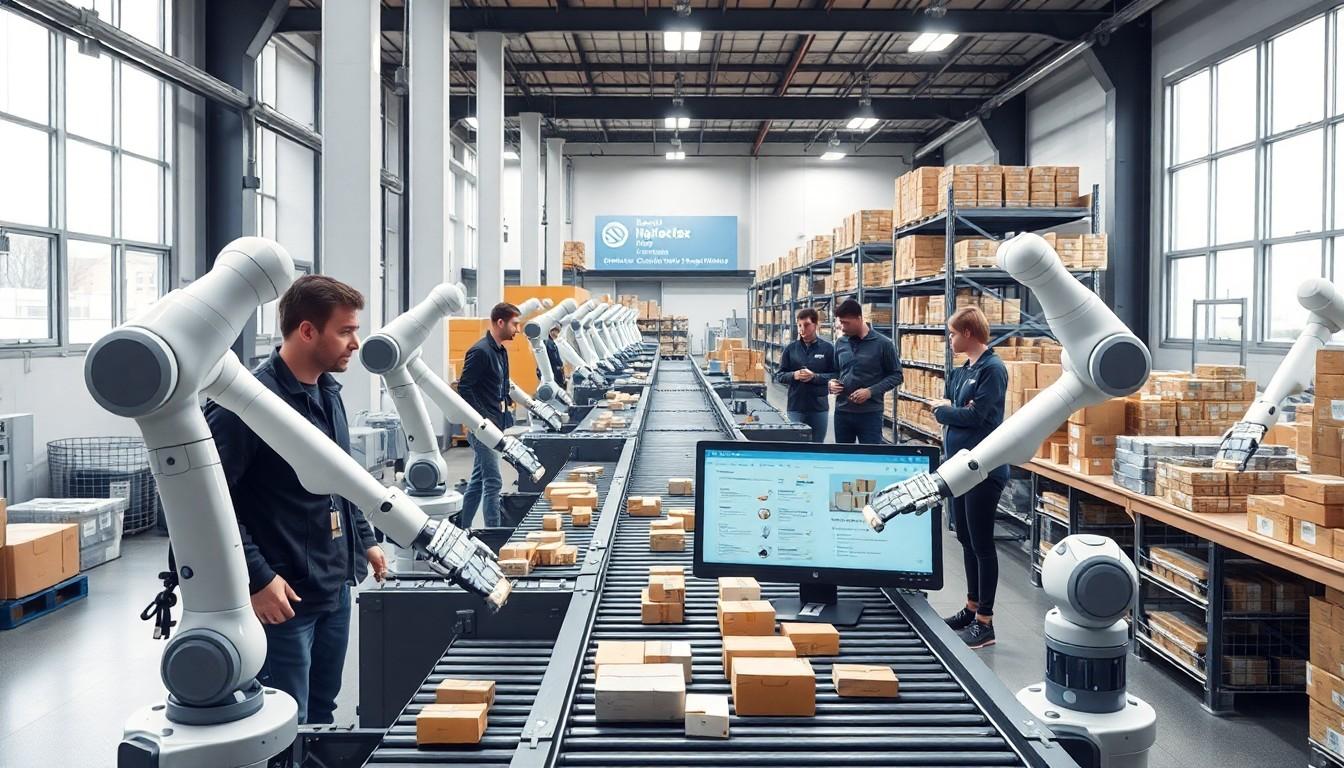
The partnership is deploying Sereact’s Cortex software and Universal Robots arms at live European sites, targeting variable returns and piece-picking workflows while expanding toward North America.
Teradyne Robotics and Sereact have announced a partnership designed to expand the use of physical AI across retail, logistics, and manufacturing, combining Sereact’s Cortex software with Universal Robots arms to take on tasks that have traditionally been difficult to automate. The companies said the system is already operating on live sites rather than remaining limited to demonstrations, with the initial use cases centered on returns processing and piece-picking. Those applications are often challenging because items can vary widely in shape, packaging, and orientation, which makes them harder to handle than more predictable automation jobs. In industry coverage of the deal, the partnership was framed as an effort to give collaborative robots more capability in unstructured environments, where standard automation has often struggled to deliver consistent results. For operators trying to modernize warehouse workflows, the pitch is that the system can address practical pain points rather than simply showcase a technical concept.
The company said the agreement builds on existing deployments across Europe, where it claims hundreds of Universal Robots systems have already been shipped in dual-arm configurations to customer sites. Among the named deployments are fulfillment centers tied to Zalando in Germany and Poland, where the robots are being used to process returned fashion items. The partnership also arrives at a time when retailers and logistics providers are under increasing pressure to process returns faster, reduce manual handling, and improve throughput in related workflows such as replenishment, sortation, kitting, packing, and machine tending. In that context, the value proposition extends beyond one narrow task. It speaks to a broader attempt to improve warehouse and fulfillment efficiency across several adjacent processes that can affect service levels, labor planning, and overall logistics performance. The partnership is therefore being presented not as a one-off deployment, but as part of a larger move toward more adaptable industrial automation in environments where product flow is constantly changing.
Sereact’s leadership said the software is designed to run the same production model across multiple tasks without requiring retraining for each new item, a claim that could matter greatly to operators seeking a more scalable automation stack. Teradyne Robotics said the fit with its platform is strategic because of its installed base and distribution network, while Sereact said the combination should help bring its system to more customers globally. The companies also said Sereact opened a U.S. headquarters in Boston earlier this year to support North American expansion, indicating that the collaboration is meant to move beyond a European rollout. That expansion matters for buyers in the U.S. market who are evaluating how to bring AI-enabled robotics into more retail and warehouse use cases without rebuilding their automation strategy from scratch.
The partnership is also being showcased at NVIDIA GTC Berlin, where the companies are demonstrating returns handling using Sereact’s Vision-Language-Action model on Universal Robots hardware. Teradyne Robotics said the software was trained and validated with NVIDIA tools before deployment, and that the system runs on NVIDIA hardware at the cell level and for development and updates. The broader message is that automation is no longer only about robot arms performing repetitive motions. It is increasingly about integrating simulation, AI perception, and deployment infrastructure into a single system that can be adapted across sites and product flows. For B2B buyers weighing whether to invest in next-generation robotics, the partnership offers a model in which physical AI is tied directly to operational outcomes such as returns processing, piece-picking, replenishment, sorting, kitting, packing, and machine tending.
What the partnership means for warehouse automation
The most important feature of the announcement is its focus on operating conditions that are not fully predictable. Traditional automation tends to perform best when products arrive in consistent positions, follow fixed paths, and present limited variation. Returns processing and piece-picking are different. A returned item may have different packaging, orientation, or physical characteristics from the item handled immediately before it. That variability makes perception and handling central to the task.
By combining Cortex software with Universal Robots arms, the companies are presenting a system intended to connect software intelligence with a flexible robotic platform. The stated goal is not simply to make a robot repeat one movement, but to support multiple tasks and product flows. The same production model is described as being usable across different tasks without retraining for every new item. For operators, that approach could make the automation stack easier to scale across workflows that include returns, replenishment, sortation, kitting, packing, and machine tending.
This matters because logistics operations are interconnected. A slowdown in returns processing can affect inventory availability and downstream handling. Delays in picking can influence packing and fulfillment. Sortation and replenishment also depend on products moving through a facility with sufficient consistency. The partnership’s stated applications therefore connect to a wider operational picture rather than standing alone as isolated demonstrations.
The European deployments provide the clearest example of that approach. The companies said hundreds of Universal Robots systems have been shipped in dual-arm configurations to customer sites across Europe. The named Zalando-related fulfillment centers in Germany and Poland show how the technology is being associated with returned fashion items, a category where variation in product shape, packaging, and orientation can be especially relevant. The companies have characterized these deployments as live operations, which distinguishes them from systems shown only in controlled demonstrations.
Why physical AI is attracting attention
Physical AI brings together perception, software models, robotic movement, and the infrastructure needed to run and update those systems. In the partnership described here, Sereact’s Vision-Language-Action model is being demonstrated on Universal Robots hardware, with NVIDIA tools used for training and validation. The system also runs on NVIDIA hardware at the cell level and for development and updates.
That combination reflects a shift in how industrial automation is being discussed. The focus is moving from a robot arm’s mechanical capabilities to the full system surrounding it. A robot needs to identify an item, interpret its condition and position, determine an appropriate action, and carry out that action through the hardware. The software and deployment environment are therefore as important to the use case as the arm itself.
For retail and logistics companies, this can be relevant when product flows change frequently. A system designed for only one product type or one fixed orientation may be less useful when a facility handles a wide range of goods. The companies’ claim that one production model can support multiple tasks without retraining for each new item is intended to address that challenge. It also supports the broader message that AI-enabled robotics can be connected to practical operational needs rather than treated as a separate technology experiment.
The partnership’s manufacturing relevance comes from the inclusion of machine tending, kitting, packing, and other processes alongside warehouse use cases. Although returns and piece-picking are the initial focus, the stated application range points toward a platform that could be used across retail, logistics, and manufacturing environments. The companies are positioning the combination as adaptable, with the potential to address several processes within an automation strategy.
Expansion beyond Europe
The opening of Sereact’s U.S. headquarters in Boston is another important part of the announcement. The companies said the office was established to support North American expansion, while Teradyne Robotics emphasized its installed base and distribution network. Together, those points indicate an effort to make the technology available to more customers globally.
For buyers in the U.S. market, the relevance lies in the possibility of adding AI-enabled robotics to existing operations without rebuilding an entire automation strategy from the beginning. The partnership is being framed around a combination of software, hardware, deployment experience, and distribution. That combination may be particularly significant for operators that are already considering collaborative robots but need them to handle more variable environments.
The companies’ stated objective is to bring the system to more customers while building on existing deployments. Its success will depend on how effectively the technology performs across live sites and how easily it can be adapted to different product flows. The current announcement provides a picture of the intended direction: collaborative robots supported by physical AI and deployed in workflows where variation has made automation more difficult.
What buyers should watch
The announcement highlights several issues that matter to organizations evaluating robotics for warehouse and manufacturing operations. First is the range of tasks that a system can support. Returns processing and piece-picking are the initial use cases, while replenishment, sortation, kitting, packing, and machine tending are also identified as relevant processes.
Second is the role of deployment infrastructure. Training and validation with NVIDIA tools, along with NVIDIA hardware used at the cell level and for development and updates, show that the system is being presented as more than a standalone robot. It is a combination of hardware, software, AI models, and update capabilities.
Third is the importance of live-site performance. The companies said the system is already operating on live sites, including deployments connected to Zalando fulfillment centers. That operational context is important because the stated challenge involves product variation and changing conditions rather than a fixed laboratory demonstration.
Finally, the partnership reflects the growing connection between sourcing decisions and logistics strategy. Buyers considering automation must look at how a system fits into existing facilities, product flows, and labor planning. The value proposition described by Teradyne Robotics and Sereact is based on using a flexible automation stack across several related processes, with the aim of improving warehouse and fulfillment efficiency.
Q&A
What are the initial use cases?
The initial use cases are returns processing and piece-picking. The companies said the system is already operating on live sites.
Where have deployments been named?
Named deployments include fulfillment centers tied to Zalando in Germany and Poland, where robots are being used to process returned fashion items.
What other workflows are identified?
The partnership also relates to replenishment, sortation, kitting, packing, and machine tending.
What technology is being demonstrated?
The companies are demonstrating Sereact’s Vision-Language-Action model on Universal Robots hardware. NVIDIA tools were used for training and validation, and NVIDIA hardware supports the system at the cell level and for development and updates.
What is the partnership’s geographic direction?
The companies said Sereact opened a U.S. headquarters in Boston to support North American expansion, while the partnership builds on existing deployments across Europe.
Disclaimer: This article may have been created with AI assistance and reviewed by our editorial team. It is provided for general informational purposes only. Readers should verify information independently before relying on this content.
