
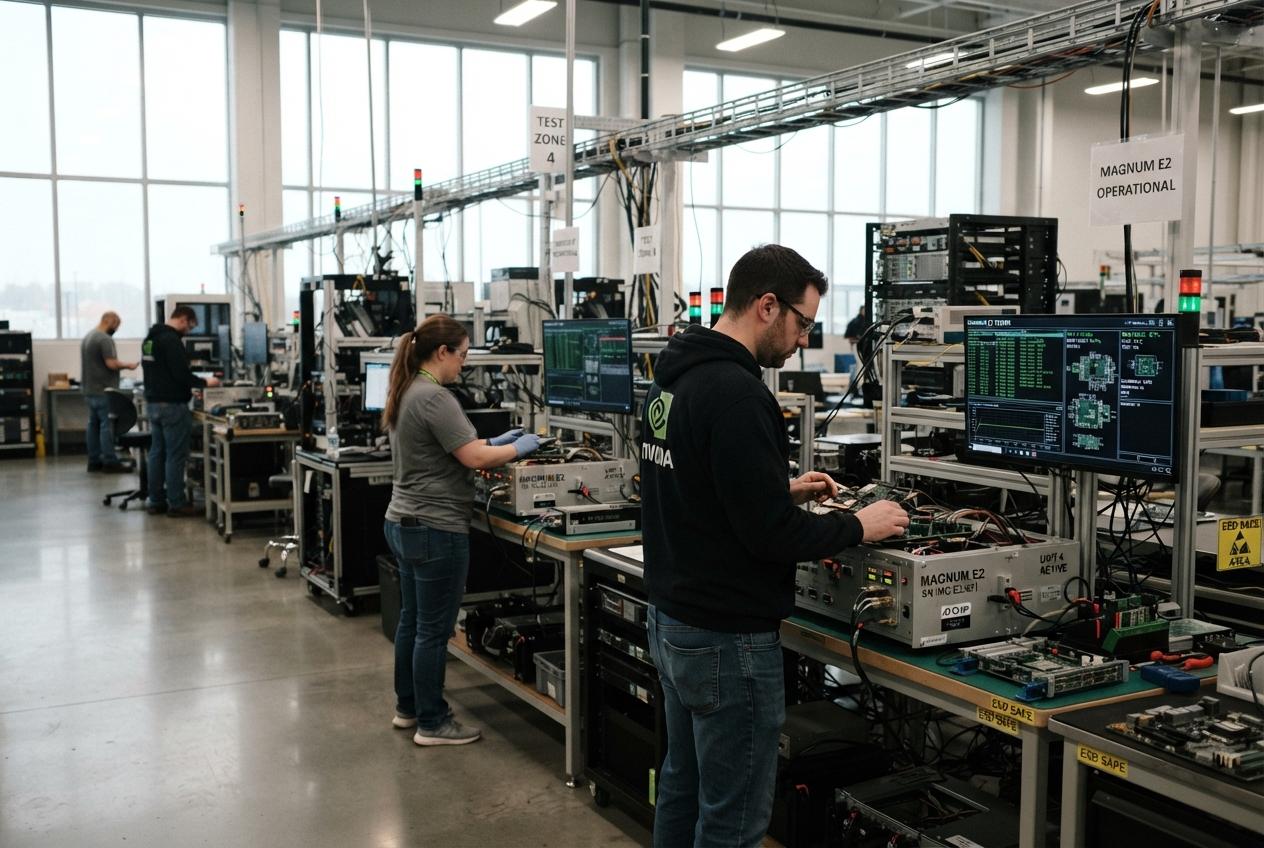
Chipmakers are facing a quieter challenge behind the AI boom: testing memory fast enough, accurately enough, and at the scale modern data centres demand. Teradyne's Magnum E2 platform targets LPDDR6, DDR6, GDDR7, and NAND flash, giving manufacturers a shared route from engineering trials to high-volume production.
The AI hardware race now depends on memory testing
The most visible AI hardware headlines tend to focus on processors, accelerators, and cooling. Yet every one of those systems also depends on memory that can move data quickly and reliably. If the memory falls short, the expensive compute engine spends more time waiting than working.
That makes Teradyne's Magnum E2 an infrastructure story rather than a flashy new chip launch. According to Teradyne, the platform is designed for the demanding interfaces emerging across AI and high-performance computing, including LPDDR6, DDR6, GDDR7, and NAND flash.
The timing reflects a broader shift in the memory market. JEDEC's LPDDR6 standard promises a substantial jump in effective bandwidth over current-generation technology, according to Tom's Hardware, while industry roadmaps are already looking beyond today's products. Faster interfaces are useful only when manufacturers can verify them consistently, and that's where testers earn their keep.
Why putting instruments closer to the chip matters
At very high speeds, the test setup can become part of the problem. Long electrical paths, connectors, and other elements between a tester and a memory device can weaken signals or narrow the apparent operating margin. In plain English, the equipment may make a capable chip look less capable than it really is.
Magnum E2 builds on Teradyne's Near-DUT Test architecture, also used in the company's Magnum EPIC system. The idea is straightforward: move digital instruments nearer to the device under test, reducing the distance signals must travel before they are generated or measured.
Teradyne says this approach helps preserve signal integrity and AC margin. The company hasn't published a quantified yield improvement or a like-for-like performance comparison in the announcement, so the most defensible takeaway is architectural. The tester is intended to give manufacturers a cleaner view of what their memory devices can actually do.
One tester for a changing memory roadmap
Memory standards don't sit still for long. Manufacturers are working across different generations and product categories, so a fixed testing system can become an expensive bottleneck surprisingly quickly.
Teradyne's programmable APG architecture is intended to support current and emerging DRAM and NAND standards on common hardware. The platform also supports NRZ, PAM3, and PAM4 signalling, giving engineers room to handle different approaches as interfaces evolve. That flexibility won't eliminate the complexity of new designs, but it could make an existing tester more useful for longer.
The wider industry direction is clear. Tom's Hardware has reported development roadmaps involving DDR6, GDDR8, LPDDR6, and even 3D DRAM, suggesting that test equipment will need to adapt alongside increasingly ambitious memory products. Nobody wants to replace a costly platform every time a new interface arrives.
Faster testing has to remain economical
Performance is only half the equation in semiconductor manufacturing. A tester that delivers beautifully detailed measurements but slows the production line too much won't win many fans on the factory floor.
Magnum E2 is designed to address higher pin counts and increased parallelism, meaning multiple devices can be tested at the same time. Teradyne also positions the system for both engineering and high-volume manufacturing, with common hardware and software intended to simplify the handoff between those stages.
That shared environment could reduce duplicated work, particularly when teams move a test programme from qualification into production. The actual savings will depend on each manufacturer's process, however, and Teradyne hasn't supplied specific figures for time or cost reductions. Even so, keeping engineers and production teams closer to the same test ecosystem sounds considerably less painful than rebuilding programmes from scratch.
The practical question is whether flexibility delivers
The built-in logic testing capability broadens Magnum E2 beyond memory-only evaluation. For devices that require both memory and logic checks, consolidating test insertions could reduce programme complexity and the number of separate steps involved.
This matters because AI supply chains need more than headline bandwidth. Manufacturers must identify marginal or defective components, maintain yields, and produce reliable parts in enormous quantities. A memory standard can look brilliant on paper, but customers ultimately care whether it works consistently in real systems.
For chipmakers considering a platform like this, the key questions are practical: Which standards will need support first? How many devices must be tested in parallel? Can existing programmes transfer cleanly? And will the system provide enough flexibility to justify the investment over several product generations? Those answers will determine whether Magnum E2 becomes a useful long-term workhorse or simply another specialised tool.
Testing is becoming a strategic part of AI manufacturing
Teradyne's announcement highlights a less glamorous but essential truth. AI progress depends not only on designing faster processors and denser memory, but also on building the manufacturing systems that can validate those parts at speed.
Magnum E2's promise rests on three ideas: preserve the signal seen by the device, support evolving memory interfaces, and keep production throughput high. It isn't a new compute engine, but it addresses the machinery that helps turn advanced memory designs into dependable products.
As memory roadmaps stretch further into the future, testing will become harder to hide in the background. The quiet equipment beside the production line may have as much influence on delivery schedules as the chip itself.
It's a small but crucial step toward making faster AI memory reliable at scale.
Disclaimer: This article may have been created with AI assistance and reviewed by our editorial team. It is provided for general informational purposes only. Readers should verify information independently before relying on this content.
