
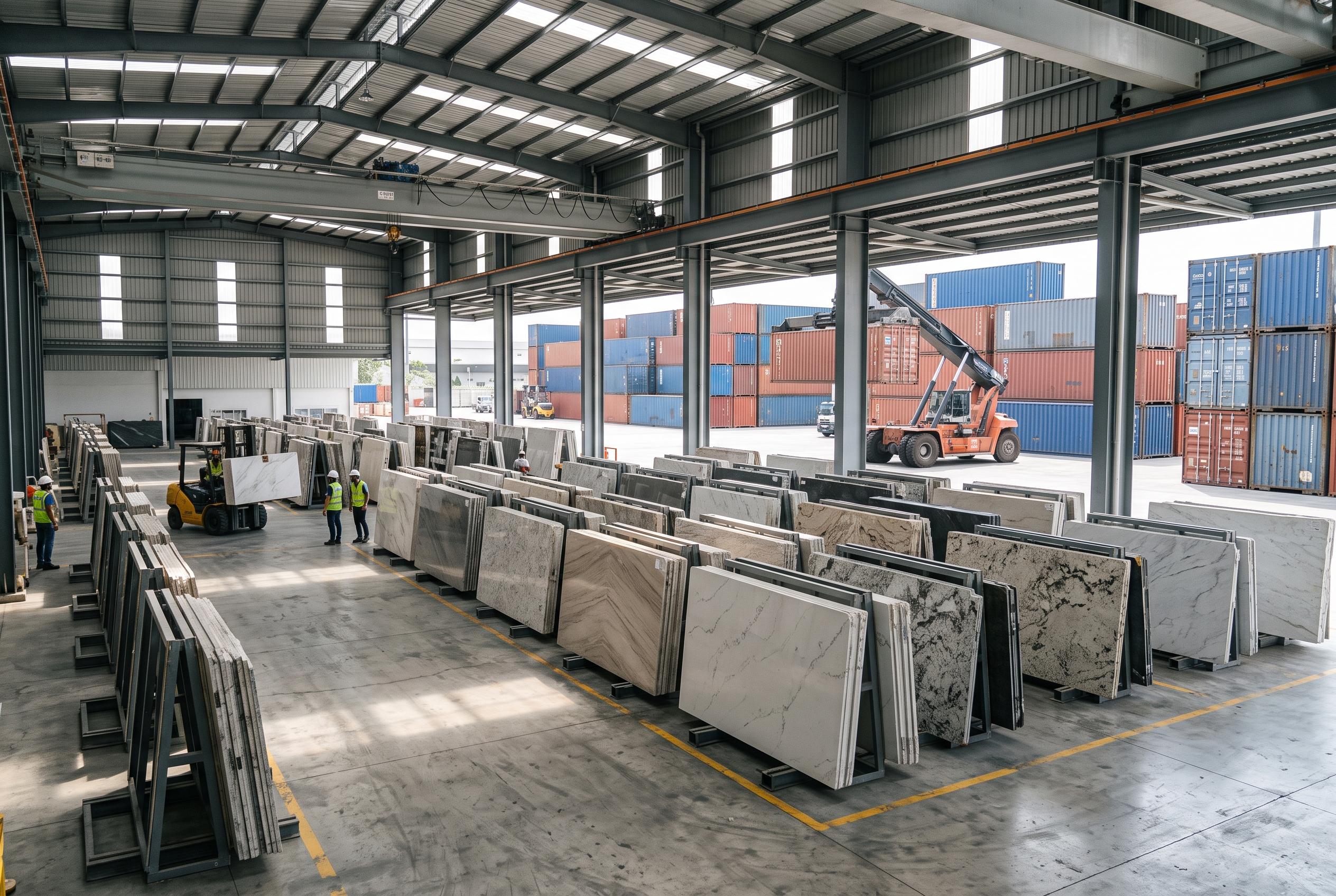
- The US introduces tariffs up to 55% on quartz surface imports, impacting global supply chains.
- India, heavily reliant on US market, challenges the safeguard at the WTO.
- The new measures may shift consumer choices toward natural and sintered stones.
The United States has recently implemented a new safeguard regime on quartz surface products, which has significantly increased the costs for companies trying to enter the US market. This move is putting immediate pressure on India’s largely export-driven manufacturers. According to the StoneNews report, these measures kicked in on August 15, 2026, and now range from a 25% to as much as 55% in tariffs. Honestly, this could really shake up global trade flows, especially considering how heavily this sector has depended on US demand. India has not taken this lying down, they’ve already challenged the decision at the World Trade Organization.
The tariff system was set up under the US safeguard law and is meant to last for four years, until August 2030, under a tariff-rate quota structure. The U.S. International Trade Commission initially indicated that lifting existing duties on quartz surface imports from India and Turkey might cause further harm to domestic producers. Also, their separate safeguard investigation was forwarded to the White House back in May. Then, President Donald Trump signed a proclamation on August 1, officially ordering the safeguard, with the administration claiming the purpose was to give US manufacturers some breathing room to adapt to import competition.
Now, for Indian producers, the timing couldn’t be worse. The StoneNews report highlighted that exports to the US are worth over $230 million annually, and more than 72% of India’s quartz surface shipments head straight to the American residential and commercial countertop markets. The manufacturing hubs are mainly in Gujarat, Rajasthan, and Telangana, places where companies like Pokarna’s Quantra division, Marudhar Quartz, Esprit Stones, and ARO Granite now face higher land costs plus tighter control over pricing. Interestingly enough, a report from the Global Trade Research Initiative, cited in the article, warns that shifting production to other markets won’t happen overnight. Product sizes, designs, and distribution have all been built around US renovation demand. So, media outlets suggest it’s not that simple to just divert production elsewhere.
Furthermore, the new tariff structure seems to be changing the competitive landscape quite a bit. Countries with free-trade agreements with the US, including Canada, Mexico, Australia, South Korea, and Singapore, , they’re all exempt. That clearly puts India and China at a disadvantage. Industry experts also say this policy might push consumers toward natural stone or sintered stone alternatives if engineered quartz gets too expensive for American buyers. As for India’s move at the WTO, they filed a request on August 14 to start consultations on the safeguard justification, and whether the quota terms or exemptions could be revised or renegotiated.
Takeaways and FAQ
Key takeaways
- - The new US safeguard regime on quartz surface products adds a major cost layer for exporters that rely on the American market.
- - India’s quartz surface industry is especially exposed because a large share of shipments is tied to US residential and commercial countertop demand.
- - The tariff-rate quota structure creates a sharp competitive divide, especially for suppliers outside US free-trade agreement partners.
- - The policy could influence sourcing decisions, logistics planning, pricing strategy, and longer-term market diversification.
- - In the short term, manufacturers may need to rethink export routes, customer mix, and product positioning rather than assume easy access to the US market will continue.
- - The situation also highlights how quickly trade policy can reshape global electronics-adjacent industrial supply chains, since quartz products often intersect with broader construction, design, and lifestyle markets through home renovation demand.
FAQ
1. Why is this safeguard regime important for exporters? Because it directly raises the landed cost of quartz surface products in the US, making it harder for non-exempt suppliers to compete on price. For export-oriented businesses, even a policy shift that seems narrow can affect sourcing decisions, customer contracts, and logistics planning.
2. Why is India more exposed than some other countries? Based on the report, India sends a large share of its quartz surface output to the US. That concentration makes the industry vulnerable when trade rules change. If a company depends heavily on one destination market, tariff increases can hit revenue, margins, and factory utilization very quickly.
3. What does a tariff-rate quota mean in practical terms? It means imports are managed through a quota system with different tariff levels depending on how much product enters the market. In practical terms, this can reward some volumes while making others much more expensive, which changes how suppliers plan shipments and negotiate with buyers.
4. Could US buyers switch to other materials? Yes, that is one of the main risks described in the article. If engineered quartz becomes too expensive, buyers may look at natural stone or sintered stone alternatives. That would not only affect sourcing choices, but also downstream lifestyle and renovation preferences.
5. What might Indian manufacturers do next? They may look for ways to diversify export markets, manage pricing more carefully, or adjust production planning. But the article suggests this is not something that can be changed overnight, because product design, sizing, and distribution have been built around US demand.
6. What is the bigger trade lesson here? Trade access can change fast, so companies with international exposure need flexible strategies. That includes monitoring policy risk, keeping logistics adaptable, and avoiding overdependence on one market. For businesses in construction materials, electronics, or mobile-related supply ecosystems, resilience often starts with sourcing diversification and market balance.
7. Does this only affect quartz surface manufacturers? Not necessarily. The immediate impact is on quartz surface products, but the broader effect can spread through suppliers, distributors, installers, and related industries. When pricing changes in one category, it can influence sourcing preferences and consumer behavior across the broader home improvement and lifestyle market.
Final thought
This case shows how one policy move can ripple through manufacturing, sourcing, logistics, and export strategy at the same time. For India’s quartz surface makers, the next phase will likely be defined by legal consultation, market adaptation, and the challenge of preserving competitiveness in a more expensive US trading environment.
Disclaimer: This article may have been created with AI assistance and reviewed by our editorial team. It is provided for general informational purposes only. Readers should verify information independently before relying on this content.
Sources by paragraph:
- - Paragraph 1: [[1]]
- - Paragraph 2: [[3]], [[6]]
- - Paragraph 3: [[1]], [[4]]
- - Paragraph 4: [[1]], [[2]], [[5]], [[7]]
