Download App
Better Online and Trade Show Sourcing Experiences.Scan the QR code to download.
Learn More
Hot Topics
by Cecile de Veyra & Vianie Li
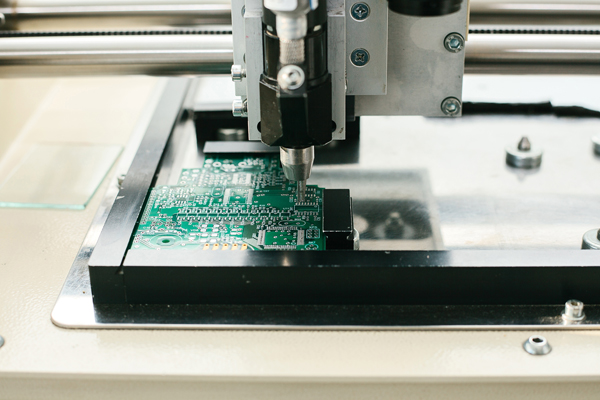
China's EMS companies have long emphasized improving their services to meet specific requirements from customers in a fast turnaround time. This has been an ongoing endeavor for the past decade, which saw a stream of technology and machine upgrades that also included the adoption of industrial robots. In recent years, smart manufacturing has become the focal point for increasing efficiency and product quality amid rising labor costs and intensifying market competition.
The Chinese government, in fact, has been encouraging the use of industrial robots for the past several years. In the “Guidance on the Promotion and Development of the Robot Industry” released by the Ministry of Industry and Information Technology (MIIT) in 2013, one of the goals was to have 100 robots per 10,000 factory workers. This was echoed in the Made in China 2025 program announced in 2015, pegging robot density at 150 per 10,000 workers by 2020.
Government support has also been extended to cover specific opportunities such as the development of the Internet of Things (IoT). In 2018, the China Information Technology Industry Federation issued the guidance document “General Program on Electronic Smart Manufacturing,” formulating the industrial internet and security and core product innovation platforms to promote smart manufacturing. A mobile IoT industry innovation center was set up, which offers support to enterprises on AI, industrial internet and NB-IoT technology and industry development.
In Deloitte's 2018 report on China's smart manufacturing, one of the key findings was “51 percent of [surveyed] enterprises are already using AI in manufacturing and management and 46 percent have started or are working on deploying AI to empower their products and services.”
However, “China’s digital transformation of its manufacturing sector remains largely in its infancy, such as the use of industrial software, and data mining and utilization at production sites,” said Fang Xiaoxia, a researcher with the Chinese Academy of Social Sciences, in a report on XinhuaNet.
Competition with foreign EMS providers operating in China will provide an impetus for homegrown companies to excel using new technologies. There are a number of Chinese companies that have already invested in smart manufacturing. Shenzhen 7Renju did so as early as 2016, setting up its own platform and offering total solutions to customers. The strategy not only boosted production efficiency and enhanced product quality as expected, but also helped lower its total cost of ownership.
Over a thousand manufacturers make up China's EMS sector and most are locally owned. Foreign companies, although a minority, still dominate the domestic and overseas markets. These include Foxconn and Flex. 3CEMS, Shenzhen Kaifa, DBG and BYDE are some of the major Chinese players.
To keep up with foreign counterparts, Chinese companies are continuing to expand their manufacturing capabilities. DBG, for example, now has a total of more than 70 SMT production lines in its factories in Huizhou, Jiaxing, Shenzhen and India.
Research and Markets forecasts a 6.8 percent CAGR for the EMS market between 2021 and 2026. This is attributed to the rise in the number of companies that are downsizing their manufacturing activities to focus on other business aspects and turning to outsourcing instead. The same option works for those seeking to expand or restart operations in other locations.
Analysts in general are confident the projected growth catalysts pre-pandemic will ensure healthy demand in the coming years. These will be communications, industrial control, and consumer, medical and automotive electronics.
More Sourcing News
Read Also

关注 “环球资源外贸” 官方微信,获取实时外贸资讯
iOS & Android
iOS & Android(Mainland China)
Copyright © 2026 Publishers Representatives Limited. All rights reserved.




