
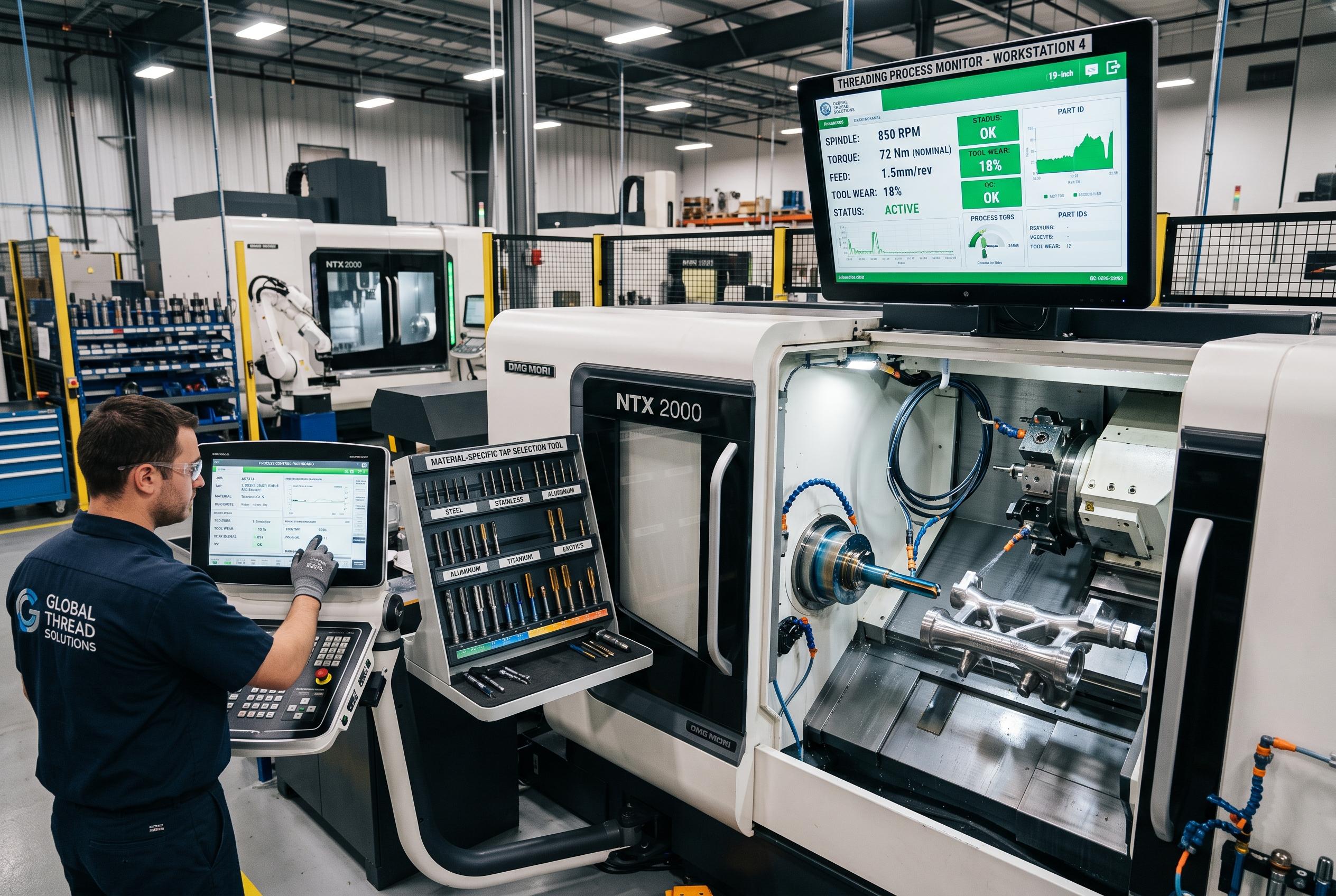
- Modern tapping now relies on process control, coatings and monitoring systems
- Material-specific tap selection and thread milling improve reliability for tough alloys
- Real-time process tracking reduces tool failure and enhances production efficiency
Threading continues to be one of those quieter but absolutely critical parts of manufacturing. If a hole is not cut really cleanly, the entire assembly can suffer. Especially in industries like automotive, aerospace, medical devices, oilfield and general industrial production, internal threads are vital, they impact everything from how strong the joint is, its resistance to leaks, to how long it lasts under fatigue and how easy it is to service. As machining tolerances get tighter and plants are expected to do more with tougher alloys, the quality of threads is not just about choosing the right tool anymore, it’s a process-control matter. MTW Magazine highlights that modern tapping has moved far beyond a simple cutting step; now, it hinges on factors like tool materials, coatings, geometry, machine rigidity and smart monitoring systems to get consistent, high-quality results.
The tricky part is that threading does not behave the same way twice, especially across different materials. Stainless steel, titanium, hardened steels and superalloys that resist heat can really push torque and temperature to the limit, and blind holes that come with their own set of challenges, like chip packing and risk of tool failure. That’s why companies like AutoDrill and WIDIA put a lot of emphasis on specialized tapping systems and tool families designed to deliver clean, reliable threads across various production setups. Baucor also stresses customized tap designs aimed at boosting productivity and thread quality. In many machining shops these days, it’s less about whether to tap or not, and more about figuring out which style of tap is best suited for the material, hole depth, and cycle time.
And the choice of tap really matters. The tool itself has become quite specialized. There are straight flute, spiral point, spiral flute and form taps, each one tailored to solve particular production issues, like evacuating chips or creating stronger, chip-free threads in ductile materials. MTW Magazine points out that coatings like TiN, TiCN, TiAlN and AlCrN, along with high-speed steels made via powder metallurgy and solid carbide, have really extended tool life and reduced friction. This broadens the “window” or the range of conditions in which the tool performs well, especially important when tool breakage or rework costs are high.
Thread milling, too, has started playing a bigger role, especially when production demands more flexibility or involves high-value parts that justify the extra programming. Pearson Manufacturing notes that it offers CNC thread milling options alongside rigid tapping and form tapping, which reflects how many job shops treat thread production today, as more of a multimethod approach than just one simple process. Thread milling is particularly handy when interrupted cuts, big diameters or tough materials make traditional tapping riskier. In those types of situations, controlling the path with CNC interpolation can be a real game changer, making recovery easier and reducing scrap.
Overall, the trend seems to be heading toward smarter, more traceable threading processes. MTW Magazine describes a shift toward real-time monitoring, tracking torque, vibration, spindle load and temperature, and using software to spot wear or potential failures before a tap actually breaks. That kind of logic lines up with equipment from companies like Oster Manufacturing and PMC-Colinet, which focus on durable, high-output machines perfect for high-volume, repetitive work. So, whether you’re a sourcing manager or a manufacturer, the message is pretty clear: threading is not a cutting-edge process by itself anymore, but the systems that succeed are the ones that blend precision tooling, digital oversight and design tuned to specific applications.
For sourcing teams, that shift matters just as much as it does for machinists on the floor. A purchasing decision is no longer only about unit price; it increasingly involves lifecycle cost, machine compatibility, support for specific materials and the logistics of keeping the right tooling available when demand changes. In electronics manufacturing, for example, where compact housings, mixed materials and high precision are common, a poor threading process can slow assembly or compromise serviceability. The same logic applies to mobile device enclosures, lifestyle products with cosmetic finishes, and any part where the fit, finish and durability all need to hold up at scale. Strong sourcing strategies now often include evaluating supplier expertise, coating options and lead times alongside the tap itself.
What’s especially interesting is how threading reflects broader manufacturing priorities. Plants are being asked to improve uptime, reduce waste and maintain quality while handling more product variation than before. That means process data, inspection records, and repeatable tool performance are becoming central to how companies manage production. In practical terms, a better tap may reduce rework, but a better system can reduce hidden losses across the entire line. That system can include tool presetting, consistent coolant delivery, machine rigidity checks and even operator training on when to switch from tapping to thread milling.
There’s also a growing emphasis on cross-functional coordination. Engineering may specify the thread form, manufacturing may decide whether rigid tapping or milling is best, and sourcing must secure the tooling and supplies needed to support that decision. When those functions are aligned, the shop is better positioned to manage challenging jobs without emergency purchases or avoidable downtime. This is where modern logistics and supply planning intersect with machining performance: if a critical tap family has long lead times or limited availability, a production schedule can quickly become vulnerable. That’s why many facilities are building stronger relationships with tooling partners and keeping contingency options in place.
Another major takeaway is that thread quality is increasingly tied to predictability rather than trial and error. The more repeatable the process, the easier it is to scale from prototype to production. That matters not only in heavy industrial settings but also in sectors such as medical devices and consumer electronics, where every defect can carry a high cost. In those environments, a well-chosen tap or thread milling strategy can support both technical performance and brand reputation.
In short, threading may not get the same attention as robotics, additive manufacturing or AI-driven inspection, but it remains one of the most important links in the manufacturing chain. Companies that treat it as a strategic process, not a minor secondary operation, are more likely to see better throughput, fewer failures and stronger outcomes across the board.
Takeaways:
- - Thread quality is now a process-control issue, not just a tooling choice.
- - Material type, hole depth, and chip evacuation should drive tap selection.
- - Coatings and tool substrates can significantly extend tool life.
- - Thread milling offers flexibility for tough materials and high-value parts.
- - Real-time monitoring improves reliability and reduces breakage risk.
- - Sourcing, logistics, and production planning all affect threading success.
Frequently Asked Questions:
- - Why is tapping harder in stainless steel and titanium? These materials generate higher heat and torque, which increases wear and raises the risk of chip packing or tool failure.
- - When is thread milling better than tapping? It is often better for large diameters, interrupted cuts, or expensive parts where reducing risk and improving flexibility matters more than speed.
- - What should sourcing teams look for in threading tools? They should consider material compatibility, coating, tool life, lead time, supplier support, and overall cost of ownership.
- - Why does machine rigidity matter so much? Less rigidity can cause vibration and misalignment, which can damage tools and reduce thread quality.
Disclaimer: This article may have been created with AI assistance and reviewed by our editorial team. It is provided for general informational purposes only. Readers should verify information independently before relying on this content.
Source Reference Map
Inspired by the headline at: [1]
Sources by paragraph:
