
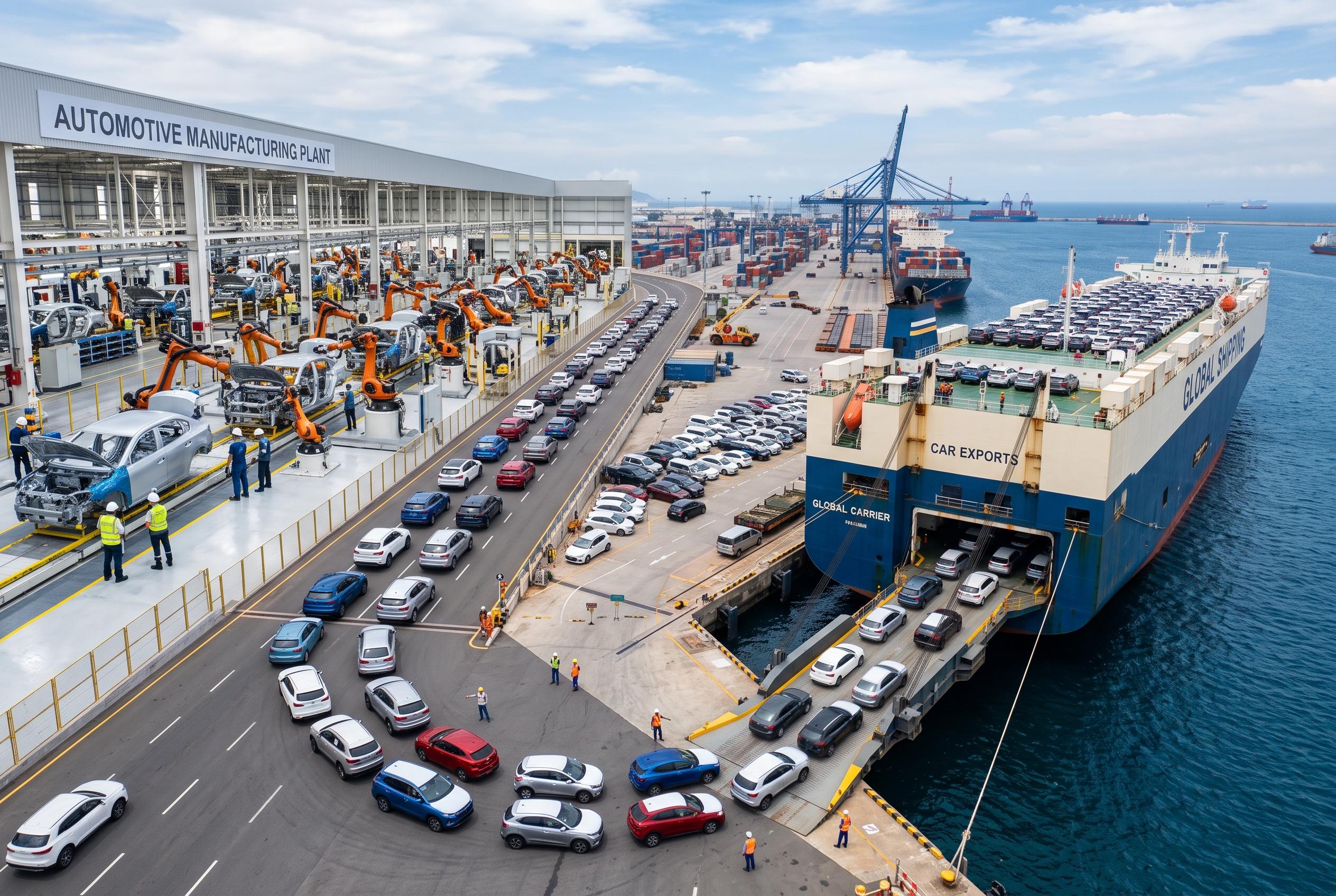
- Vietnam's car exports are expanding beyond domestic borders to markets like Australia and Mexico
- Industry growth driven by increased scale and deeper integration into regional supply chains
- Challenges remain in boosting localization rates and supporting-industry capabilities for sustainable development
About five years ago, Vietnam’s auto production was mainly concentrated in assembly, while supporting-industry businesses remained weak. The localization rate for passenger cars at the time was only around 8 to 10 percent; for trucks and buses it was higher, but still far from many stated targets.
Five years later, those shortcomings have not disappeared. However, one notable change has emerged: cars made in Vietnam are increasingly going beyond the domestic market.
Recently, Hyundai Thanh Cong held a ceremony to export the first batches of Hyundai Creta vehicles produced in Vietnam to Mexico and Australia. In 2026, the company expects to export 15,280 units, including 10,160 finished vehicles and 5,120 kits. It also aims to reach more than 60,000 export units per year starting in 2030.
Vũ Tấn Công, an expert with nearly 40 years of experience in management and auto sales at foreign-invested automakers, and former secretary general of the Vietnam Automobile Manufacturers Association (VAMA), said that Hyundai Thanh Cong’s move to bring vehicles produced and assembled domestically to international markets marks a step forward for the company in particular and Vietnam’s auto industry in general. He said that a model made in Vietnam meeting the durability, reliability, safety and other requirements of foreign markets also shows that Vietnamese businesses have made progress in technical capability, technology and R&D.
Notably, Hyundai Thanh Cong is not the only case. In recent years, THACO has sent many vehicle lines produced in Chu Lai abroad; VinFast has exported electric cars to the US, Europe and Southeast Asia; and Kim Long Motor has also recently begun sending domestically produced buses to South Korea and Thailand.
Still, export volumes remain relatively modest compared with major auto manufacturing hubs in the region. But what is noteworthy is that some factories in Vietnam are gradually shifting from mainly serving the domestic market to also supplying outside markets.
According to Vũ Tấn Công, THACO, VinFast, Kim Long Motor and Hyundai Thanh Cong’s gradual export of complete vehicles is significant. It is a sign that businesses in Vietnam are beginning to participate more deeply in regional and global auto supply chains. From an industrial perspective, exports can also help solve a long-standing problem: scale.
The fact that more and more businesses are sending vehicles made in Vietnam to the world shows that Vietnam’s role in the regional supply chain is gradually changing.
Công said that Vietnam’s market is not large enough, which means output for each assembled model is very low; low output in turn makes it difficult for parts companies to invest in production lines, molds or technology at a scale sufficient to reduce costs. When local components lack competitiveness, manufacturers continue to rely on imported sources, making localization difficult to improve.
Therefore, if factories in Vietnam do not only produce for domestic customers but also supply many markets, the economics will be different. Larger output can create incentives for suppliers to invest more deeply, while also forcing assemblers and parts companies to raise standards for quality, productivity and cost.
That is why the greatest value of exports may not lie only in the number of vehicles sold abroad, but in the ability to create enough scale for the industry behind the car to develop together.
Even so, Công also acknowledged that a few tens of thousands of exported cars per year are not enough to say Vietnam’s auto industry has truly undergone a "transformation." A more important measure is how much of the value in those vehicles is actually created domestically.
The expert assessed that, aside from some companies such as VinFast, THACO and Kim Long Motor, which have a higher degree of production autonomy, the localization rate by value for passenger cars in Vietnam is currently only about 20 to 22 percent. For trucks and buses, it is around 45 to 50 percent. He said that this level remains low compared with targets, as well as compared with the corresponding rates in some automobile-producing countries in ASEAN and Asia.
To develop the auto industry sustainably, the key challenge remains raising localization and the capacity of supporting-industry businesses.
This is also a major bottleneck for the industry. Supporting-industry capacity remains limited, and many high-tech, high-value-added components are still dependent on imports. Therefore, the next step for Vietnam’s auto industry cannot simply be assembling more cars, but must be creating more value in each vehicle.
According to Công, that requires helping supporting-industry businesses absorb technology, increase R&D investment, expand their ability to produce raw materials, parts and assemblies, and create conditions for businesses to join international supply chains directly.
Opportunities may come from the changing global auto industry itself. In the race of traditional internal combustion engines, Thailand, Indonesia and Malaysia have accumulated advantages over decades. But as the industry rapidly shifts toward electrification, the supply chain is also creating new links. Công believes Vietnam still has room to narrow the gap if it chooses the right direction, especially by participating more deeply in the supply chains for electric and hybrid vehicles. From batteries and electric motors to electronic and electrical component clusters.
Looking back to 2021, Công affirmed that cars made in Vietnam are now appearing more often on ships heading out into the world. If behind those shipments are larger production volumes, more Vietnamese suppliers, more high-value components, and stronger R&D capacity, then that will truly be the path for Vietnam’s auto industry to gradually move from assembly to manufacturing.
And if in 2021 the question was whether Vietnam’s auto industry could find an outlet, then according to this expert, the right question in 2026 may be: how far will Vietnam go on that road?
Takeaways
- - Vietnam’s auto industry is no longer focused only on the domestic market; exports are becoming a real part of the story.
- - The biggest value of exports is scale, which can strengthen sourcing, logistics and supplier investment.
- - Localization is still the key weakness, especially for high-value electronics and other advanced components.
- - The shift toward electric and hybrid vehicles may give Vietnam a better chance to move up in global auto supply chains.
Disclaimer: This article may have been created with AI assistance and reviewed by our editorial team. It is provided for general informational purposes only. Readers should verify information independently before relying on this content.
