
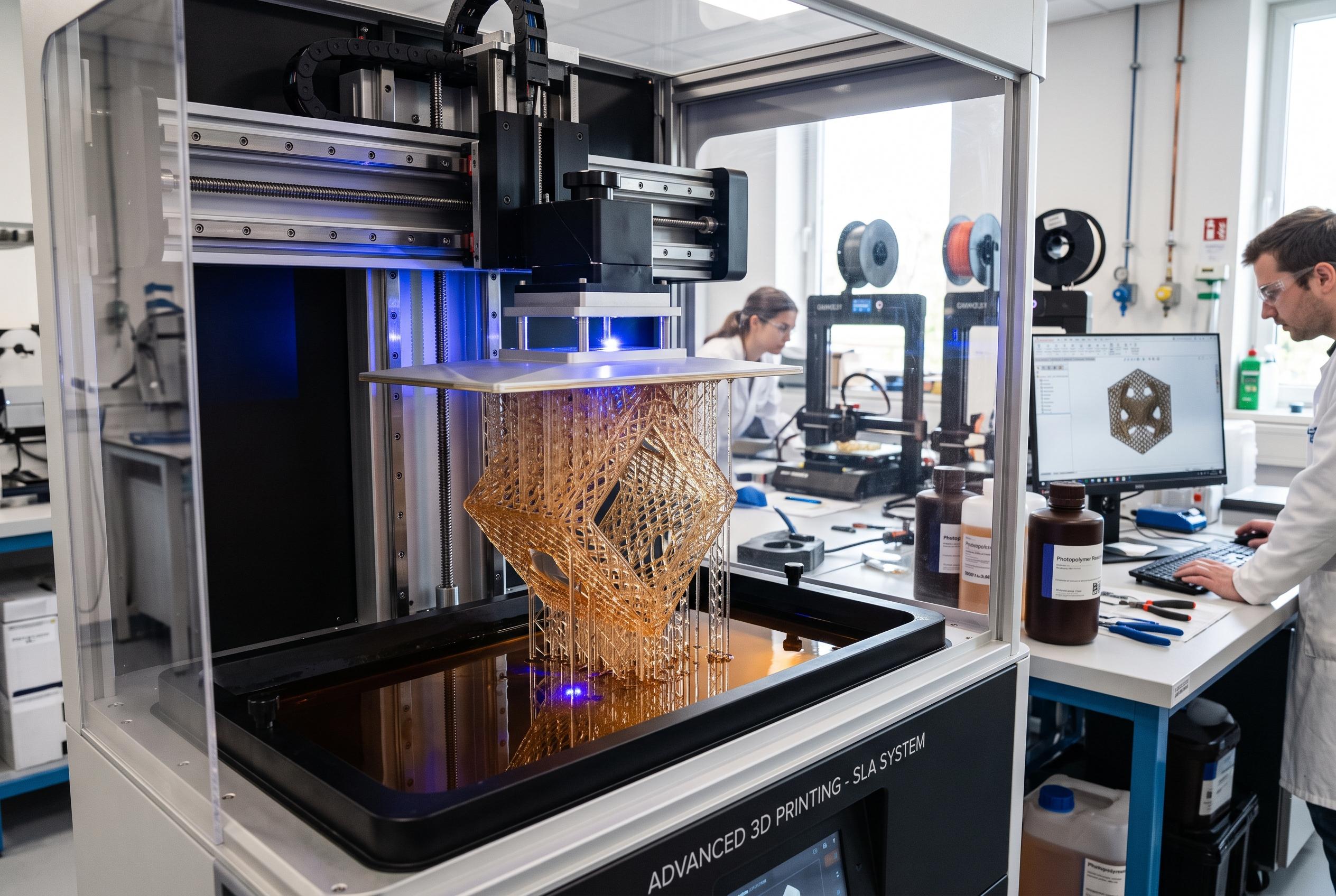
- Additive manufacturing moves beyond prototyping to a key industrial process in sectors like aerospace, medical and automotive
- Diverse techniques including metal, ceramic and biomaterials expand application possibilities amid ongoing challenges
- Hybrid production methods and localized sourcing reshape supply chains, enabling rapid, customized and on-demand manufacturing
Additive manufacturing has moved far beyond its original role as a prototyping tool. What began as a niche method of building objects layer by layer has become a diverse set of industrial processes used across aerospace, automotive, medical, tooling and other sectors. The benefits are clear: less material waste, more design freedom, faster development cycles and the ability to produce parts on demand. In today’s manufacturing environment, additive manufacturing has become an important part of the conversation about how products are designed and made.
When you look at its history, the story often starts with stereolithography, one of the earliest additive manufacturing methods developed in the 1980s. This early process helped establish the core idea behind 3D printing: converting digital models into physical objects through successive layers. The field has since expanded into several major categories. The National Institute of Standards and Technology classifies additive manufacturing technologies into areas such as powder bed fusion, directed energy deposition, material extrusion, vat photopolymerization, binder jetting and material jetting. That range shows how broad the field has become and why different methods serve different production needs.
For manufacturers, this variety matters because additive manufacturing is not one solution. It is a collection of technologies, each with its own strengths and limitations. Some processes are better suited for quick prototypes, while others are designed for final parts that must meet demanding performance requirements. A company making precision components may prioritize surface quality and repeatability. An aerospace supplier may focus on lightweight designs and complex internal geometries. A medical manufacturer may need customized parts with controlled material properties.
Metal printing has been a major driver of broader industrial adoption. HP’s overview of metal 3D printing explains that processes such as direct metal laser sintering and selective laser melting use a laser beam to melt metal powder, forming solid parts layer by layer. These methods are especially useful in sectors where performance and geometric complexity are both important. Other techniques, including electron beam melting and binder jetting, also play important roles, with each process offering different tradeoffs in strength, finish quality, speed and post-processing needs.
In practice, choosing a metal printing process is often as much a production decision as a technical one. Factors such as tolerances, production volume, material behavior, and overall cost all matter. A process that allows for complex geometry may require more finishing afterward. Another process may be better for certain applications but less suitable for others. For engineering and procurement teams, the choice involves not only the part design but also the downstream steps needed to complete it.
The materials landscape has also expanded well beyond plastics and metals. Research shows that additive methods are now being used for high-performance ceramic components in aerospace, defense and medical applications. Stereolithography and powder bed fusion are among the techniques used in ceramic additive manufacturing. At the same time, the field still faces challenges related to shrinkage, cracking and process control. Progress depends not just on adding new materials, but on finding reliable ways to process them.
Additive manufacturing has also opened new possibilities for composite systems and biomaterials. Composite additive manufacturing can support lightweight parts for transportation and sporting goods, while biomaterials have enabled bioprinting in tissue engineering and regenerative medicine. These developments show how additive manufacturing continues to expand into applications where customization, complexity and function are essential.
Another important development is hybrid manufacturing, which combines additive and subtractive steps in a single workflow. This approach can improve surface quality, tighten tolerances and reduce production time while preserving the geometric flexibility of additive manufacturing. For many industrial users, the best option is not to replace conventional manufacturing entirely, but to combine it with additive methods where it makes sense.
From a sourcing perspective, additive manufacturing also changes how companies think about supply chains. Instead of depending only on large-scale centralized production, manufacturers can evaluate whether certain parts are better produced closer to the point of use. That can matter for spare parts, low-volume components, or specialized items that are expensive to store in inventory. In logistics, this creates new opportunities as well as new planning requirements, since digital files, material availability, and quality control become part of the production conversation.
This shift is especially relevant in electronics and mobile-related manufacturing, where product cycles are fast and design changes are frequent. Additive manufacturing can support rapid iteration for housings, fixtures, enclosures, jigs, and specialized tooling. While it does not replace all traditional electronics production, it can improve responsiveness when teams need to test concepts, customize components or reduce lead times during development.
For lifestyle products, additive manufacturing has also encouraged greater personalization. Consumers increasingly expect products that reflect individual preferences, and manufacturers can use 3D printing to explore customized shapes, fits and functions. This is one reason the technology has gained attention beyond heavy industry. It supports not just engineering goals, but also product differentiation in markets where design and user experience matter.
Looking ahead, the most important opportunity may be integration. Additive manufacturing works best when it is connected to design software, quality systems, post-processing, inspection and logistics planning. As these pieces become more aligned, companies can make better decisions about when to print, what to print and how to scale production responsibly. That does not mean additive manufacturing will replace every conventional process. Instead, it will likely continue to grow as one of several essential tools in modern manufacturing.
Takeaways
- - Additive manufacturing is no longer only for prototyping; it is now an industrial production method.
- - Different processes serve different needs, so material choice, tolerances, and finish quality matter.
- - Metal, ceramic, composite, and biomaterial applications continue to expand the field.
- - Sourcing and logistics strategies are changing as companies evaluate distributed, on-demand production.
- - Additive manufacturing is increasingly relevant to electronics, mobile, and lifestyle products through customization and rapid iteration.
Disclaimer: This article may have been created with AI assistance and reviewed by our editorial team. It is provided for general informational purposes only. Readers should verify information independently before relying on this content.
