
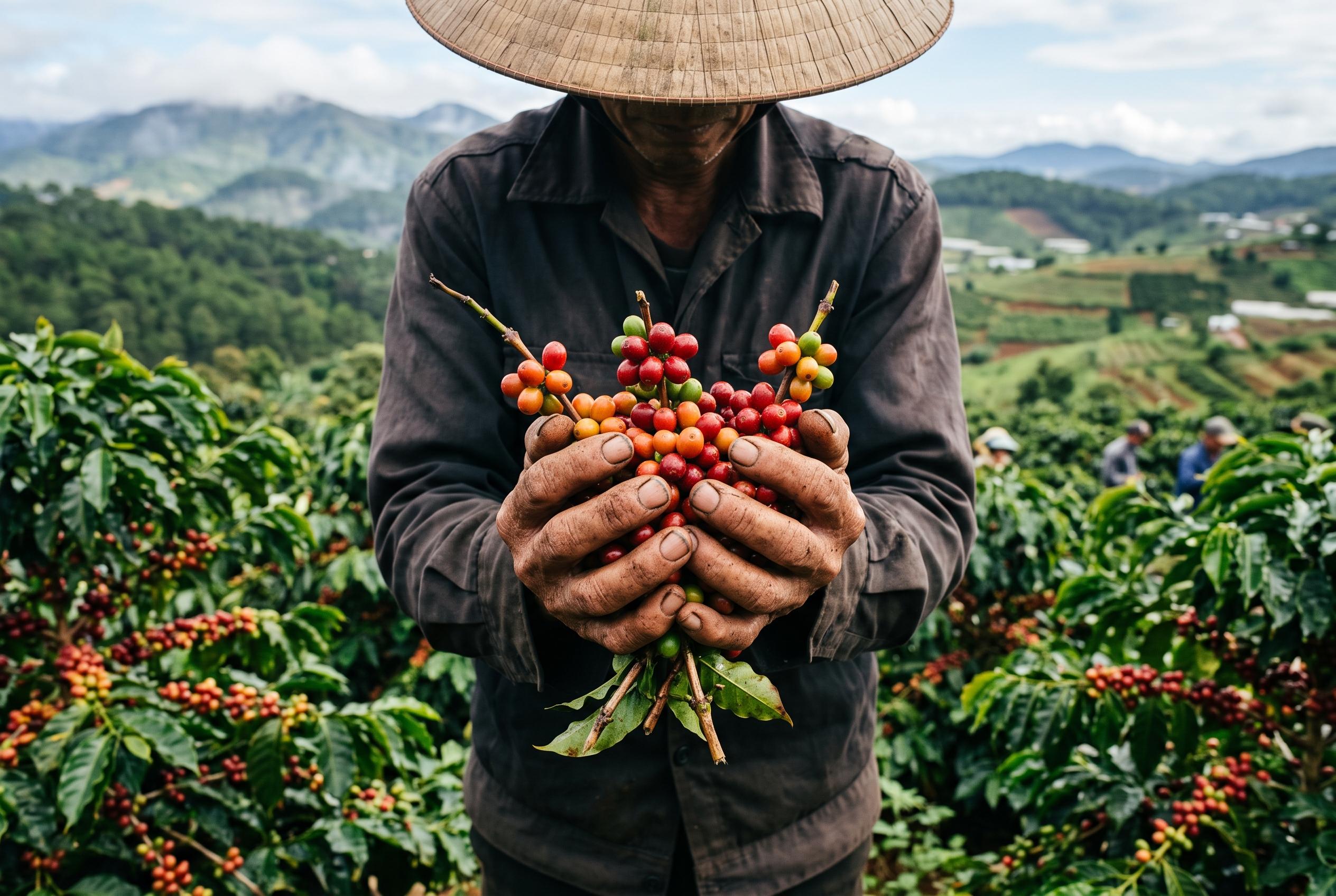
- UCC launches a regenerative agriculture pilot in Vietnam to improve soil health and resilience
- Project aims to address climate change impacts and strengthen sustainable sourcing commitments
- Success could influence global coffee supply chains and serve as a model for climate adaptation strategies
UCC has rolled out a new regenerative agriculture pilot in Vietnam, as part of its efforts to secure more climate-smart supply chains while cutting down emissions from one of its main sourcing regions. The project aims to test whether certain farm-level practices, like using biochar and reducing reliance on traditional fertilizers, can cut greenhouse gases, increase carbon storage in the soil, and help coffee plants better withstand hotter temperatures, shifting rainfall patterns, and decreasing soil health. According to AgNavigator, this initiative also ties directly into UCC’s broader goal of sourcing all of its own-brand coffee sustainably by 2030 and reaching carbon neutrality by 2040.
Vietnam is pretty important for UCC not just because it’s a big coffee producer, but also because it’s closely connected to Japanese coffee culture, Masahito Hibi, who’s section manager at UCC Japan’s Sustainability Promotion Office, explained in comments cited by AgNavigator. The company is working with Atlantic Commodities Vietnam, a subsidiary of ECOM Group, to leverage local producer networks and agricultural knowledge. The pilot is meant to generate practical lessons that can be shared with other coffee-growing communities. UCC emphasizes that the goal isn’t only to boost yields and resilience but also to foster a more balanced, fair relationship between growers and buyers.
Building on its broader initiatives, UCC’s Vietnam project is part of an effort to expand its sustainable sourcing network. Back in April, they added the Brazilian coffee cooperative Cooxupé and Mitsui & Co. Coffee Trading Brazil to their list of suppliers meeting sustainability standards, bringing the total to 12 partners, according to AgNavigator. They also joined the Japan Climate Leaders’ Partnership in June, which signals a bigger push across industries towards decarbonization and sharing knowledge about climate action.
The company and its collaborators say the pilot will serve as a way to document methods for reducing emissions, which could ideally be scaled up later down the line. This is especially significant in sectors where smallholder farmers, many based in Vietnam’s Central Highlands, are already struggling with drought, unpredictable rainfall, and depleted soils. These challenges have been highlighted in previous coffee sustainability projects in the region. By framing regenerative farming as both a climate change solution and a strategy for more sustainable sourcing, UCC is positioning the Vietnam trial as part of a longer-term shift in the way coffee is produced, financed, and traded.
What makes this pilot worth watching is not just the farming technique itself, but the way it links agricultural practice, sourcing strategy, and supply chain resilience. In global commodity markets, even a small improvement in soil health or fertilizer efficiency can have a cascading effect on logistics, procurement, and long-term availability. For coffee buyers, the most immediate question is often whether a pilot can improve consistency without raising costs beyond what growers can absorb. For farmers, the bigger question is whether climate-smart methods can be adopted in a way that improves livelihoods rather than adding new burdens.
That balance matters because regenerative agriculture is not a one-size-fits-all model. Practices like biochar application, reduced synthetic fertilizer use, and soil restoration can offer benefits, but their success depends on local conditions, access to training, and the economics of adoption. In a sourcing context, those details are crucial. A sustainable sourcing promise has real value only if it can be translated into practical support at the farm level, clear measurement methods, and buyer relationships that reward progress over time. This is why partnerships between companies, traders, and local producers often become the backbone of these programs.
The Vietnam pilot also reflects a broader shift in how businesses think about climate risk. For years, many supply chains focused mostly on price, volume, and quality. Now, the conversation increasingly includes emissions, adaptation, traceability, and long-term resilience. Coffee is especially vulnerable because it is tied to weather, altitude, and soil quality in ways that make it sensitive to environmental change. When temperatures rise and rainfall becomes less predictable, sourcing decisions become more complicated, and the cost of inaction can show up later in lower yields, weaker bean quality, and more volatile supply.
This is where climate-smart sourcing becomes a business issue as much as an environmental one. Companies that rely on agricultural inputs must think about continuity: where will product come from, who is producing it, and under what conditions? In that sense, regenerative agriculture is not just a sustainability label. It is a logistics strategy, a risk-management approach, and a relationship-building tool. It can help create more stable supply chains while also aligning with consumer expectations around responsibility and transparency.
The coffee sector also offers a useful case study for other industries that depend on complex sourcing networks, including electronics and mobile manufacturing, where traceability, supplier standards, and lower-carbon operations are increasingly important. Even though the materials and risks are different, the underlying lesson is similar: supply chains are only as resilient as the ecosystems and communities that support them. Whether the product is coffee, electronics, or everyday lifestyle goods, companies are being pushed to think more carefully about how sourcing decisions affect both people and the planet.
For consumers, these developments can feel distant, but they shape the products that reach shelves, cafés, and homes. A cup of coffee may seem simple, yet behind it is a chain of decisions involving growers, traders, logistics providers, and sustainability teams. The growing attention to regenerative methods shows that buyers are looking beyond short-term volume and toward a more durable model of production. That could eventually influence pricing, procurement standards, and the types of sustainability claims companies are willing to make.
It is also worth noting that pilots like this often matter most when they are shared. If UCC and its partners can document what works in Vietnam, the findings may help inform future sourcing programs in other regions facing similar climate pressures. That kind of knowledge transfer is valuable because it reduces duplication and helps speed up adoption across the broader coffee industry. In practical terms, it can mean better guidance for producers, stronger collaboration with buyers, and more efficient use of sustainability investments.
At the same time, the success of any regenerative agriculture effort will depend on patience. Soil restoration and carbon storage do not happen overnight, and farmers need time, tools, and trust to make changes stick. The most effective programs usually combine field-level experimentation with fair commercial terms, ongoing measurement, and real market incentives. Without those pieces, even a promising pilot can struggle to scale.
Takeaways
- - UCC’s Vietnam pilot connects regenerative agriculture with long-term sustainable sourcing goals.
- - The project is designed to test climate-smart practices that may improve soil health and resilience.
- - Partnerships with local and international supply chain players are central to the effort.
- - The initiative reflects a broader shift toward lower-carbon logistics and more responsible sourcing.
- - If successful, the pilot could offer a model for other coffee-growing regions facing climate stress.
FAQ
Why is Vietnam important to UCC? It is a major coffee sourcing region and has strong ties to Japanese coffee culture.
What is UCC testing in the pilot? The company is looking at regenerative practices such as biochar use and reduced fertilizer reliance.
Why does this matter for supply chains? Healthier farms can support more stable sourcing, better resilience, and lower emissions over time.
Can this approach be scaled? That is the goal, but scaling will depend on results, farmer adoption, and commercial support.
Disclaimer: This article may have been created with AI assistance and reviewed by our editorial team. It is provided for general informational purposes only. Readers should verify information independently before relying on this content.
Source Reference Map
Inspired by headline at: [1]
Sources by paragraph:
- - Paragraph 1: [2], [6]
- - Paragraph 2: [2]
- - Paragraph 3: [2], [6]
- - Paragraph 4: [3], [5], [7]
