
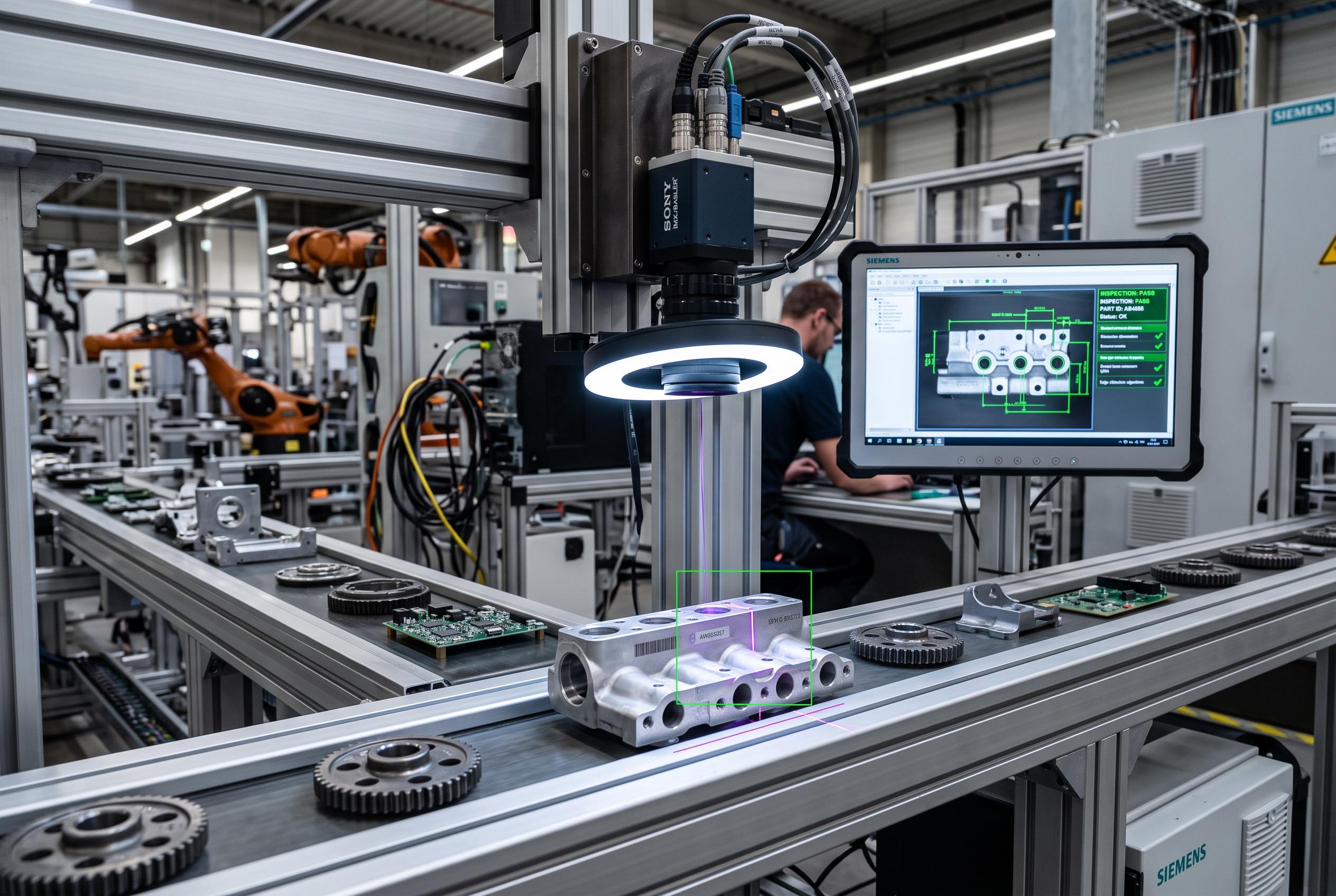
- Edge AI enables faster, local inference for industrial environments
- World models could revolutionize manufacturing process automation
- Distinction between recognition and measurement remains crucial for system accuracy
Daniel Lau, a professor and researcher specializing in machine vision, says that the field is being shaped by artificial intelligence in two clear ways. First, it's improving how vision systems recognize scenes, Lau told Vision Systems Design in a recent interview. And second, it’s enabling more powerful processors to be integrated into edge devices, those that can make decisions locally rather than sending video data all the way to a remote server. This hardware shift has really helped move industrial vision beyond narrow, tightly controlled setups, allowing for faster deployment in environments where latency, bandwidth, and privacy concerns are key. It’s also blurring the lines between traditional industrial inspection and broader AI perception systems, even though the core technical goals might still be quite different.
For folks in manufacturing and systems integration, Lau’s insights are especially practical. He emphasizes that the camera is still fundamentally a measuring tool , not just a device to produce content. He argues that machine vision mainly aims to extract quantitative info from images. Meanwhile, newer computer vision and vision-language systems are built around latent representations, which can identify what’s in a scene, but don’t necessarily recover precise physical properties or dimensions. So, to put it simply, a model might recognize it’s looking at a washer, but that doesn’t mean it can tell you the washer’s radius or its exact size. That difference still matters when it comes to inspection, metrology, and quality control.
He also pointed out that world models are among the most intriguing research directions right now. Lau mentioned that his team is working on reconstructing process structures from video by analyzing real-world operations, breaking them down into organized steps and dependency graphs, stuff like directed acyclic graphs (DAGs), and sometimes, more complex structures like directed acyclic hypergraphs when necessary. The idea is to learn that structure purely from what’s observed, then use it to define the rewards needed for reinforcement learning, not by hand, but by letting the system figure it out itself. This could be a game-changer for industrial automation, especially since manufacturing sequences often rely on multiple conditions being met at the same time.
If you look around, you can already see this larger trend in various products and ongoing research. NVIDIA’s Holoscan platform and a growing number of Edge systems built around Jetson are demonstrating how real-time inference is moving closer and closer to the sensors themselves. Meanwhile, recent robotics projects like VLASH and WorldCycle reflect a push toward enabling AI systems to plan ahead and master long-term behaviors more efficiently. Interestingly enough, there was also a report about an NVIDIA Jetson module, supposedly found inside a Russian missile, which highlights a different twist. That same compact hardware that’s perfect for factory vision applications can also be repurposed for military use, adding more complexity to export controls and end-use regulations. For Lau, that’s another reason to keep the focus of machine vision on measurement, separate from the broader hopes for generative and agentic AI systems.
At a practical level, this shift is also changing how companies think about sourcing, electronics, and logistics. Procurement teams are no longer evaluating a vision system only by camera resolution or software accuracy; they are also comparing edge compute options, thermal constraints, power budgets, and integration timelines. In mobile and distributed industrial deployments, those details matter because a system that works in a lab may fail when installed on a fast-moving production line, a warehouse robot, or a remote inspection unit. As AI becomes more embedded in electronics stacks, the best implementations will likely be the ones that balance speed, reliability, and maintainability without losing the precision required for industrial use.
This is where the future of machine vision starts to look less like a single technology and more like an ecosystem. On one side, there is traditional inspection: gauging dimensions, finding defects, checking alignment, and verifying that a part meets specification. On the other, there is broader perception: understanding scenes, tracking actions, and predicting what comes next. Edge AI is pushing those worlds closer together, but the distinction between recognition and measurement still matters. For manufacturers, that means the most useful systems will be those that can do both when needed, while clearly preserving the metrology-grade trust that industrial work depends on.
Takeaways
- - Machine vision and general computer vision are converging, but they still solve different problems.
- - Edge AI is making local inference faster and more practical for industrial environments.
- - Cameras remain measurement tools in inspection, not just content generators.
- - World models could help automate complex manufacturing workflows by learning process structure from video.
- - Sourcing, electronics integration, and logistics are becoming more important in vision-system selection.
- - The biggest opportunity may be building systems that combine perception with precision without confusing one for the other.
Q&A
Q: Why does the distinction between recognition and measurement matter? A: Because identifying an object is not the same as measuring its physical properties accurately.
Q: Why is edge AI so important for industrial vision? A: It reduces latency, limits bandwidth needs, and supports deployment closer to sensors and machines.
Q: Are world models useful for manufacturing? A: Potentially yes, especially for learning process steps and dependencies from real operational video.
Q: What should companies prioritize when sourcing vision hardware? A: Accuracy, compute performance, power efficiency, integration ease, and supply-chain reliability.
Disclaimer: This article may have been created with AI assistance and reviewed by our editorial team. It is provided for general informational purposes only. Readers should verify information independently before relying on this content.
Sources:
