
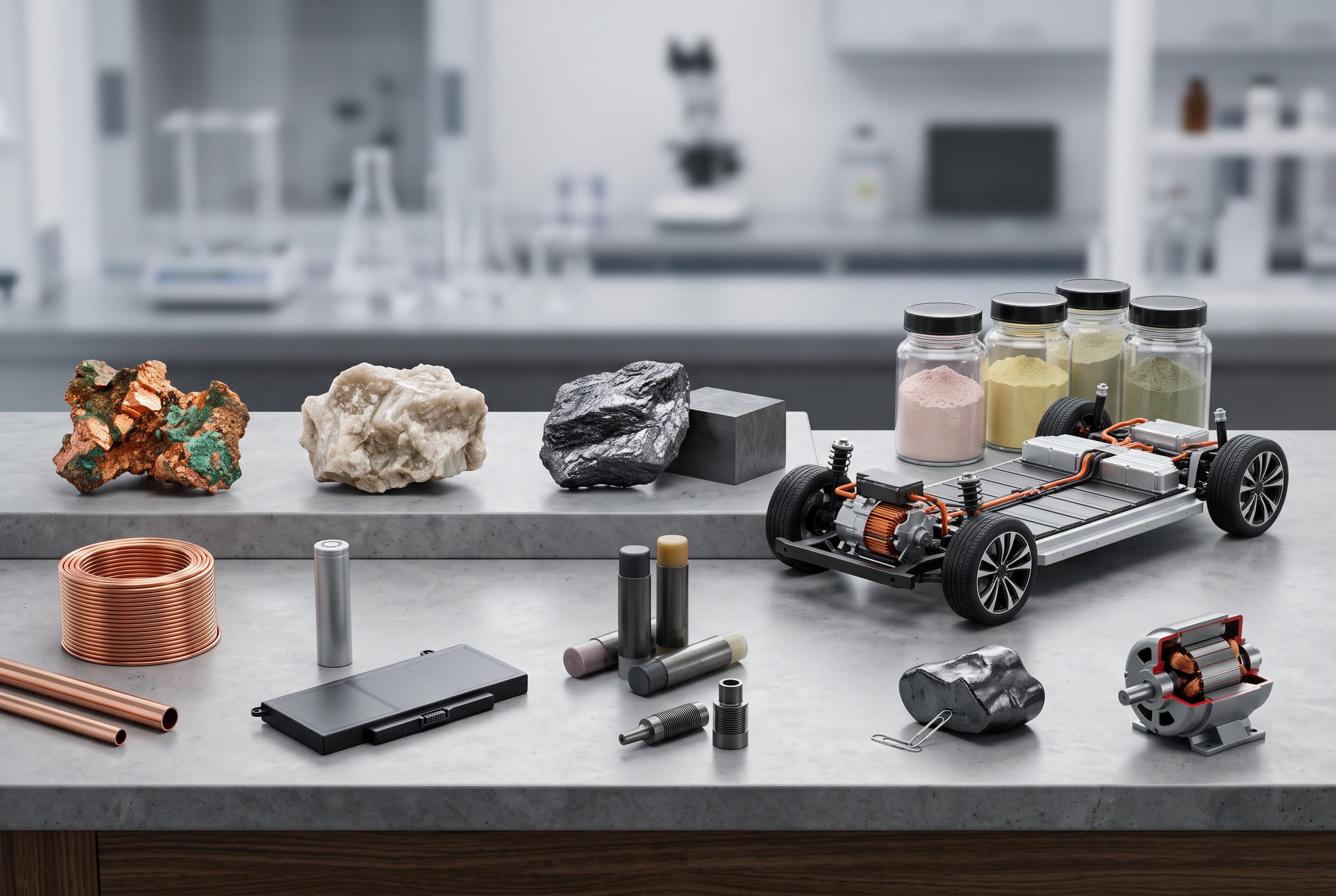
- Many emerging and vital technologies depend on rare and often overlooked minerals
- Concentration of mining, processing, and refining poses global supply risks
- Diversification, recycling, and substitution strategies are crucial for resilience
The world’s most advanced machines depend on materials most people rarely hear about. A pinch of gallium can affect a radar system, a tantalum capacitor can determine whether a satellite works reliably, and a shortage of copper can delay an entire data center. That is what makes the next technology race so unusual: countries may have the software, capital and engineering talent to build something, yet still lack the minerals needed to manufacture it.
Here are 10 materials quietly shaping everything from electric cars and power grids to robots, weapons and space systems.
- - Copper: The metal carrying the electric age Wikimedia Commons Copper is hardly exotic, but no other mineral on this list touches as many parts of the modern economy. Power lines, transformers, electric motors, charging stations, renewable-energy projects and data centers all need it. The International Energy Agency (IEA) expects copper demand to rise by about 7 million tonnes by 2040. Based on projects currently planned, the world could face a supply deficit of approximately 25% by 2035. The difficulty is not merely finding copper. New mines can take years to permit and build, while declining ore grades mean companies must process more rock to recover the same amount of metal.
- - Lithium: The mineral inside the battery boom Wikimedia Commons Lithium powers electric vehicles, smartphones, laptops, drones and grid-scale storage systems. The IEA expects demand for it to more than triple by 2040 under its stated-policy scenario.
Australia is a major miner, while Chile, Argentina and China supply lithium chemicals and other processed materials. Sodium-ion and other battery chemistries could reduce pressure in some markets, but lithium remains deeply embedded in global battery manufacturing.
- - Graphite: The battery material hiding in plain sight Wikimedia Commons Lithium receives most of the attention, yet conventional lithium-ion batteries also depend on graphite. The material forms the anode, where lithium ions are stored while the battery charges. Several countries possess natural graphite deposits, but producing battery-grade material requires purification, shaping and coating. China dominates much of this processing, meaning another country’s mine cannot immediately replace disrupted Chinese supply.
- - Cobalt: High performance with a human cost Wikimedia Commons Cobalt improves the stability, energy density and lifespan of certain batteries. It is also used in jet-engine superalloys, cutting tools and components expected to survive extreme temperatures.
Most mined cobalt comes from the Democratic Republic of the Congo, while China plays a large role in refining it. Reports of child labor, unsafe artisanal mines and pollution have made cobalt one of the technology industry’s most controversial materials. Battery makers are reducing cobalt use where possible, but aerospace and other demanding applications cannot always trade performance for lower cost.
- - Nickel: More range, more environmental pressure Wikimedia Commons Nickel helps some electric-vehicle batteries store more energy without becoming excessively heavy. It also remains essential for stainless steel, gas turbines, chemical equipment and aerospace superalloys. Indonesia has driven much of the recent growth in nickel production and processing. That expansion has brought concerns over deforestation, marine pollution, mining waste and the use of coal-powered processing facilities.
- - Rare earths: The magnets that make machines move Rare earths are a group of 17 elements, although only a handful are central to advanced machines.
Neodymium, praseodymium, dysprosium and terbium help produce compact permanent magnets used in EV motors, wind turbines, robots, drones and missile-guidance systems. The real bottleneck comes after mining. Separating rare earths, turning them into metals and manufacturing high-performance magnets requires an industrial chain that China has spent decades building. The IEA estimates that China’s share of rare-earth refining fell from more than 90% in 2023 to 85% in 2025. That remains enough concentration for export restrictions to ripple through automotive, energy and defense industries.
- - Gallium: A small metal with oversized influence Wikimedia Commons Gallium helps create gallium nitride and gallium arsenide, semiconductor materials used in radar, satellites, 5G equipment, LEDs and efficient power electronics. These compounds can perform better than silicon in certain high-frequency and high-power applications.
Gallium is usually recovered as a by-product while processing other metals, making supply difficult to expand quickly. A US Geological Survey analysis found that China accounted for as much as 98% of global gallium production in 2023.
- - Germanium: Helping machines communicate and see Wikimedia Commons Germanium supports fiber-optic networks, infrared cameras, night-vision equipment, satellite solar cells and thermal-imaging systems. Its value comes from serving civilian communications and military sensing at the same time. Like gallium, germanium is generally recovered as a by-product rather than extracted from dedicated mines. Disruption at a small number of processing facilities can therefore affect several industries at once.
- - Tungsten: Built for extremes Wikimedia Commons Tungsten has the highest melting point of any metal and can retain strength under punishing conditions. It is used in cutting tools, drilling equipment, aerospace parts, furnaces and defense systems.
Its importance extends beyond products containing tungsten. Factories rely on tungsten-carbide tools to cut and shape steel, titanium and other difficult materials, making it a quiet enabler of modern manufacturing. The IEA reported that tungsten prices increased sixfold during 2025 and early 2026 amid export controls and stronger demand.
- - Tantalum: Tiny components, serious consequences Wikimedia Commons Tantalum is best known for capacitors that store electrical charge inside remarkably small spaces. They appear in smartphones, servers, medical implants, cars, aircraft and military electronics. Its market is small, but that does not make it unimportant. A missing capacitor can hold up a sophisticated machine worth millions of dollars, while conflict and governance concerns complicate sourcing from parts of Central Africa.
The technology race starts below ground The world is unlikely to run out of all 10 minerals at once, but that is not the danger governments are preparing for.
The bigger issue is concentration: who mines these materials, who refines them, who makes the components, and who controls the logistics that move them from one factory to another. For industries built on electronics, mobile devices, electric vehicles, clean energy and defense systems, the supply chain can be as decisive as the invention itself. A country may design the best battery, radar system or robot in the world, yet still struggle if it cannot secure stable sourcing for the minerals underneath it.
That is why this topic matters far beyond mining. It affects trade policy, industrial strategy, recycling, and even everyday lifestyle products that people use without thinking about the materials inside them. The next generation of technology will not just be judged by performance, but by resilience, diversification and the ability to withstand shocks in sourcing and logistics.
Takeaways
- - Advanced technology depends on hidden minerals as much as on software and engineering.
- - Supply risk often comes from processing and refining, not just mining.
- - China remains central across several critical materials, especially for batteries and semiconductors.
- - The materials most tied to electronics, mobile devices and clean energy are also the most exposed to disruption.
- - Recycling, substitution and diversified sourcing can help, but none are immediate fixes for every industry.
Frequently Asked Questions Q: Why are these materials considered strategic? A: Because they are essential to industries that power modern economies, from electronics and energy to defense and mobility.
Q: Is mining the only bottleneck? A: No. Processing, refining, manufacturing and logistics can be just as important.
Q: Which materials matter most for mobile and electronics products? A: Lithium, graphite, cobalt, gallium, germanium and tantalum are especially important.
Q: Can substitutes fully replace these materials? A: In some cases they can reduce pressure, but many applications still rely on these materials for performance or reliability.
Disclaimer: This article may have been created with AI assistance and reviewed by our editorial team. It is provided for general informational purposes only. Readers should verify information independently before relying on this content.
Source: Noah Wire Services
