
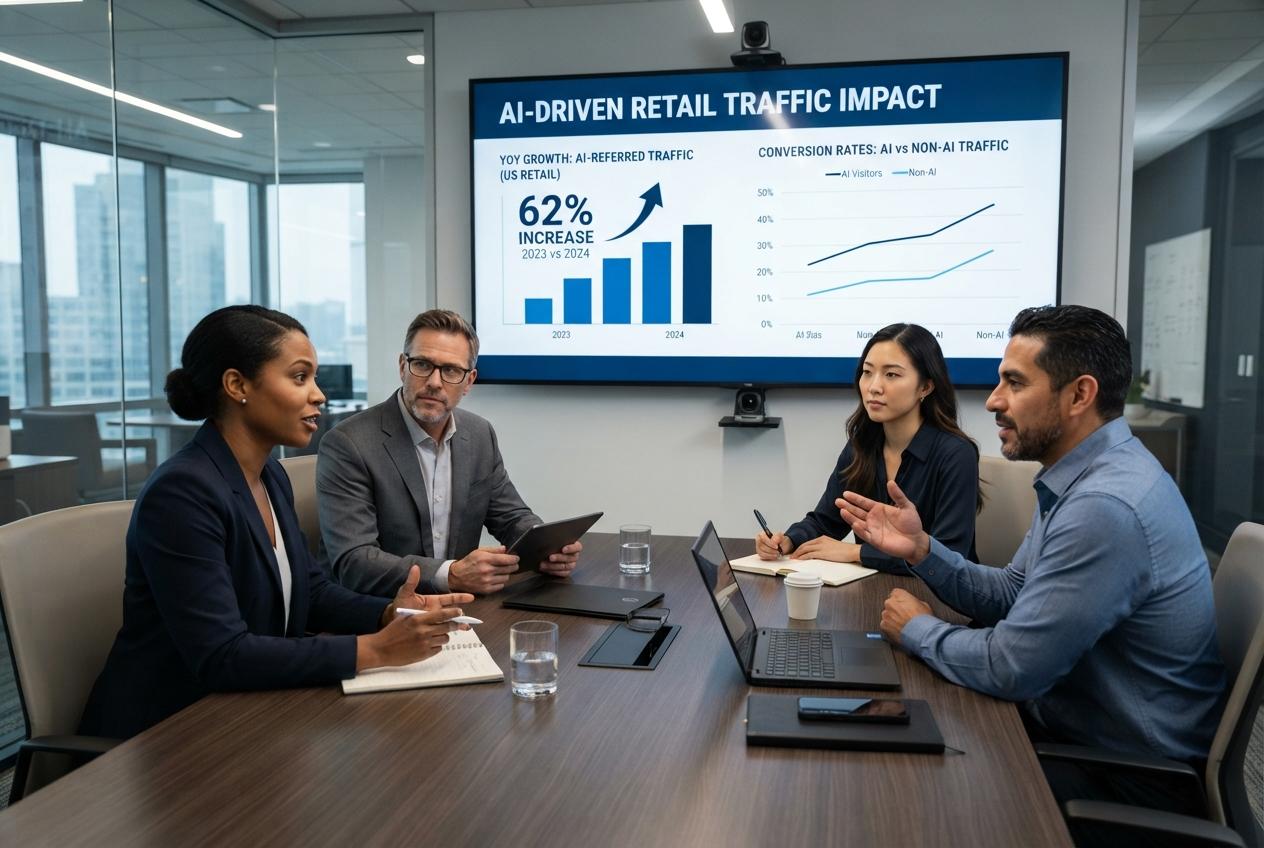
- AI-referred traffic to U.S. retail sites increased 62% year over year in July
- Visitors referred by AI are more engaged and convert at higher rates
- Brands must optimize content for AI readability and focus on discovery and storytelling
Artificial intelligence is moving from an experimental shopping tool to a reliable source of traffic for retailers, and the “high-intent” shoppers it sends to brands’ websites are buying.
AI-referred traffic to U.S. retail sites rose 62% year over year in July, while those visits converted at a rate 60% higher than traffic from non-AI sources, according to new data from Adobe released Wednesday.
It marked the 11th consecutive month in which AI traffic outperformed other channels on conversion rates.
“It’s not just about discovery, but the people that are coming to a brand’s own site or storefront, they’re converting at a higher rate,” said Loni Stark, vice president of strategy and product at Adobe.
Adobe’s data also showed that AI-referred visitors were more engaged. Based on more than 1 trillion visits to U.S. retail sites, it found that they spent 59% more time on retailers’ websites and were 33% less likely to bounce. They also added products to their carts at a 28% higher rate.
The shift is changing the way brands need to think about how consumers discover products, said Kimberly Smith Carney, founder of the Impakt conferences focused on AI, commerce and retail, as well as chief executive officer of The Wires, a marketplace for fashion, beauty and pet brands.
“We’re moving from a search-driven world to a discovery-driven world,” Carney said.
Instead of searching, scrolling and filtering through hundreds of products, consumers can increasingly describe what they are trying to accomplish, including their budget, preferences and destination, and ask an AI system to surface relevant options.
For fashion brands, that could mean competing for an AI system’s recommendation as well as the customer’s attention.
“The next battle won’t just be for the consumer’s attention. It will be for the AI’s recommendation because you want AI to recommend you , but how do you get that LLM to recommend you? That’s going to be key,” Carcone said.
That presents new challenges for brands, Stark said, which will need to adapt their websites to ensure they can be read and understood by machines to support product recommendations.
The average U.S. retail homepage scored just 61% for AI readability, meaning nearly 40% of its content was not fully readable by large language models, according to Adobe’s data. Apparel performed best among the retail categories studied, at 76%, followed by electronics at 70%.
For fashion retailers that have spent years optimizing for SEO, it means they have a good foundation for the AI era, with product taxonomies, detailed descriptions and structured information about color, fit and materials already on tap.
“Fashion has been so focused and so good at being able to market and to merchandise to the human, and now it’s about, ‘How do you translate all of that information to things that are AI readable?’” Stark said.
That translation is becoming increasingly important as consumers use AI not just to find products, but to ask more detailed and specific questions about them. A shopper might once have searched for “red summer dress.” An AI assistant can handle a much more detailed request, incorporating price, materials, use, weather, location, personal preferences and other specifics into a recommendation.
Retailers will need to make their product information more descriptive and structured. Apparel companies are increasingly adding metadata, clearer descriptions and more layers of information, Stark said. A dress can be described not only by its silhouette and fabric, but by whether it is suited to a party or wedding, or how it performs in everyday use or cleaning.
For luxury brands, that could also mean translating elements of brand history and craftsmanship into concrete, verifiable information that an AI system can read when answering a consumer’s question. The provenance of a fabric, where it was made or how a product was constructed can become data for the LLM.
Third-party information will also matter. Adobe’s study noted that LLMs draw on outside sources to provide information about brands, their reputations and products, making reputable editorial coverage and reviews potentially important parts of a brand’s digital footprint.
Carney said brands also need to think beyond simply adding AI tools, and determine what they want the technology to accomplish for consumers rather than jumping on the bandwagon just because their competitors are.
“Simply adopting AI and using AI is not strategy,” she said. “The more important question in my mind is, ‘What are you using it to solve for the consumer?’”
That also means resisting the temptation to make AI-driven personalization too narrow. If a system only recommends products based on what a consumer has previously bought or searched for, it risks eliminating the serendipity that makes fashion fun.
“The goal shouldn’t be to predict me perfectly. The goal should be to understand me well enough to help me discover,” Carney said.
Fashion consumers may want recommendations that are relevant to their tastes, but they may also want to encounter a new designer, silhouette or brand that they would not have known to search for themselves.
The rise of AI could also give the in-person experience a new relevancy. Since consumers no longer need to visit a store simply to make a transaction because they can buy almost anything from their phones, a physical store “has to give them a reason to show up,” she said, pointing to experience, discovery, community and human connection.
Carney, who previously owned a retail store for 17 years, said she believes physical and experiential retail will have a new importance as AI takes over more of the transactional and research aspects of shopping.
“For brands and retailers, AI creates an opportunity to understand their consumers in real time,” said Carney. “Commerce is coming back. You can’t replicate touching a product. So really discovering a brand or experiencing their world in person will become a profound experience as we continue to evolve in this AI world.”
Adobe’s data shows that AI-referred shoppers are still clicking through to retailers’ own websites, where they can see richer imagery and video, assess products and ultimately complete their purchases. LLM-based purchasing itself remains at an early stage, Stark said.
That leaves fashion brands with the dual need to make enough information available for AI systems to understand and recommend their products, while preserving the visual, emotional and physical elements that make fashion difficult to reduce to data.
For luxury brands that challenge is particularly acute.
Houses will also need to make their heritage, craftsmanship and quality easier for AI systems to understand. Information about where a material comes from, how a product is made and the history behind a collection can help AI systems answer questions about a brand and recommend its products.
“The storytelling starts to become this AI layer,” said Stark. “There’s a lot that can’t be communicated just in words, like where the pockets are, what’s the curve of the pocket. There’s just so much in fashion and it’s so personal.”
Takeaways
- - AI is becoming a meaningful traffic source for retail, and the visitors it sends are more likely to engage and convert.
- - Brands need content that is readable by machines as well as useful to humans, especially for sourcing, product details, and logistics information.
- - Discovery is replacing simple search, which means retailers may need to optimize for AI recommendations, not just SEO.
- - Physical stores still matter because lifestyle, touch, and in-person experience remain hard to replicate on mobile or online.
- - The strongest brands will likely be those that balance structured data with storytelling and brand identity.
FAQ
What does “AI-referred traffic” mean? It refers to shoppers who arrive at a retail site after using an AI tool or assistant that pointed them to the brand.
Why is AI traffic considered high-intent? Because these shoppers often arrive with clearer needs, more context, and stronger purchase readiness.
Why do retailers need AI readability? If machines cannot understand product pages, they are less likely to recommend those products accurately.
Does AI replace the need for stores? No. The article suggests physical stores may become even more important for discovery, community, and experience.
Disclaimer: This article may have been created with AI assistance and reviewed by our editorial team. It is provided for general informational purposes only. Readers should verify information independently before relying on this content.
