
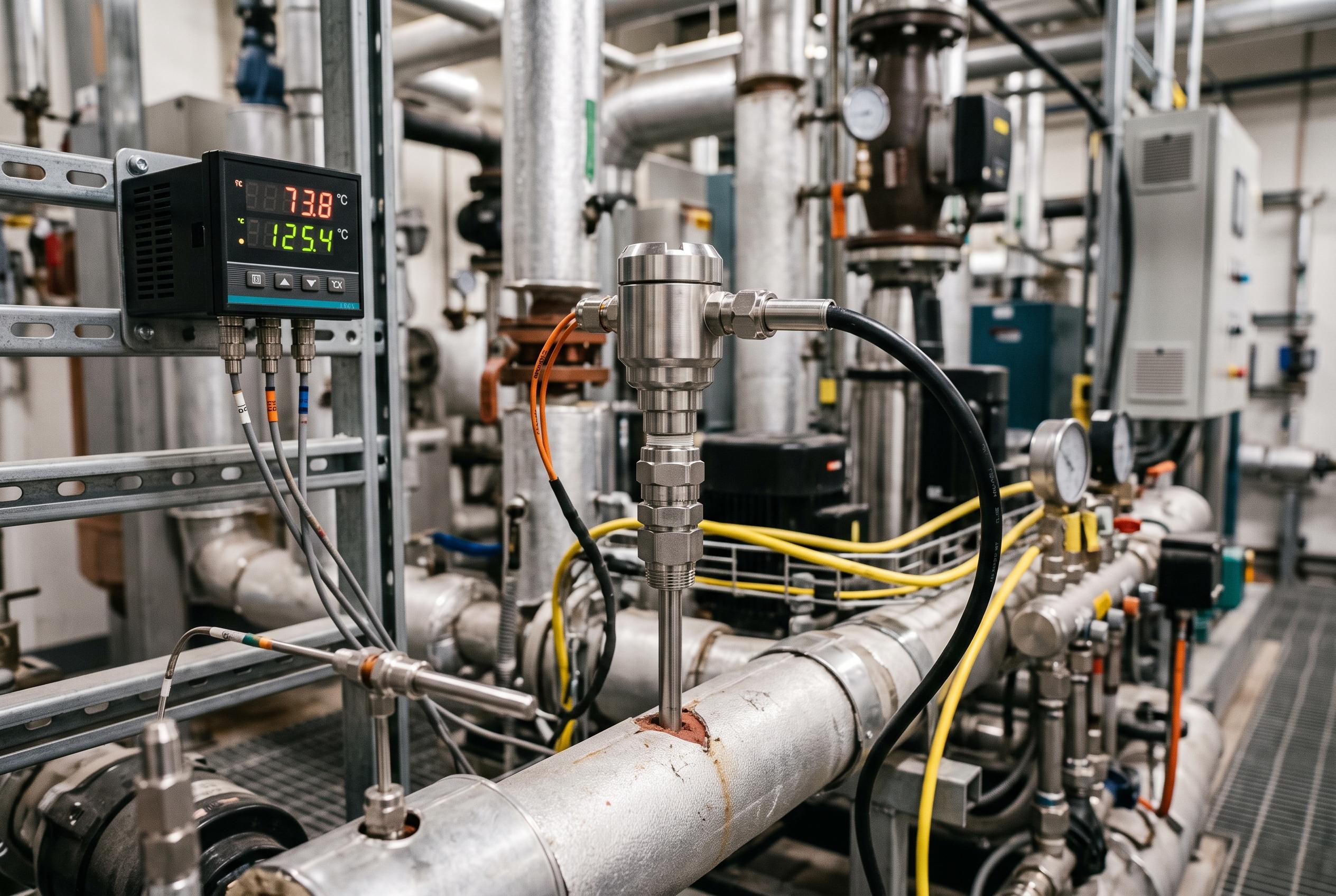
- Market value to surpass USD 10 billion by 2033 driven by automation and IoT
- Sourcing resilience and logistics are key factors in procurement strategies
- Demand growing across industries with a shift to smarter, connected sensing solutions
The temperature sensors market is trending toward steady growth, as manufacturers, automotive suppliers, healthcare equipment producers, and process industries put more focus on quality control, energy efficiency, regulatory compliance, and predictive maintenance strategies. DataM Intelligence reports that the market was valued at about USD 7.43 billion in 2025 and is expected to reach roughly USD 10.01 billion by 2033. Its newer projection estimates 2026's value at about USD 7.82 billion, on the same growth trajectory. The overall message is clear: temperature sensing is no longer just about simple measurement, but increasingly about being a key component in industrial reliability.
This transition is largely fueled by factory automation, adoption of the Industrial Internet of Things (IoT), and a growing need to monitor conditions in real time across dispersed manufacturing assets. According to Grand View Research, the market was valued at approximately USD 6.7 billion in 2023 and is predicted to climb to USD 10.1 billion by 2030, with Asia Pacific holding a 35.6% revenue share in 2023. Other market research firms project different long-term values by 2033, which shows that estimates can vary depending on methodology and scope.
For buyers, it is no longer just about finding sensors that are affordable or highly accurate. Procurement teams are increasingly considering how well sensors work with automation systems, their cybersecurity readiness, the support they get over their lifespan, and how well they can provide data for predictive analytics. Non-contact measurement methods, especially infrared sensing, are becoming popular in industries like food processing, plastics, metals, and chemical manufacturing. These methods can speed up surface readings and reduce contamination risks.
Electrification of vehicles, particularly in the automotive sector, is also altering what is in demand. Electric vehicle battery management systems need precise thermal monitoring to improve battery performance, operational safety, and lifecycle management. Healthcare devices, wearables, and consumer electronics are also pushing suppliers to develop smaller, more accurate, and lower-power sensors. DataM Intelligence notes that the market is split into contact and non-contact sensors, with options like thermistors, thermocouples, thermostats, infrared sensors, and others serving industries from oil and gas to chemicals, consumer electronics, and healthcare.
Regionally, North America remains central because of the U.S. concentration of industrial automation providers, semiconductor companies, medical technology manufacturers, and advanced manufacturing investments. Japan, Germany, and South Korea also stand out, thanks to their advanced manufacturing, automotive production, and electronics industries. Looking ahead, the next wave of growth appears to be more about intelligent sensing platforms than traditional analog sensors, with wireless monitoring, IoT integration, real-time analytics, and energy-efficient designs becoming increasingly important.
As this market continues to mature, sourcing decisions are becoming more strategic. A sensor is no longer evaluated in isolation; it is assessed as part of a wider electronics and logistics ecosystem that includes supply continuity, calibration support, installation speed, and compatibility with digital platforms. Buyers increasingly want confidence that temperature sensors can be sourced reliably, shipped on time, and integrated with minimal disruption. In a world where downtime can affect production schedules, healthcare outcomes, and mobile device performance, the ability to secure dependable components matters almost as much as technical specifications.
This is especially relevant for manufacturers operating across global supply chains. Logistics performance can influence lead times for critical electronics components, and that makes vendor diversification an important topic in procurement planning. Companies that depend on temperature sensors for process industries, cold chain monitoring, or embedded systems often need multiple sourcing channels to reduce exposure to shortages, freight delays, and regional disruptions. In practical terms, this means that technical teams, purchasing teams, and supply chain managers are working more closely than before to align product performance with sourcing resilience.
Another important factor is the move toward smarter devices across lifestyle categories. Temperature sensors are now embedded in products that shape everyday living, from home appliances to wearables and mobile accessories. Consumers may not notice the sensor itself, but they do notice the results: better energy efficiency, safer operation, more responsive controls, and longer-lasting batteries. That same expectation is moving upstream into industrial applications, where stakeholders want systems that can self-monitor, flag abnormalities, and support predictive maintenance before failures occur.
For electronics manufacturers, the implications are broad. As products become smaller, more connected, and more power-conscious, sensor selection becomes a design decision that affects performance, cost, and product lifecycle. This is true in consumer electronics, automotive electronics, healthcare devices, and industrial control systems alike. The challenge is not only to improve accuracy, but also to maintain stability, reduce power consumption, and ensure that sensors remain reliable across changing operating conditions.
The temperature sensors market also reflects a broader shift in how industries think about measurement data. Temperature is no longer a standalone reading; it is a data point that can be combined with vibration, pressure, humidity, and throughput metrics to form a more complete operational picture. When connected to cloud systems or local control platforms, temperature sensors can help organizations detect drift, identify inefficiencies, and optimize performance. This is why intelligent sensing platforms are becoming central to industrial digital transformation rather than remaining a back-end component.
From a sourcing perspective, the market also rewards suppliers that can offer flexibility. Some buyers need high-volume standardized sensors for mass production, while others require specialized products for harsh environments, medical certification, or compact designs. Suppliers that can address both contact and non-contact needs, provide documentation, and support integration efforts are likely to be more competitive. In this environment, product breadth, technical support, and quality assurance are major differentiators.
The shift toward predictive maintenance is another strong driver. Instead of waiting for equipment to fail, companies can use sensor data to identify abnormal temperature patterns and intervene earlier. This reduces unplanned downtime, protects equipment, and can improve safety. In industrial settings, even small temperature deviations may indicate larger operational issues, so reliable thermal monitoring is increasingly seen as a practical investment rather than a discretionary upgrade.
Looking at the bigger picture, the market’s steady rise is tied to a combination of regulatory pressure, sustainability goals, automation, and connected systems. Energy efficiency is especially important because organizations are being asked to reduce waste while maintaining output. Temperature sensors help support this goal by enabling better process control and fewer inefficiencies. At the same time, regulatory compliance in sectors like healthcare, food, and chemicals continues to push demand for accurate, traceable measurements.
For stakeholders evaluating this market, the most useful takeaway is that temperature sensors are moving from commodity parts to strategic enablers. They sit at the intersection of electronics, logistics, sourcing, and operational intelligence. Whether used in a mobile device, an automotive battery pack, or a process industry control system, their value lies in helping businesses make faster and better-informed decisions.
Takeaways
- - Temperature sensors are becoming essential for quality control, predictive maintenance, and energy efficiency.
- - Sourcing and logistics are now as important as accuracy when choosing suppliers.
- - Electronics, automotive, healthcare, and process industries are driving demand for both contact and non-contact sensors.
- - Wireless monitoring, IoT integration, and real-time analytics are shaping the next phase of growth.
- - The market is shifting toward intelligent sensing platforms rather than basic measurement tools.
Frequently Asked Questions
What is driving growth in the temperature sensors market? Factory automation, IoT adoption, predictive maintenance, and rising demand for real-time monitoring are major growth drivers.
Which industries use temperature sensors the most? Manufacturing, automotive, healthcare, consumer electronics, oil and gas, chemicals, and food processing are key users.
Why are non-contact sensors gaining attention? They can provide faster readings and reduce contamination risks, which is useful in sensitive or high-volume environments.
How are sourcing and logistics affecting the market? Buyers want reliable supply, shorter lead times, and strong support to avoid disruptions in production and deployment.
What is the next trend in temperature sensing? The market is moving toward smarter, connected, and more energy-efficient sensing platforms.
Disclaimer: This article may have been created with AI assistance and reviewed by our editorial team. It is provided for general informational purposes only. Readers should verify information independently before relying on this content.
Source Reference Map
Inspired by headline at: [1]
Sources by paragraph: - Paragraph 1: [3] - Paragraph 2: [2], [3] - Paragraph 3: [3], [2] - Paragraph 4: [3] - Paragraph 5: [3], [7]
