
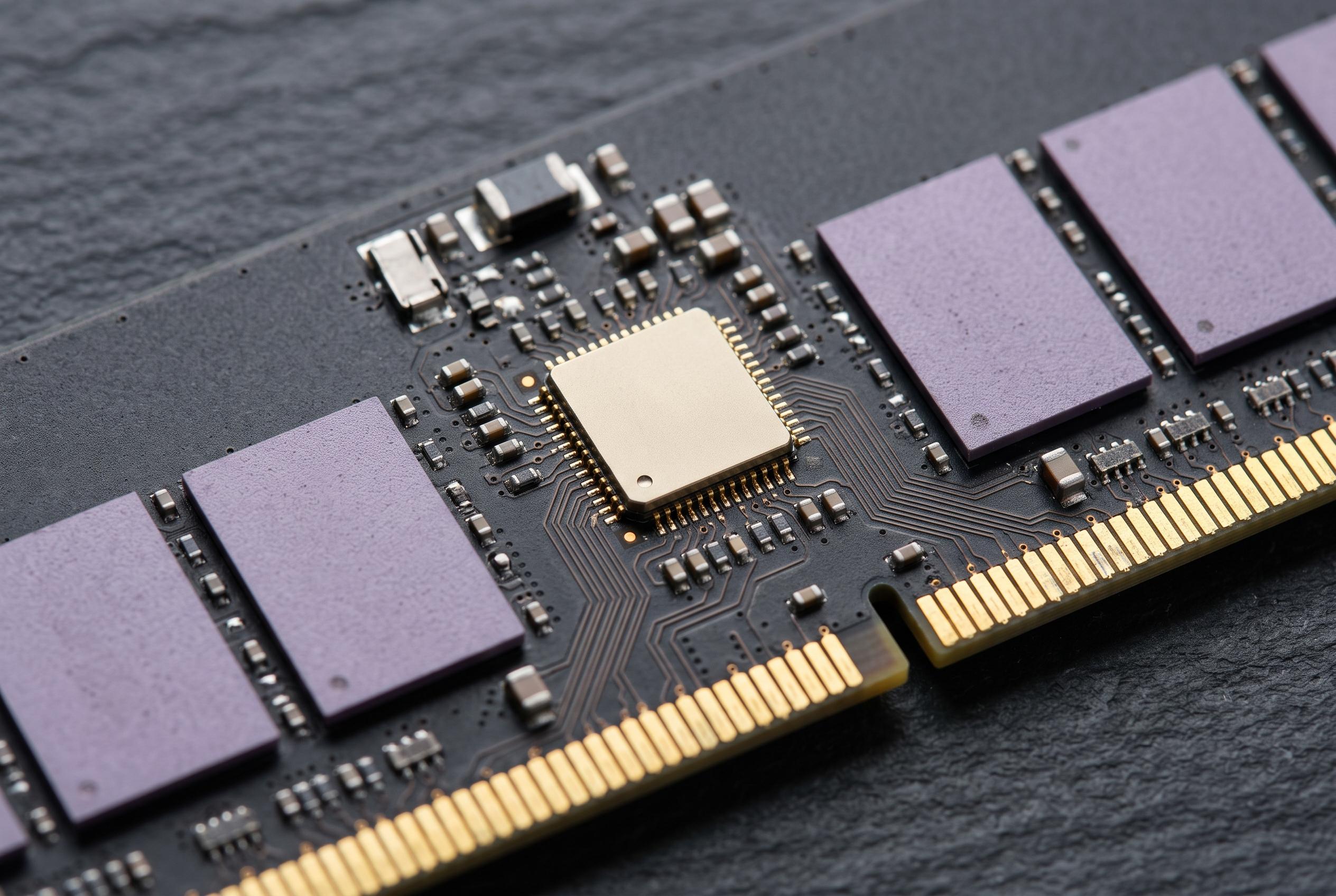
China’s CXMT is preparing to enter the high-value server memory market with a next-generation 4F² DDR5 RDIMM, potentially arriving by year-end. The move matters because it targets the same performance-focused territory dominated by Samsung, SK hynix, and Micron, while promising denser memory cells and a fresh challenge to the established chip giants.
CXMT is aiming straight at the server market
The most interesting part of CXMT’s announcement isn’t simply that another company is making DDR5 memory. It’s that the Chinese manufacturer is targeting server-grade RDIMMs, the buffered modules used to keep signals stable in demanding systems. That’s a much tougher arena than supplying memory for everyday phones, laptops, and other consumer devices.
According to TrendForce, CXMT is accelerating work on a 4F² DDR5 RDIMM with a possible year-end release. If the product reaches customers on schedule, it could give the company an early foothold in a market where reliability, capacity, and predictable performance matter far more than a low sticker price.
For data-center operators, denser memory is especially attractive. Servers are hungry for capacity, and every improvement in how many cells fit on a chip can influence system size, power use, and total operating costs.
Why 4F² technology has engineers watching closely
The name sounds like laboratory shorthand, but the idea is fairly straightforward. In a 4F² design, memory cells occupy less silicon area than in the conventional 6F² arrangement. In theory, that lets manufacturers pack more storage into each chip without simply making the die larger.
Industry experts cited by TrendForce and TweakTown estimate that the approach could lift cell density by roughly 30% to 50%. That doesn’t automatically guarantee a faster or cheaper memory module, but it creates valuable room for higher capacities and potentially better manufacturing economics.
CXMT has also highlighted a vertical surround-gate transistor, or VSG, as a key part of its design. The structure is intended to help control tiny memory cells as layouts become more crowded. Think of it as making the neighborhood denser without letting the wiring turn into complete chaos.
A possible two-year timing advantage over Samsung
Timing gives this announcement extra bite. Samsung is reportedly working toward commercialising its own 4F² DRAM technology in 2028, using a process that separates memory cells and peripheral circuits before joining them with hybrid bonding, according to TrendForce.
TweakTown reported that CXMT’s proposed launch could therefore arrive as much as two years earlier than Samsung’s planned production window. That gap would be significant if CXMT can deliver consistent quality at scale, rather than merely demonstrate a promising engineering sample.
Still, an early announcement isn’t the same thing as a mature product. Server customers typically qualify memory carefully, test it across long operating cycles, and demand dependable supply. A first launch may open the door, but large-scale adoption will depend on yields, compatibility, failure rates, and CXMT’s ability to support enterprise buyers.
What this means for DDR5 server memory buyers
For customers shopping for or specifying server memory, the practical question won’t be whether 4F² sounds futuristic. It’ll be whether the modules work smoothly with existing platforms and offer a convincing balance of capacity, stability, and cost.
RDIMMs include a register that helps manage signals between the processor and the memory chips. That makes them well suited to servers with larger memory configurations, but it also raises the bar for validation. A module can have impressive density on paper and still face a long road before it becomes a trusted data-center choice.
The broader memory market is already under pressure from artificial intelligence workloads and expanding data-center demand. TechRadar recently reported warnings that tight RAM supply could persist through 2028, a reminder that new manufacturing capacity may be welcomed even when it comes from a challenger still proving itself.
CXMT’s next test is commercial execution
CXMT says it has disclosed more than 300 patents connected with the architecture. That suggests the company isn’t treating 4F² as a one-off experiment, but patents alone won’t settle the contest. The decisive test will be whether CXMT can turn a clever layout into reliable, high-volume server products.
The company’s move also carries importance beyond one product launch. A successful server-memory push would strengthen China’s domestic semiconductor supply chain and give CXMT a stronger position in a premium market currently led by Samsung, SK hynix, and Micron.
For now, the year-end target is the date to watch. If the modules arrive on time and perform as promised, CXMT could make the next generation of DRAM competition noticeably more crowded.
A denser memory cell could become a very big deal for the servers running the modern economy.
Disclaimer: This article may have been created with AI assistance and reviewed by our editorial team. It is provided for general informational purposes only. Readers should verify information independently before relying on this content.
