
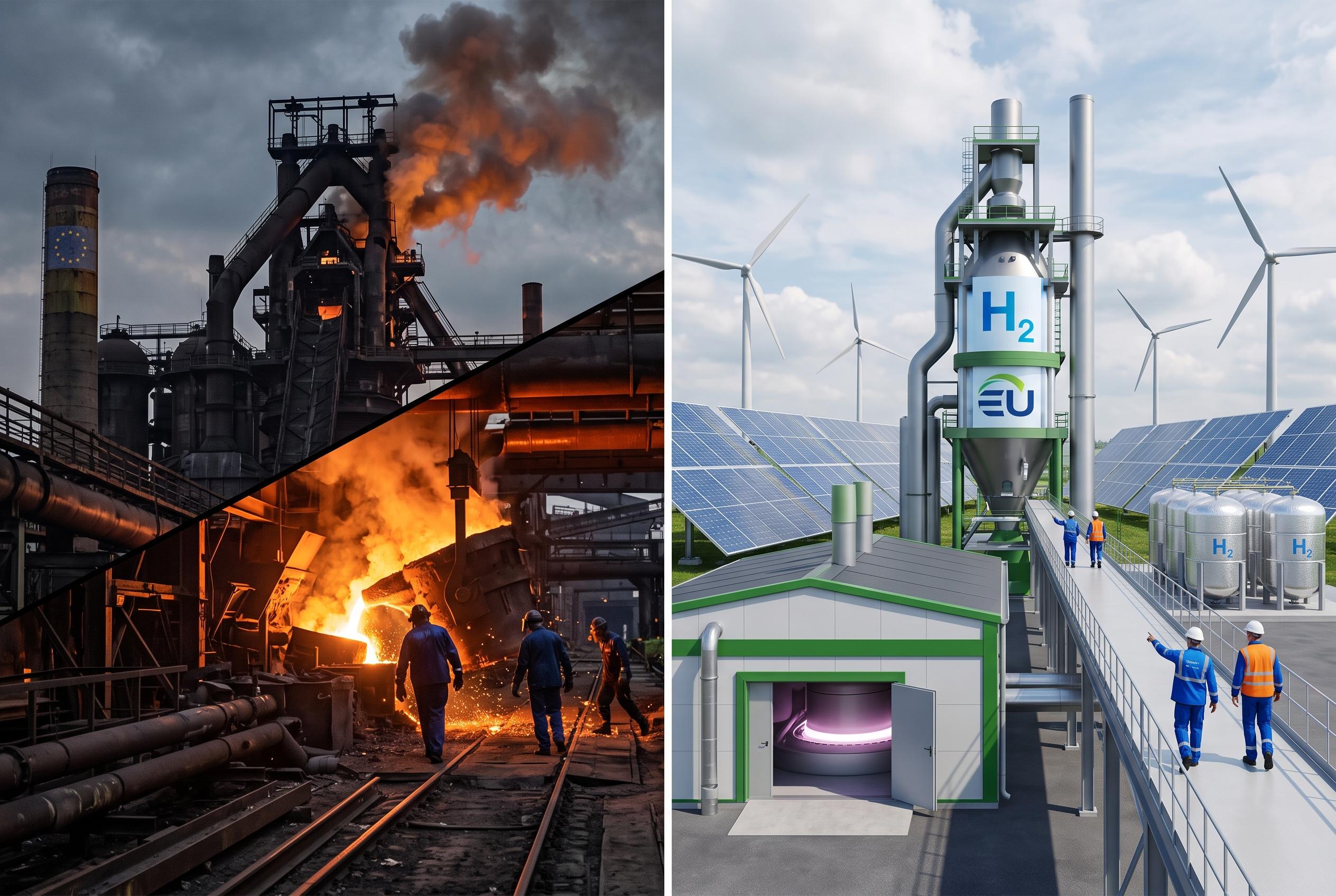
As the EU expands its steel safeguards and implements the Carbon Border Adjustment Mechanism, critics question whether Brussels is crossing the line from climate action to disguised protectionism, challenging the credibility of its stance against US tariffs.
Brussels has long accused Washington of dressing up protectionism as industrial policy. Now, after the EU tightened its own steel safeguards on July 1 and expanded the Carbon Border Adjustment Mechanism, the bloc is facing the same charge in reverse: that a tariff remains a tariff, even if it is wrapped in climate language, as the Financial Times reported in remarks tied to US Ambassador Andrew Puzder.
The Commission says CBAM is meant to curb carbon leakage and push cleaner production abroad. According to the Council of the European Union and the Commission’s customs guidance, the mechanism became fully operational on January 1, 2026, after a transitional phase, and now imposes a carbon price on imports in sectors including iron and steel, aluminum, cement, fertilizers, electricity and hydrogen. At the same time, the EU has also moved to protect its steel sector directly, setting tariff-free quotas at 18.3 million tons a year and applying a 50 percent duty to volumes above that level.
That dual approach is precisely what critics say weakens Brussels’ case against US steel and aluminum tariffs. The EU has argued that its own policy tools are environmental or defensive, while the US measures are protectionist, but the practical effect for importers is the same: foreign goods become more expensive. As the Commission also prepares to add more product categories to its steel shield, including stainless steel wire, forged bars and cast pipes, the line between climate policy and market protection is becoming harder to defend.
The numbers used to justify the steel clampdown are also drawing scrutiny. According to the Commission’s own framing, import pressure was assessed mainly over 2023 to 2025, a window in which recorded steel imports rose from 28.51 million tons to 32.89 million tons. But the steelnews.biz analysis says most of that increase came from Türkiye, while imports from other third countries rose only modestly. It also notes that Swiss shipments fell sharply over the same period, yet were still treated as evidence of rising import volumes. For Brussels, the argument is about safeguarding strategic industry; for its critics, it is another case of policy first, statistics second.
The tension comes at a delicate moment in transatlantic trade. In May, the Council and the European Parliament reached a provisional deal to implement the tariff elements of the EU-US Joint Statement, and in June lawmakers approved legislation removing tariffs on US industrial goods while preserving space for the bloc to defend its interests. The European Parliament said the Commission will report by December 1, 2026, on steel and aluminum derivatives. That leaves Brussels trying to balance climate ambition, industrial strategy and trade diplomacy while Washington watches for any sign that Europe’s defensive wall is less principled than advertised.
Beyond the headlines, the dispute matters because trade policy now reaches deep into everyday sourcing decisions. For manufacturers, distributors and retailers, tariffs and carbon charges are not abstract political tools; they change which suppliers remain viable, which routes make sense and which contracts can be renewed without a price shock. In sectors such as electronics, logistics, lifestyle goods and mobile products, even a modest increase in input costs can ripple through the supply chain, affecting everything from component sourcing to final retail pricing.
That is one reason the EU’s position is so closely watched by companies that do business on both sides of the Atlantic. A producer that sources metal-intensive components for electronics may already be balancing freight costs, customs delays and inventory risk. Add a carbon-based border charge or a steep safeguard duty, and the calculation becomes more complicated. The policy goal may be emissions reduction or industrial resilience, but the commercial result is often the same: firms are pushed to search for alternative suppliers, shift production, or absorb costs that eventually show up in margins or consumer prices.
The logistics side of the story is equally important. Modern trade is built on tightly coordinated transport networks, warehousing and cross-border compliance systems. When tariffs or carbon charges are layered onto imports, logistics teams have to reassess lead times, bonded storage strategies, duty classifications and documentation. That can create a knock-on effect for just-in-time production models, especially where mobile devices, consumer electronics and lifestyle products rely on fast-moving, internationally sourced parts.
For sourcing teams, the larger question is predictability. Businesses can adapt to higher duties if the rules are clear and stable. What they struggle with is policy that changes by category, origin, carbon content, or political timing. When a measure is presented as climate action but functions like a tariff, companies may find it harder to forecast landed costs, negotiate long-term contracts, or evaluate whether to localize supply chains. In that sense, the debate over CBAM is not just about steel; it is about how governments define legitimate intervention in a global market.
This is also why critics argue that Europe should be careful about the language it uses. If the EU wants to maintain credibility when challenging U.S. tariffs, it must explain precisely how its own tools differ in purpose, design and effect. Otherwise, Washington can point to the same economic outcome, higher import costs, and say the distinction is mostly rhetorical. Climate policy may be an important justification, but it does not automatically remove the protectionist impact felt by importers and downstream industries.
At the same time, supporters of the EU approach would say that the comparison is incomplete. They would argue that carbon pricing and steel safeguards are responding to different harms: emissions leakage on one hand and industrial overcapacity on the other. They may also contend that the measures are time-bound, rule-based and embedded in a broader regulatory framework rather than used as blunt trade retaliation. From that perspective, the policy is not simply a wall; it is an attempt to preserve industrial capacity while steering markets toward lower emissions.
Still, the political optics are difficult. Once a government starts combining climate objectives with border charges and market shields, every new measure invites questions about intent. That is especially true when the same government criticizes another for similar behavior. The EU wants to be seen as defending multilateral norms and fair competition, but it also wants to protect strategic industries from disruption. Those goals can coexist, yet they can just as easily collide when the policy tools look similar to the tariffs Brussels condemns elsewhere.
For companies operating internationally, the lesson is to treat trade policy as a core business risk rather than a background issue. Sourcing strategies that worked when border frictions were low may no longer be resilient enough. Electronics manufacturers may need more supplier diversity. Logistics providers may need new compliance workflows. Mobile and lifestyle brands may need to rethink how they price products and where they hold inventory. In every case, the common thread is that trade rules now shape commercial strategy as much as consumer demand does.
Takeaways:
- - CBAM and steel safeguards may be justified differently, but critics see similar tariff-like effects.
- - The EU’s dual approach raises questions about consistency in its criticism of US tariffs.
- - Sourcing, logistics and pricing decisions in electronics, mobile and lifestyle sectors can all be affected.
- - Predictability matters as much as the duty rate itself for companies managing global supply chains.
- - The political dispute is really about where climate policy ends and protectionism begins.
Frequently asked questions:
Q: Why is CBAM controversial? A: Because critics say it works like a tariff even though it is framed as climate policy.
Q: Which sectors are covered? A: Iron and steel, aluminum, cement, fertilizers, electricity and hydrogen.
Q: Why does this matter for businesses? A: It can change sourcing choices, logistics planning and final product costs.
Q: What is the main political risk for the EU? A: That it may struggle to criticize U.S. tariffs while using similar tools itself.
Source Reference Map
Inspired by headline at: [1]
Sources by paragraph:
