
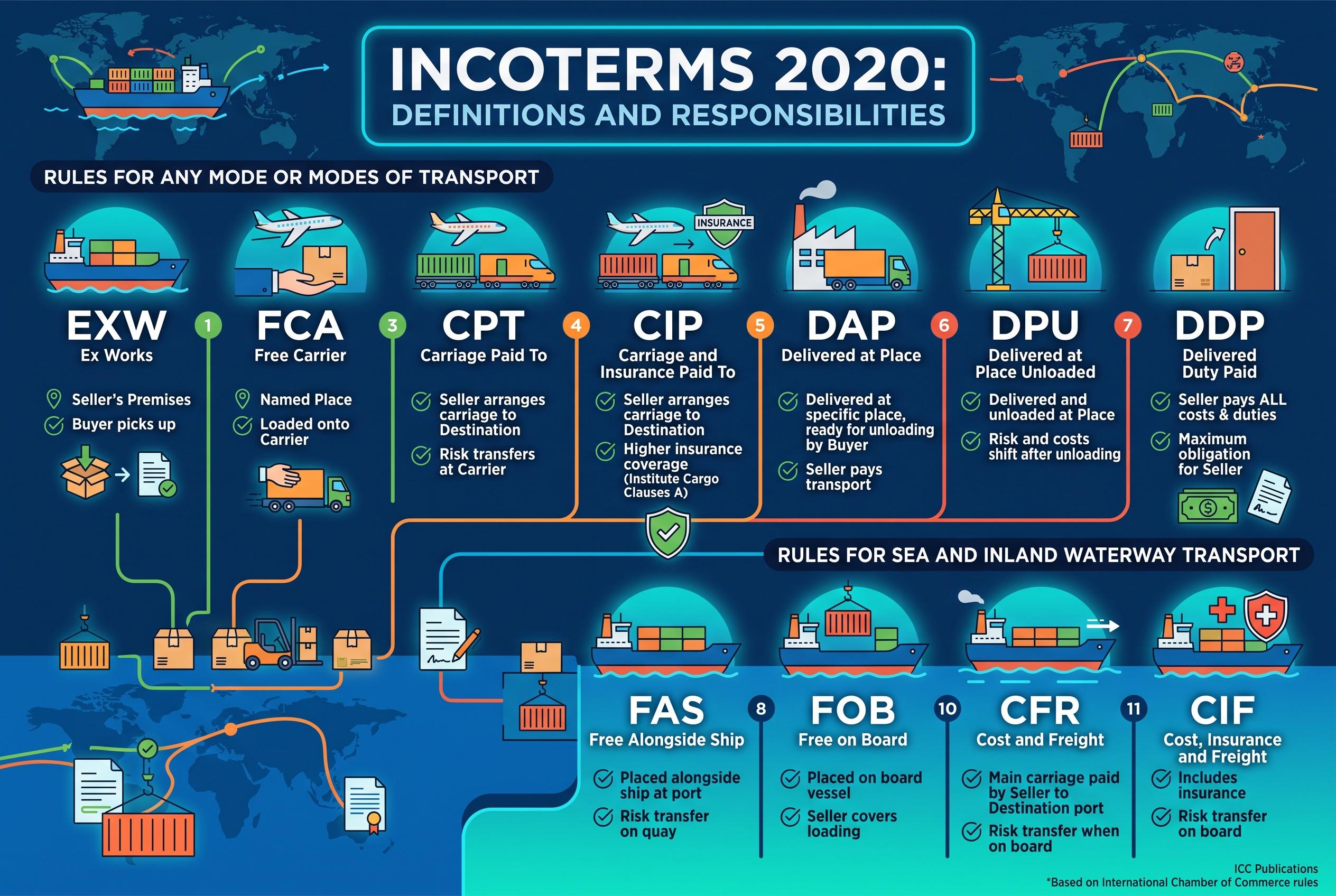
As international trade evolves, Incoterms 2020 are becoming crucial for defining responsibilities, costs and risks in global shipments, with shipment visibility tools enhancing supply chain control amid changing customs and market dynamics.
For importers and exporters, the real question in an international shipment is not only where the cargo is, but who is carrying the cost and the risk at each step. That is why logistics teams pay close attention to Incoterms and often pair them with shipment-visibility tools to track containers as they move through the supply chain. According to guides from Delpa Group, SEACOMP and other trade specialists, Incoterms 2020 remain the standard language for defining delivery points, freight charges, customs duties, insurance obligations and the moment risk shifts from seller to buyer.
Published by the International Chamber of Commerce, Incoterms are a set of internationally recognized rules used to prevent misunderstandings in cross-border sales. They are not a sales contract, but they help define the division of responsibility inside one. Industry guides note that the 2020 edition includes 11 terms, covering responsibilities ranging from export clearance and inland transport to maritime freight and import formalities. For businesses new to global trade, that clarity matters because the price on an invoice can look attractive until extra freight, insurance or customs costs appear at destination.
FOB, or Free On Board, remains a common choice in sea freight when the buyer wants more control. Under that term, the seller clears the goods for export and delivers them on board the vessel nominated by the buyer at the port of shipment. From that point, the buyer assumes the risk and takes over the main transport arrangements, including the ocean leg and onward handling. Trade guides also note that for containerized cargo handed over to a carrier before loading, ICC guidance often points companies toward FCA rather than FOB.
CIF, or Cost, Insurance and Freight, works differently. Here, the seller pays for transport to the destination port and arranges insurance, but the risk still transfers earlier, once the cargo is loaded on the vessel at the port of origin. That distinction is often misunderstood by newer importers. The arrangement can be convenient because the seller handles the main freight and insurance booking, but the buyer should remember that the default insurance cover under CIF is only basic, so higher-value or fragile cargo may require additional protection.
DDP, or Delivered Duty Paid, places the heaviest burden on the seller. In that arrangement, the seller handles export and import formalities, pays the import duties and taxes, and delivers the goods to the named destination. For buyers, that can simplify procurement and budgeting, but trade advisers note that it usually comes at a higher landed cost because the seller is taking on more work, more compliance exposure and more administrative risk. Not every exporter is willing or able to offer DDP, especially where customs rules are complex.
For B2B buyers and suppliers, the practical lesson is that Incoterms are less about jargon than about total landed cost and operational control. A lower product price may be misleading if freight, insurance, border charges and customs clearance fall elsewhere in the chain. The best term depends on the shipment, the destination market and which party is best equipped to manage logistics end to end. In international trade, that clarity can be as valuable as the cargo itself.
In sourcing, Incoterms also help buyers compare suppliers on a more equal footing. A factory quote for electronics or mobile accessories may look appealing at first glance, but if one supplier quotes EXW and another quotes CIF or DDP, the apparent price gap may only reflect where responsibility begins and ends. Procurement teams that source components, consumer devices or lifestyle products often use Incoterms to align quotations with a true landed-cost model, so they can compare not just unit pricing but also freight, insurance, packaging, customs brokerage and final delivery expenses.
This is especially important in electronics sourcing, where product value can be high and supply chains are sensitive to delay. Semiconductor parts, phone accessories, wearables and other mobile-related goods often move through multiple handoffs before reaching an assembler, distributor or retailer. Each handoff can create a new point of exposure if the contract language is unclear. When the shipment is time-sensitive, logistics teams may prefer terms that make responsibilities easy to map, because missed handover windows can affect downstream production schedules, inventory planning and even retail launch timelines.
Shipment visibility tools add another layer of control. While Incoterms define who is responsible at each stage, tracking systems show where the cargo is in real time or near real time. That combination can help importers spot delays before they become expensive problems. If a container is stuck at transshipment, a buyer who knows the shipment terms can quickly determine whether the seller, carrier, freight forwarder or customs broker should act first. For companies managing multicountry supply chains, that speed matters almost as much as the cargo itself.
Logistics teams also use Incoterms to reduce disputes. Many conflicts in global trade are not about product quality, but about assumptions. A seller may assume that the buyer will arrange inland trucking after arrival, while the buyer expects a door delivery. Or a buyer may assume insurance is comprehensive when it only covers a basic minimum. The more precisely the term is selected, the less room there is for interpretation later. That is why experienced importers often review the transport mode, destination port, destination country rules, and service level before choosing a term.
Another practical issue is customs clearance. Some terms place customs obligations clearly on one party, while others make the division more complex. Importers should understand whether the seller is responsible for export clearance only, or whether the buyer must take over import duties, taxes and documentation at the destination. This matters for cash flow as well as compliance. Duties and taxes can significantly affect the final landed cost, and when they are unexpected, they can strain margins or delay release of the goods.
For exporters, Incoterms can also influence customer relationships. Offering a more service-heavy term may make a quote more attractive, especially to smaller buyers who prefer simplicity. However, taking on too much responsibility can expose the seller to risk that is difficult to price accurately, particularly in markets with changing customs procedures or fluctuating freight rates. Sellers that specialize in sourcing and exporting electronics, consumer goods or lifestyle products often balance convenience against control by offering a limited set of terms that fit their operational capabilities.
Containerized freight deserves special attention because the physical handover point may differ from the traditional sea-shipment model some companies still picture. In modern logistics, cargo may be delivered to a terminal or carrier before it is actually loaded on the vessel. That is one reason trade specialists emphasize matching the term to the transport reality rather than relying on habit. A term that made sense decades ago in bulk shipping may not be the best fit for today’s intermodal supply chains, especially when shipments move from factory to consolidation center to port to final distribution hub.
This is also where risk management becomes part of procurement strategy. Businesses that rely on a single supplier or a single shipping lane can reduce surprises by documenting who is responsible for what, when, and under which delivery point. Clear Incoterms can support insurance planning, because the insured party should match the party bearing risk. They can also improve internal reporting, since finance teams need to know when freight and duty costs should be recognized, and operations teams need to know which milestones matter most for inbound planning.
For companies dealing in mobile devices, accessories and other fast-moving electronics, speed and predictability can be as important as price. A delayed shipment may affect product launches, retail promotions or customer commitments. In those situations, logistics planning is not just about moving boxes; it is about keeping the whole commercial timeline intact. A well-chosen Incoterm can help by making service boundaries clear from the start, allowing sourcing, logistics and finance teams to coordinate around a shared expectation.
At the same time, businesses should not treat Incoterms as a substitute for a detailed purchase agreement. The rules identify standard responsibilities, but they do not resolve every issue. Companies still need to specify packaging standards, inspection requirements, delivery schedules, insurance coverage levels, dispute procedures and documentation requirements. In practice, the strongest trade relationships combine the clarity of Incoterms with a contract that defines the details unique to the shipment.
Because global trade is rarely static, the most effective teams revisit their shipping terms periodically. Freight markets change. Customs processes change. Supplier capabilities change. A term that works for one lane or one product category may not be the best choice for another. That is why many importers and exporters review terms during sourcing negotiations instead of after an order is already placed. It is easier to agree on responsibility before the container is booked than to untangle it after a delay or damage claim.
Ultimately, the reason Incoterms remain central to international commerce is simple: they turn a complex logistics journey into a shared operational language. They help buyers know what they are really paying for, and they help sellers know where their obligations end. For any business involved in sourcing, electronics, mobile goods or broader global logistics, that clarity supports better pricing, better planning and fewer disputes.
Takeaways
- - Incoterms define responsibility, cost, and risk in cross-border trade.
- - FOB, CIF, and DDP are common, but each shifts obligations differently.
- - Total landed cost matters more than the invoice price alone.
- - Shipment visibility tools work best when paired with clear trade terms.
- - The right Incoterm depends on the cargo, route, compliance burden, and buyer-seller capability.
FAQ
What do Incoterms cover? They define delivery points, risk transfer, freight responsibility, customs duties, and insurance obligations.
Are Incoterms a contract? No. They are rules used inside a sales contract to clarify responsibilities.
Why do importers use them? To avoid misunderstandings and calculate the true landed cost of a shipment.
Which term gives buyers the most control? FOB often gives buyers more control in sea freight, while DDP gives buyers the least operational burden.
Why does shipment visibility matter? It helps teams track delays, manage risk, and act quickly when cargo moves through the supply chain.
Source Reference Map
Inspired by headline at: [1]
Sources by paragraph:
