
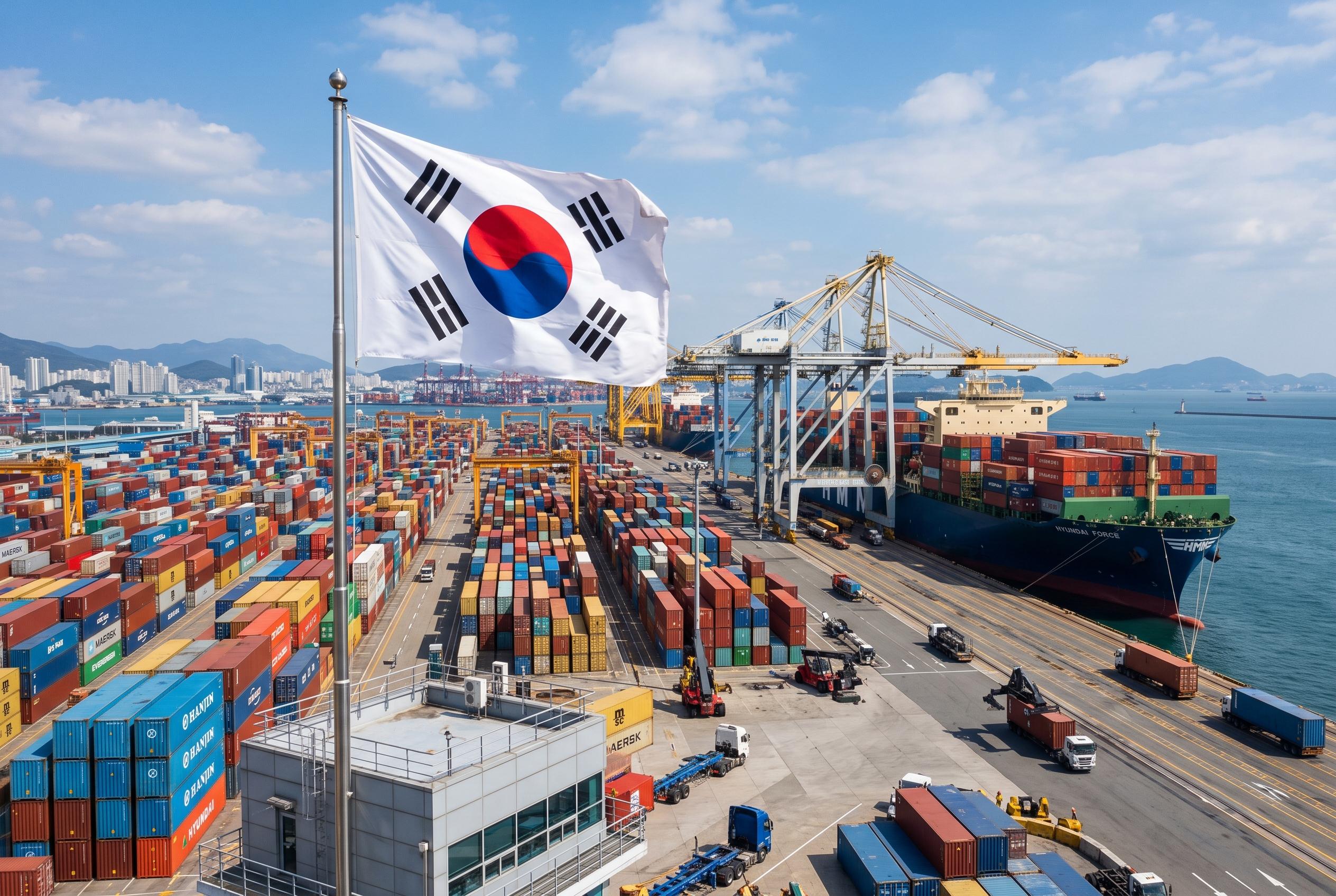
- South Korea hits a record high in exports, led by semiconductors and industrial goods
- Shipping costs soar on major routes, squeezing profit margins
- Diversified supply chains and logistics agility become critical for competitiveness
South Korea’s exports hit a record high in July, topping $98.959 billion and extending the streak of monthly exports above $90 billion to two months. The trade surplus also ran for a 18th straight month. But as exports surged, shipping costs on major long-haul routes rose sharply, adding to the burden on exporters.
According to the Korea Customs Service on the 18th, July exports rose 63.0% from a year earlier to $98.959 billion, while imports increased 26.5% to $68.567 billion. The trade surplus came to $30.392 billion. From January through July, exports totaled $595.063 billion, up 50.5% year on year, while imports rose 18.2% to $427.03 billion. The cumulative trade surplus stood at $167.76 billion.
Semiconductors led the gains. Chip exports jumped 176.3% from a year earlier to $41.17 billion, marking the 17th consecutive month of growth and the second straight month above $40 billion. Passenger car exports rose 8.4% to $5.95 billion. Ship exports increased 47.2%, petroleum products 35.7%, and auto parts 1.9%, while display devices fell 9.1% and home appliances declined 0.7%.
Exports increased across major markets, including China (96.2%), the United States (69.1%), Vietnam (79.3%), the European Union (55.6%), and Taiwan (22.0%). The trade balance with China swung from a $1.375 billion deficit in July last year to a $5.363 billion surplus this year. The surplus with the United States widened from $3.915 billion to $8.507 billion.
Meanwhile, shipping costs on major export routes rose. According to the Customs Service’s “July Export and Import Freight Costs” report, sea freight for a 2TEU container to the U.S. West Coast rose 11.1% month on month to 8.559 million won. The U.S. East Coast increased 14.4% to 8.143 million won, and the EU rose 36.4% to 5.68 million won.
Freight costs to the Middle East also climbed 14.5% to 8.78 million won. Costs had been 3.686 million won in February and rose for five straight months to more than double that level. Even on shorter routes, freight costs increased, with China up 26.5%, Japan up 0.8%, and Vietnam up 7.1%.
The July figures highlight a familiar but important tension in global trade: strong demand can lift exports, but logistics costs can quickly erode the benefits. For manufacturers, sourcing teams, and exporters across electronics, mobile components, automotive parts, and industrial goods, the current environment demands a closer look not just at sales volumes, but at the full landed cost of moving products across borders. When freight rates rise on long-haul lanes such as the U.S. West Coast, U.S. East Coast, and Europe, the impact is felt throughout the supply chain, from factory planning and inventory holding to pricing negotiations and delivery schedules.
For Korea’s export-heavy industries, semiconductors remain the centerpiece of the recovery. The jump in chip exports shows how deeply the country remains tied to the electronics cycle, especially in advanced memory and related components. That strength is meaningful beyond one sector: higher chip shipments often support a wider ecosystem of suppliers, including materials, equipment, packaging, and logistics providers. It can also spill into adjacent categories such as mobile devices, consumer electronics, and data-center hardware, where demand for chips and supporting parts remains closely linked to global technology investment.
At the same time, the broader export mix suggests that Korea’s trade performance is not resting on a single pillar. Gains in cars, ships, petroleum products, and auto parts indicate that industrial exports are contributing alongside electronics. That diversity matters in periods of volatility because it can soften the impact if one sector slows. But the uneven results across display devices and home appliances also show that not every category is benefiting equally. In practical terms, that means sourcing strategies and production planning may need to stay flexible, especially for companies balancing cyclical demand in lifestyle products with steadier demand in infrastructure and mobility-related exports.
The regional trade picture also matters. Stronger exports to China, the United States, Vietnam, the EU, and Taiwan point to broad-based external demand. For businesses, this is a reminder that export growth is not just a headline number; it is a reflection of how global sourcing networks and downstream markets are shifting. The U.S. and EU markets often impose longer shipping lead times, stricter compliance requirements, and higher logistics exposure, while Asian routes may be shorter but still vulnerable to congestion and price swings. For exporters, the challenge is to keep service levels high while managing freight volatility and maintaining competitiveness in both price-sensitive and quality-sensitive markets.
Rising freight costs are especially relevant for electronics and mobile supply chains, where product value can be high but margins may still be sensitive to transport expenses, expedited shipping, and inventory delays. When a 2TEU container costs significantly more on a major route, companies may respond by adjusting shipment timing, consolidating loads, increasing regional inventory buffers, or renegotiating contracts with logistics partners. These choices can affect not only operating margins but also customer delivery performance, especially in industries where product cycles are short and launch timing is critical.
There is also a sourcing angle. As exporters and importers face higher transport costs, they may look more closely at supplier diversification, nearshoring options, and regional warehousing. For companies tied to electronics components or mobile accessory distribution, the balance between cost, lead time, and resilience becomes more important than ever. A sourcing decision that looks efficient on paper can become expensive if freight rates rise or if a route becomes unreliable. In that sense, logistics is no longer a back-office function; it is a strategic variable that influences competitiveness across the full value chain.
The data also suggests that the trade surplus may remain strong if export momentum continues, but future performance will depend on how companies absorb cost pressures. Exporters with stronger pricing power may pass through some freight increases, while others may need to absorb them or seek efficiency gains elsewhere. That can affect investment decisions, inventory policies, and even product design. For example, lightweight packaging, more efficient palletization, and smarter shipment planning can all reduce transport costs over time. In industries tied to lifestyle goods and consumer electronics, these operational adjustments can make a measurable difference.
Just as important, the export boom underscores how closely South Korea’s economy remains connected to global trade cycles. Semiconductors, autos, ships, and industrial goods all depend on external demand, while freight rates reflect the state of global logistics networks. When both demand and shipping costs rise at the same time, the effect can be mixed: national export totals look strong, but individual firms may face more pressure than the headline numbers suggest. That is why many companies are now focusing on end-to-end visibility, from sourcing and production to final delivery.
For policymakers and business leaders, the July report serves as a reminder that export strength should be matched by supply chain resilience. Record exports are an encouraging sign, but sustainability will depend on whether logistics networks can keep pace without creating excessive cost burdens. If freight rates remain elevated, exporters may need better forecasting, more agile sourcing arrangements, and stronger coordination with logistics partners to preserve competitiveness. In a market shaped by fast-moving electronics demand and global mobile supply chains, those capabilities can be as important as product quality itself.
Takeaways
- - South Korea’s exports hit a record high, driven mainly by semiconductors and other industrial goods.
- - Freight costs rose sharply on major routes, adding pressure on exporters despite strong sales.
- - Electronics and mobile-related supply chains remain highly sensitive to logistics changes.
- - Diversified sourcing and flexible logistics planning are becoming more important for competitiveness.
- - Strong trade figures do not eliminate cost risk; they often make it more visible.
FAQ
Why were exports so strong in July? Chip exports led the surge, while several other sectors also posted gains across major markets.
Why are freight costs important if exports are rising? Higher logistics costs can reduce margins and affect sourcing, pricing, and delivery decisions.
Which routes saw the biggest freight increases? The EU route rose the most among the major lanes mentioned, while U.S. and Middle East routes also climbed.
What industries are most affected? Electronics, mobile components, automotive parts, and other export-oriented sectors are especially sensitive to shipping costs.
What should exporters watch next? They should monitor freight trends, demand in key markets, and sourcing flexibility to manage cost pressure.
