
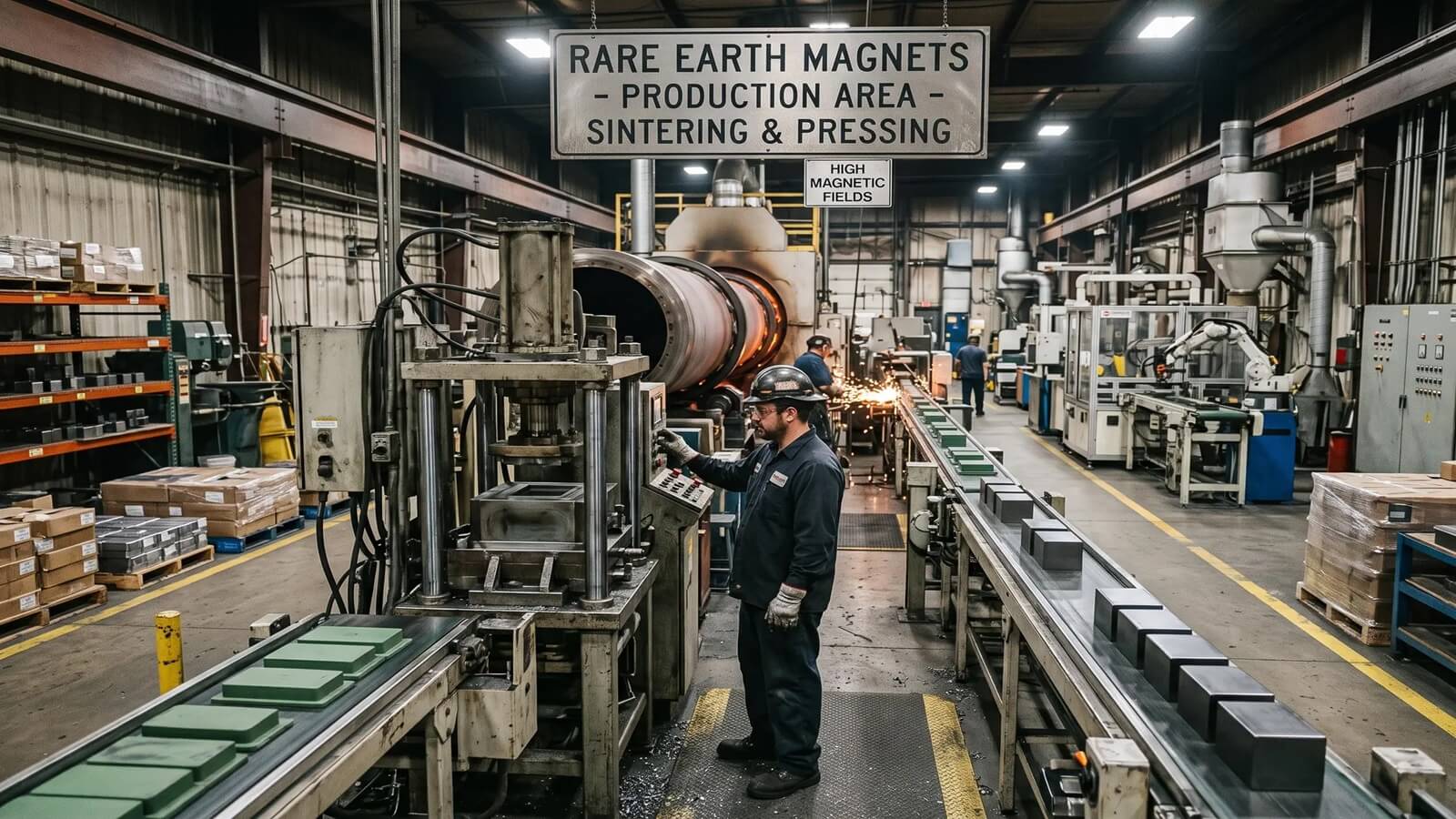
India’s effort to establish a domestic industry for rare-earth magnets has now moved into a more tangible phase. About 20 companies have submitted bids to develop integrated manufacturing facilities for sintered neodymium-iron-boron (NdFeB) magnets, according to the latest reports. The response marks an important step toward reducing India’s dependence on imported rare-earth magnets, which are critical for sectors such as electric mobility, renewable energy, electronics and advanced manufacturing.
The Ministry of Heavy Industries opened the technical bids through the government’s e-procurement portal, and the list of applicants is broad. It includes Larsen & Toubro, Coal India, 20 Microns, Attero Recycling, Lohum Magnets & Energy Solutions, Prozeal Green Energy, Singapore-based NEO Performance Materials, Proterial (India), PrNd Metal and Magnets and the Midwest Energy-Midwest Advanced Materials joint venture, among others. The participation of both established industrial companies and specialized materials firms highlights growing interest in India’s domestic rare-earth magnet manufacturing capabilities.
That matters because rare-earth magnets are a key component in modern electronics and mobility systems. India’s push is not only about expanding manufacturing capacity, but also about building a more secure supply chain for critical inputs. The scheme aims to support a domestic value chain from rare-earth oxide processing to finished magnets, reducing reliance on imports and exposure to global disruptions.
The Union Cabinet approved the scheme in November 2025 with a total financial outlay of ₹7,280 crore ($0.762 million). The program aims to establish 6,000 metric tons per annum (MTPA) of integrated REPM manufacturing capacity in India. Under the plan, the government will select five beneficiaries through global competitive bidding, with each eligible to establish up to 1,200 MTPA of capacity.
The scheme will run for seven years, including a two-year gestation period for setting up manufacturing facilities and five years of incentives linked to REPM sales. It is designed to develop an integrated domestic value chain covering the conversion of neodymium-praseodymium (NdPr) oxide into finished rare-earth magnets.
The government expects the initiative to strengthen domestic supply chains for critical industries while improving India’s competitiveness in the global rare earth permanent magnet market. Increased domestic REPM production could support strategic sectors including electric vehicles, wind energy, electronics and advanced industrial technologies. As reported by msn.com, the program aligns with India’s broader clean-energy objectives and is expected to contribute to the country’s target of achieving net-zero emissions by 2070.
Beyond the headline numbers, the scheme points to a broader shift in India’s industrial strategy. Rare earth magnets sit at the intersection of sourcing, manufacturing, logistics and technology policy. For years, downstream sectors have relied heavily on imported inputs, making production planning vulnerable to price swings, shipping delays and supply concentration in a few overseas markets. A domestic magnet ecosystem would not eliminate those pressures overnight, but it could create more options for manufacturers and improve resilience across the value chain.
That is especially relevant for the electronics industry, where compact, high-performance magnets are used in components that demand precision, durability and efficiency. As consumer devices become slimmer and more power-efficient, material performance becomes even more important. In mobile devices, wearables, speakers, sensors and other compact electronics, supply consistency matters as much as product quality. A stable local source can help manufacturers plan production more confidently and potentially reduce lead-time uncertainty.
The same logic applies to electric mobility. EV motors depend on advanced magnet materials, and the broader transition to cleaner transport requires dependable access to key inputs. When a country is trying to scale EV adoption, domestic production of critical components can support not just assembly lines, but also the supporting ecosystem of testing, quality assurance, and logistics. In that sense, the rare-earth magnet scheme is not a standalone industrial project; it is part of a larger effort to strengthen India’s manufacturing backbone.
For the sourcing community, the development is equally significant. Integrated domestic production can change how companies think about procurement, supplier diversification, and contract strategy. Instead of relying only on overseas sourcing channels, buyers may eventually gain access to local vendors that can offer shorter replenishment cycles and closer coordination. That can matter for industries that need just-in-time deliveries, predictable inventory management and tighter control over product specifications.
Logistics also plays an important role in rare earth value chains. Materials must move through multiple processing stages, and each step adds complexity in handling, storage, compliance and transport. If India succeeds in building an end-to-end domestic chain from oxide processing to finished magnets, logistics planning could become more streamlined. Localized production may also reduce exposure to cross-border freight disruptions and long transit times, both of which can affect manufacturers operating in fast-moving sectors.
The participation of recycling and materials-focused companies is another notable signal. It suggests that the magnet ecosystem may not be built only on primary extraction and processing, but also on the recovery and reuse of materials already in circulation. That matters for both industrial efficiency and long-term sustainability. In modern electronics and industrial manufacturing, access to secondary materials can help companies think more strategically about resource use, lifecycle management and supply resilience.
India’s policy push also reflects a wider global trend: countries are rethinking how they secure critical inputs for clean energy, advanced manufacturing and digital infrastructure. Rare-earth materials are increasingly viewed not just as commodities, but as strategic industrial assets. For India, developing domestic magnet capacity could help create a stronger position in future technology supply chains, particularly where control over materials has downstream effects on competitiveness.
Still, the road from bid participation to commercial production will require execution. Building integrated manufacturing facilities is a complex task, and the scheme’s success will depend on project readiness, technology transfer, quality standards and market demand. Companies will need to align production economics with policy incentives while also navigating material sourcing, process engineering and long-term customer commitments. In other words, the challenge is not simply to build factories, but to build a reliable industrial system.
That industrial system will likely need coordination across public policy, private investment and technical expertise. If the selected beneficiaries move quickly, the result could be a stronger domestic ecosystem that supports not just magnets, but also adjacent industries in electronics, mobility and energy. If the process slows, however, India could still face a gap between policy intent and manufacturing output. For that reason, industry observers will be watching the next stages closely, including beneficiary selection, project timelines and the pace of facility development.
For businesses, the potential upside is clear. Domestic REPM production could help improve supply security, support product planning, and reduce dependence on long international sourcing chains. For consumers, the benefit may be less visible but still meaningful: more stable manufacturing ecosystems can support the availability of the electronic and mobile products that shape daily lifestyle and work routines. From smartphones and appliances to EVs and renewable-energy systems, rare-earth magnets quietly underpin much of modern life.
The broader significance is that India is trying to move up the value chain. Instead of remaining primarily a consumer of imported materials, the country is positioning itself to produce a strategic input domestically. That is a major step for an economy with ambitions in clean energy, advanced manufacturing, and technology-driven growth. If successful, the scheme could become a reference point for how India builds resilience in critical sectors while encouraging private investment and industrial capability.
At the same time, the government’s approach shows a preference for scale and structure. Selecting five beneficiaries through global competitive bidding suggests that the scheme is designed to create concentrated capacity rather than diffuse, fragmented production. That may help with quality control, standardization, and technology absorption, especially in a sector where performance specifications are demanding. For downstream buyers, predictable output from large integrated facilities could be more valuable than smaller, uneven supply.
There is also a strategic timing element. As global manufacturing networks continue to adjust to geopolitical tensions, shipping disruptions, and shifts in clean-energy demand, countries are reassessing where critical materials come from. India’s rare earth magnet push fits into that environment. It is both an industrial policy move and a sourcing strategy, aimed at reducing vulnerability while laying the groundwork for future growth.
Ultimately, the bid response suggests that industry sees opportunity in the policy framework. Whether that opportunity becomes a durable domestic ecosystem will depend on how quickly projects advance, how effectively companies execute, and how well demand from electronics, mobility and energy sectors develops over time. But even at this early stage, the initiative marks a meaningful step toward a more self-reliant manufacturing base.
Takeaways:
- India is moving from policy intent to practical steps in rare earth magnet manufacturing.
- The scheme could strengthen sourcing resilience for electronics, mobile, EV, and energy industries.
- Logistics, technology, and supply-chain coordination will be central to execution.
- A successful domestic value chain may reduce dependence on imported critical materials.
Disclaimer: This article may have been created with AI assistance and reviewed by our editorial team. It is provided for general informational purposes only. Readers should verify information independently before relying on this content.
