
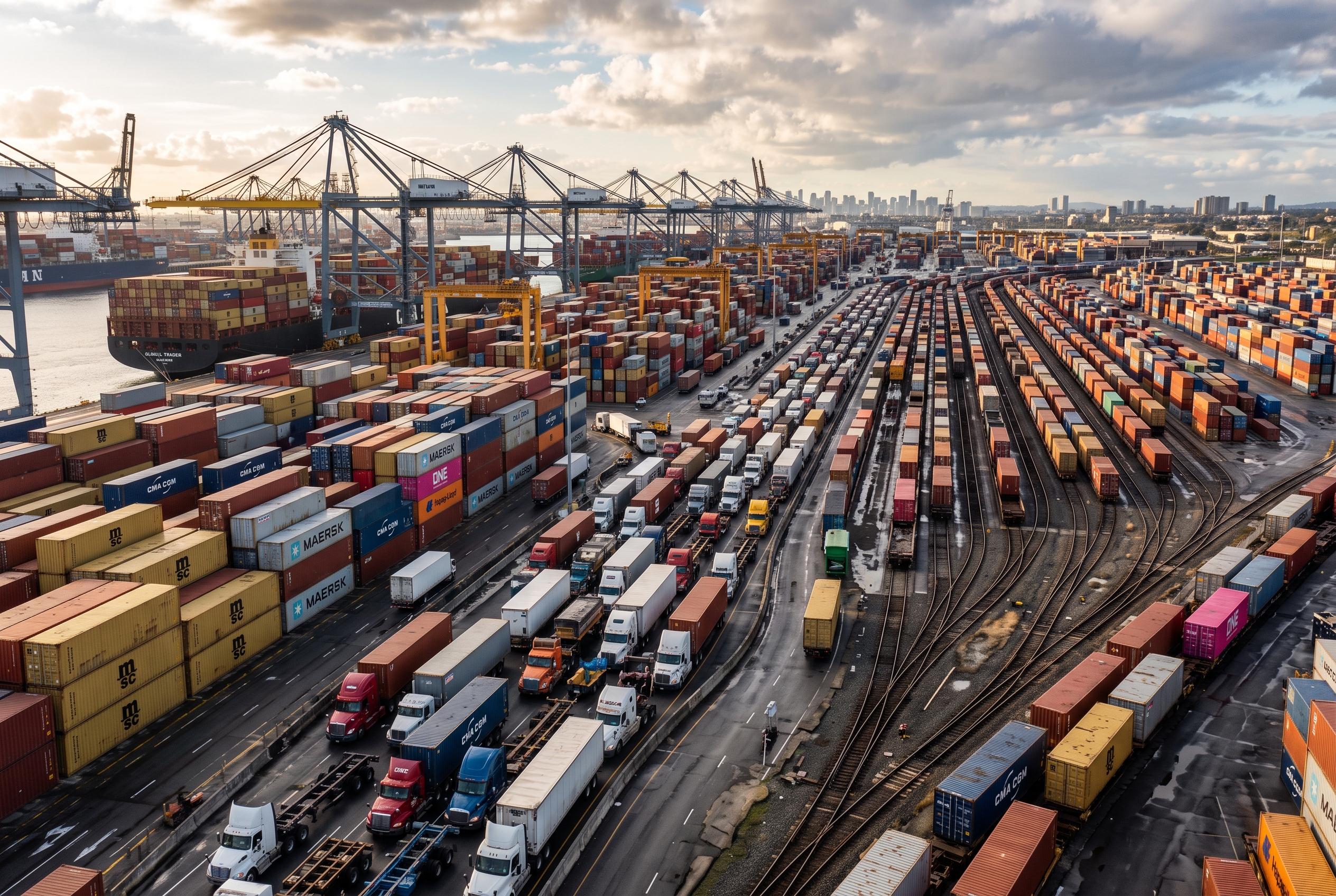
- Ocean shipping revenues are rising, but landside costs and delays are escalating.
- Ports, rail, and trucking infrastructure lag behind growing cargo volumes.
- Efficient post-discharge operations are becoming critical competitive advantages.
Ocean carriers are reporting stronger revenues, but at the same time, their financial statements are revealing something else that’s becoming increasingly apparent: the cost of moving containers after they leave the ship is rising quite rapidly. In a recent Substack Shipping News analysis, Sorin Honc pointed out that the real bottleneck in global trade is gradually shifting over to the landside , that is, the trucks, rail connections, storage yards, and other off-dock assets that haven't kept pace with the surge in cargo volumes. Honestly, it’s a pretty clear sign that the entire supply chain is feeling the pressure.
That view lines up pretty closely with comments from Maersk’s CEO, Vincent Clerc, who spoke to CNBC on August 12. He mentioned how years of underinvestment in landside infrastructure are now clashing with ongoing trade growth. Maersk’s recent second-quarter results make this tension quite obvious. They reported a 20% increase in revenue year over year, hitting $15.8 billion, and their container shipping division saw a significant boost in profit. But, interestingly enough, their report also pointed out rising container-handling costs. Maersk blamed this on congestion at terminals, higher storage charges, and the overall increase in volume.
And it’s not just one or two companies dealing with this issue. Hapag-Lloyd, for example, shared similar concerns in its first-half 2026 results, noting that container-handling expenses climbed by $276 million, reaching a total of $4.2 billion. They said the cost hikes were due to longer transit times, more storage expenses, and inland transportation costs. Over in Europe, the World Ports Organization has been highlighting a widening gap between terminal capacity and demand, which they see as a key reason for vessel delays. Maersk has also pointed out that berth and yard congestion have been building up for around 15 to 20 years , basically, since trade growth started outpacing infrastructure improvements.
Now, it’s worth noting that congestion isn’t exactly uniform across all ports. Some gateways are handling the flow better than others. Still, the problem is pretty evident in several major locations. According to Portcast’s August 2026 data, Vancouver had a low congestion index with a median wait of just 0.58 days. Yet, Kuehne+Nagel’s rankings from August 18 still described Vancouver as slightly disrupted, with the average berth wait above two days for about a week. Plus, Kuehne+Nagel also reported that the inland rail dwell time for Vancouver and Montreal hovered at six days in mid-August , kinda showing how important the inland flow really is, sometimes even as much as the vessel call itself.
For shippers these days, the message is pretty loud and clear: ocean capacity alone no longer determines how fast freight moves. McKinsey has argued that landside cooperation is fast becoming the next big frontier for container alliances. Carriers are looking for ways to control more parts of the chain and cut down on waste , you know, kind of streamlining the whole process. With port congestion indexes still high in many regions, the real edge usually belongs to those gateways that can move boxes efficiently after they’re discharged, not just those that can get ships to berth quickly.
What makes this shift especially important is that it changes how shippers think about reliability. In the past, a booking decision might have focused mostly on vessel schedule, route frequency, and rate. That still matters, of course, but the landside now has an outsized effect on whether cargo actually arrives on time. If a container clears the ship but sits in a yard, waits for a truck appointment, or gets delayed on rail, the theoretical advantage of a fast ocean leg can disappear quickly. In practical terms, the supply chain is only as smooth as its slowest handoff.
This is where sourcing strategies also begin to change. Importers and exporters can no longer treat the port as a simple endpoint. Instead, they have to consider the entire flow from origin to final delivery, including customs timing, warehouse availability, drayage capacity, and rail connectivity. For companies that rely on just-in-time inventory, even small disruptions can ripple into production schedules, retail replenishment, and customer service commitments. That means sourcing teams, logistics managers, and procurement leaders increasingly need to work from the same playbook.
The broader lesson for global trade is that infrastructure is not just a public-policy issue; it is a commercial one. When terminals, rail links, and storage systems lag behind cargo volumes, the result is not merely inconvenience. It can affect pricing, reliability, and the attractiveness of entire trade lanes. Ports that invest in efficient landside coordination can create a real competitive advantage, while those that struggle may push cargo toward alternative gateways whenever possible. In a world where shipping decisions are increasingly data-driven, operational performance can matter just as much as headline capacity.
There is also a lifestyle angle to this story, even if it sits far downstream from the port. Delays and added handling costs eventually show up in the prices and availability of everyday goods, including mobile devices, electronics, apparel, and household items. When logistics become more expensive, those costs often move through the chain in subtle ways. Consumers may not see berth congestion or yard dwell times, but they can feel the effects when inventories tighten, replenishment slows, or promotions become less predictable. In that sense, landside bottlenecks are not just a shipping problem; they are part of the everyday cost structure of modern life.
The economics of the container industry also suggest that carriers are being pushed to rethink their role. If revenue can rise while handling costs rise even faster, then profitability becomes more dependent on network design, asset coordination, and partnership quality. That helps explain why there is growing interest in integrated logistics models and more end-to-end visibility. The more a carrier can anticipate congestion, coordinate with terminals, and align inland transport, the more it can protect margins and service levels. For the customer, that may translate into fewer surprises and a more predictable delivery window.
At the same time, there are limits to what private coordination alone can solve. Some bottlenecks require broader infrastructure investment, regulatory cooperation, and long-term planning. Ports, rail operators, trucking providers, and local authorities all influence the outcome. If one part of the chain improves while another remains constrained, the system simply shifts pressure elsewhere. That is why the current congestion cycle feels so persistent: it is not a single failure, but a network effect built over years of uneven investment and rising demand.
Takeaways:
- - The main constraint in container shipping is shifting from sea to land.
- - Higher revenues do not necessarily mean lower operating pressure for carriers.
- - Landside assets like trucks, rail, yards, and storage are now central to trade performance.
- - Shippers need to evaluate the full logistics chain, not just vessel schedules.
- - Efficient post-discharge movement is becoming a competitive advantage for ports and carriers.
- - Infrastructure gaps can influence sourcing decisions, costs, and even consumer prices.
- -
Q&A
Why is landside congestion becoming more important now? Because trade volumes have outgrown the infrastructure that moves containers after discharge.
Does ocean freight capacity still matter? Yes, but it is no longer the only major determinant of delivery speed.
What should shippers watch most closely? Berth waits, yard dwell time, rail availability, and truck access.
Can congestion affect consumer goods? Yes, especially for high-volume categories like electronics, mobile products, and other imported items.
Disclaimer: This article may have been created with AI assistance and reviewed by our editorial team. It is provided for general informational purposes only. Readers should verify information independently before relying on this content.
Sources by paragraph:
