
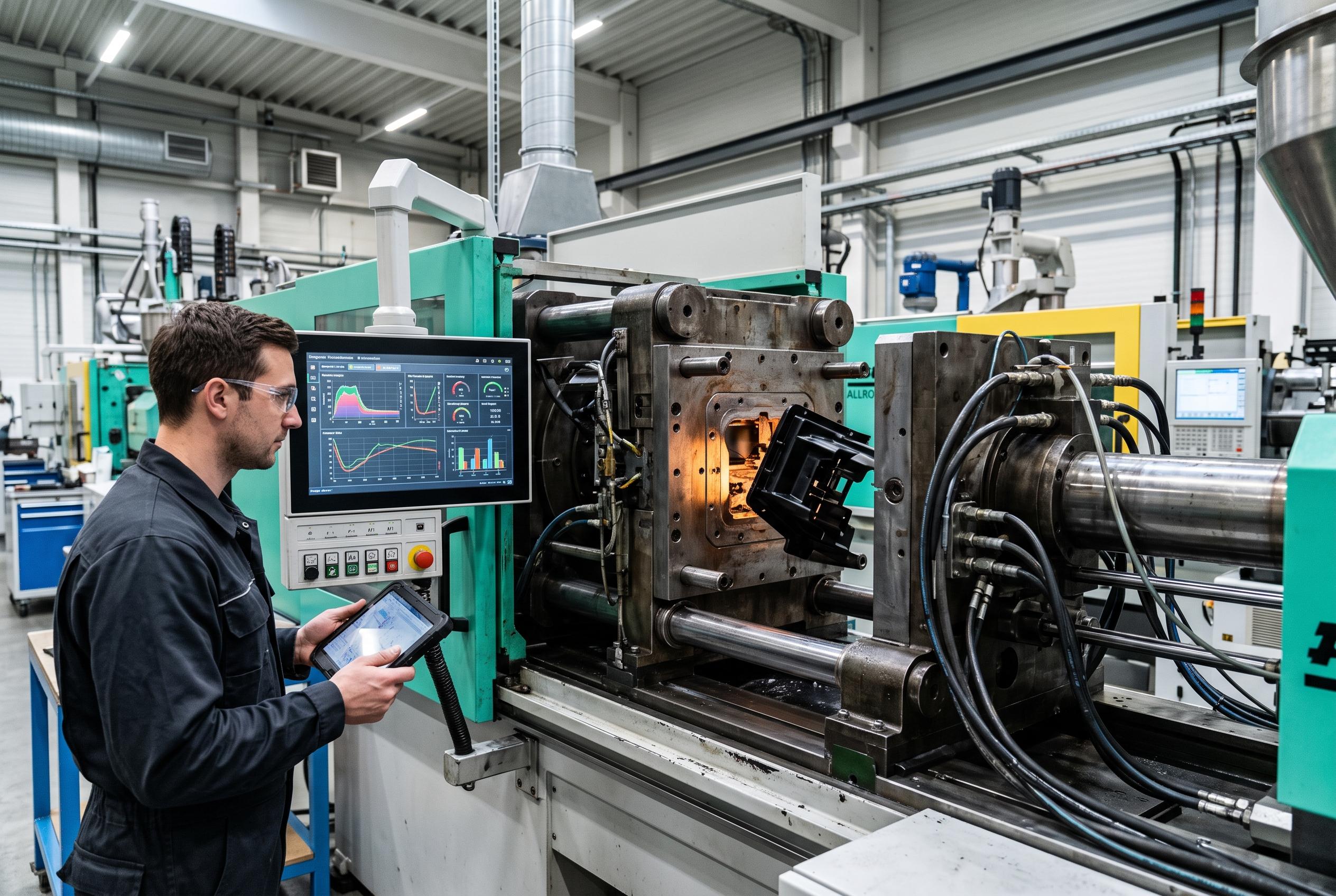
Manufacturers are turning to injection molding process monitoring to see more than a finished part or a flashing alarm. By connecting shot-level data, quality results, operator notes, and plant-wide trends, teams can troubleshoot faster, prove whether a change mattered, and turn scattered production history into repeatable know-how.
A Finished Part Can't Tell the Whole Story
A questionable part often arrives with a frustrating lack of clues. The press may show setpoints, actual values, cycle times, and alarms, while quality records sit somewhere else and a technician remembers making an adjustment during the run. The result is plenty of information, but not necessarily a clear explanation.
That gap is why injection molding process monitoring matters more than visual inspection alone. As Aprios explains, process signals can reveal changes that may not yet be visible in the part, giving manufacturers an earlier chance to investigate. A curve that drifts quietly can be more revealing than a defect discovered at the end of a batch.
The useful starting point is simple: what happened during the shot? A shot-by-shot record can show whether a change was sudden, gradual, isolated, or repeated. It gives the processor evidence to examine instead of asking the next shift to rely on memory and educated guesses.
When Does a Process Change Actually Matter?
Not every movement in a process trace creates a bad part. Likewise, a machine that looks steady doesn't guarantee that every part meets its critical requirements. The important question is whether the monitored signal has a demonstrated relationship with the characteristic that matters.
That connection is usually built through process studies, part measurements, historical production data, and appropriate statistical analysis. Research published through ScienceDirect highlights the value of linking manufacturing data with quality assessment rather than treating monitoring as a disconnected technical exercise.
Alarm limits deserve the same care. A convenient percentage copied from another job may be easy to configure, but it can be meaningless for the mold, material, machine, or tolerance in front of you. Stronger limits come from capable production data and a clear understanding of what variation the part can actually tolerate.
Context Turns a Curve Into a Clue
A graph becomes far more useful when it answers what changed around the event. Did the run follow a restart? Was a new material lot loaded? Did someone alter the setup, swap an auxiliary unit, or make a mold adjustment? Without those details, an outlier is just a lonely dot on a screen.
Process monitoring systems can help connect cycle data with job information, change records, and operator notes. Detail Mold's overview of injection molding process monitoring similarly points to the importance of watching relevant variables over time, rather than treating each inspection result as a standalone verdict.
This doesn't mean burying operators under paperwork. The best approach is to automate the records the system can capture and keep manual entries focused on decisions that genuinely need human context. A short, consistent note can save the next engineer an hour of detective work.
Plant-Level Data Shows Whether the Problem Is Bigger
Machine-side monitoring is excellent for the immediate question: what is this press doing right now? But production leaders eventually need a broader view. Is the issue limited to one mold, or is the same material behaving differently across several machines? Has a similar drift appeared on another shift or in an earlier run?
Smart manufacturing platforms are increasingly designed to connect equipment, production history, and analysis across the factory. Fox Molds and MachineMetrics both describe this wider IoT approach as a way to improve visibility, compare performance, and support faster decisions across connected injection molding operations.
Temperature control is a good example of why that comparison matters. ENGEL notes that stable temperature management plays an important role in repeatable injection molding, yet the causes of variation may involve the machine, mold, material, or surrounding equipment. A plant-wide view helps teams look beyond the most obvious suspect.
Choose a Real Problem Before Buying More Data
The smartest rollout usually starts small. Pick one costly, recurring problem, then define the part requirement, the business impact, the signals worth watching, and the person responsible for responding when the process moves outside its approved range.
From there, establish a baseline using capable production and compare the relevant signals with actual part measurements. Decide what evidence an operator or engineer should review, what action is allowed, and when the issue needs escalation. This turns monitoring into a workflow rather than another dashboard competing for attention.
The final step is the one teams often skip: confirm that the correction worked and stayed effective. Historical records and audit trails can help distinguish a genuine improvement from a temporary recovery. Over time, that evidence makes experienced processors' decisions easier to teach, repeat, and improve.
It's a small shift in thinking, but it turns molding data from a record of the past into a tool for better decisions.
Disclaimer: This article may have been created with AI assistance and reviewed by our editorial team. It is provided for general informational purposes only. Readers should verify information independently before relying on this content.
