
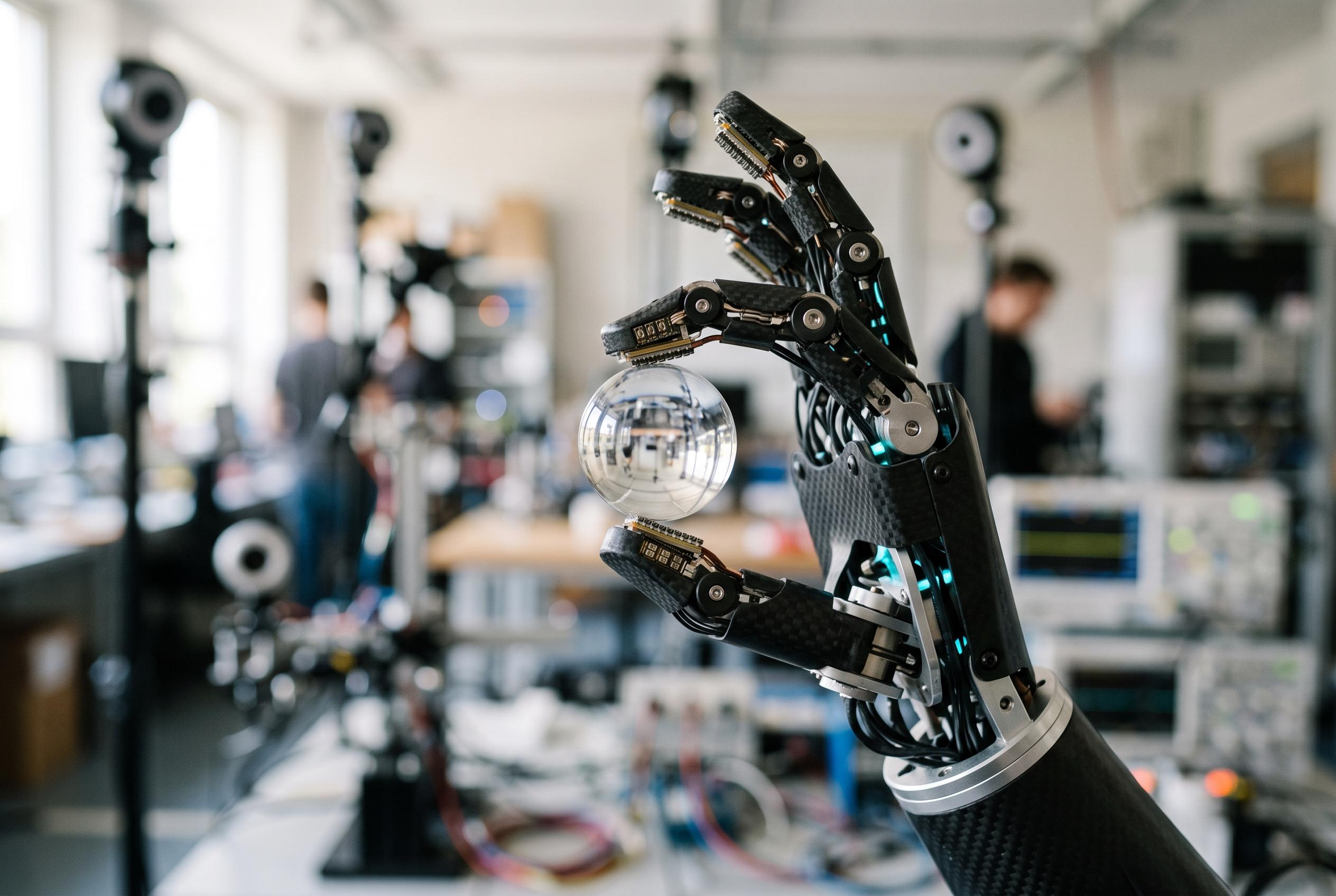
Investors are looking beyond AI chips as robots move from warehouses into factories, stores, and eventually homes. Amazon's autonomous machines already handle heavy internal logistics, while Tesla and other manufacturers are pushing humanoid robots toward real-world work. For investors, the shift creates opportunities across robotics hardware, sensing, software, and infrastructure.
Essential Takeaways
- - Robotics is broadening: Warehouse automation is already established, while humanoid machines remain an emerging opportunity.
- - Amazon is a useful case study: Its Proteus robots move large loads and operate autonomously inside fulfillment facilities.
- - Humanoid robots are still developing: Tesla Optimus and similar systems are aimed at factory and household tasks, but widespread consumer use is still some way off.
- - The supply chain matters: Robots need processors, memory, sensors, connectivity, and data-center support.
- - Smaller specialists could benefit: Vision and motion-control companies may offer more focused exposure than the biggest AI names.
Robotics is becoming AI's next big growth engine
The most interesting part of the robotics story isn't the shiny humanoid demo. It's the quieter industrial work already happening behind warehouse walls, where machines sort, carry, and position products with a steady mechanical hum.
Amazon's Proteus illustrates the transition. The autonomous robot is designed to move through fulfillment facilities without being confined to a fixed route, helping transport inventory while employees handle other parts of the process. TechRadar has described Proteus as a fully autonomous system built for moving customer orders through Amazon's logistics network.
That matters because robotics adoption doesn't have to wait for a robot that can fold laundry or cook dinner. Businesses can see a clearer return from machines that reduce repetitive lifting, improve throughput, and keep goods moving. According to Amazon's own operations updates, the company is also framing automation as a way to support employees rather than simply replace them.
Warehouse robots are already earning their keep
For investors, warehouses offer a more tangible starting point than household robots. The environment is structured, the tasks are repetitive, and even modest efficiency improvements can add up across a huge distribution network.
Amazon's European robotics investment shows how the company is expanding automation beyond a single pilot project. Its machines can work alongside human staff, taking on physically demanding movement while people manage tasks that require judgment and flexibility. That combination is less dramatic than a fully robotic warehouse, but it's probably more practical.
The same logic is spreading across retail logistics. Companies supplying automated storage, retrieval, and inventory systems are gaining attention as retailers try to handle rising order volumes without endlessly expanding floor space or labor costs. The result is a robotics market that feels less like a distant bet and more like an industrial upgrade already under way.
Humanoid robots are chasing the next frontier
Humanoid robots attract more headlines because their shape suggests a familiar future: a machine that can use existing tools, navigate human spaces, and tackle a variety of jobs. Tesla's Optimus is central to that vision, with proposed applications ranging from factory work to household chores.
Still, a polished demonstration isn't the same as a reliable commercial product. Optimus-focused analysis has highlighted both the system's potential and its current limitations, particularly around dexterity, autonomy, safety, and the ability to perform useful tasks consistently outside controlled settings.
Workplace trials could arrive well before consumer versions. A factory floor can be adjusted for a robot, monitored closely, and supplied with repeatable tasks. A home is another story, with stairs, pets, clutter, wet surfaces, and the occasional mystery object on the floor. Advanced AI's workplace briefing points to that gradual path, with humanoids likely entering controlled professional environments before becoming everyday home helpers.
The hardware opportunity runs deeper than chipmakers
Robots need more than a processor. They require cameras and 3D sensing to understand their surroundings, control systems to coordinate movement, tactile feedback for gripping, and software that turns instructions into safe actions.
That creates a wider investment landscape. Large AI infrastructure companies may benefit because robots depend on advanced computing, memory, cloud services, and data centers. But less celebrated suppliers could also play a crucial role, especially if their components become standard across multiple robot makers.
Vision technology is one area worth watching. A robot needs to judge distance, recognize objects, and understand changes in its environment before it can act safely. Motion and touch are just as important. A machine that can see a cup but can't grasp it gently, or walk without losing balance, isn't especially useful. In robotics, the unglamorous components often determine whether the headline-making hardware works.
How investors can assess robotics stocks
A sensible way to compare robotics companies is to look past the word "AI" and ask what the business actually sells. Does it provide sensors, actuators, warehouse software, industrial robots, computing capacity, or a complete automation system? Each category has different customers, margins, competition, and risks.
It's also worth separating current revenue from future promises. Amazon's warehouse deployment offers evidence of present-day use, while Tesla's humanoid strategy represents a much longer-term opportunity. Companies focused on industrial automation may produce steadier results, whereas humanoid specialists could offer greater upside but face more execution risk.
Investors should also watch customer concentration, production costs, and whether a company's technology works outside a demonstration. The robotics winners won't necessarily be the brands with the most recognizable machines. They may be the quiet suppliers whose sensors, controllers, and software sit inside many competing platforms.
The outlook is compelling, but patience matters. Robotics adoption can be expensive, technically difficult, and uneven. Even so, as Advanced AI's workplace analysis suggests, the move into real working environments could give the sector a durable growth path rather than a brief burst of hype.
Robotics may be AI's most practical next act, beginning with warehouses and gradually moving into more personal spaces.
Disclaimer: This article may have been created with AI assistance and reviewed by our editorial team. It is provided for general informational purposes only. Readers should verify information independently before relying on this content.
