
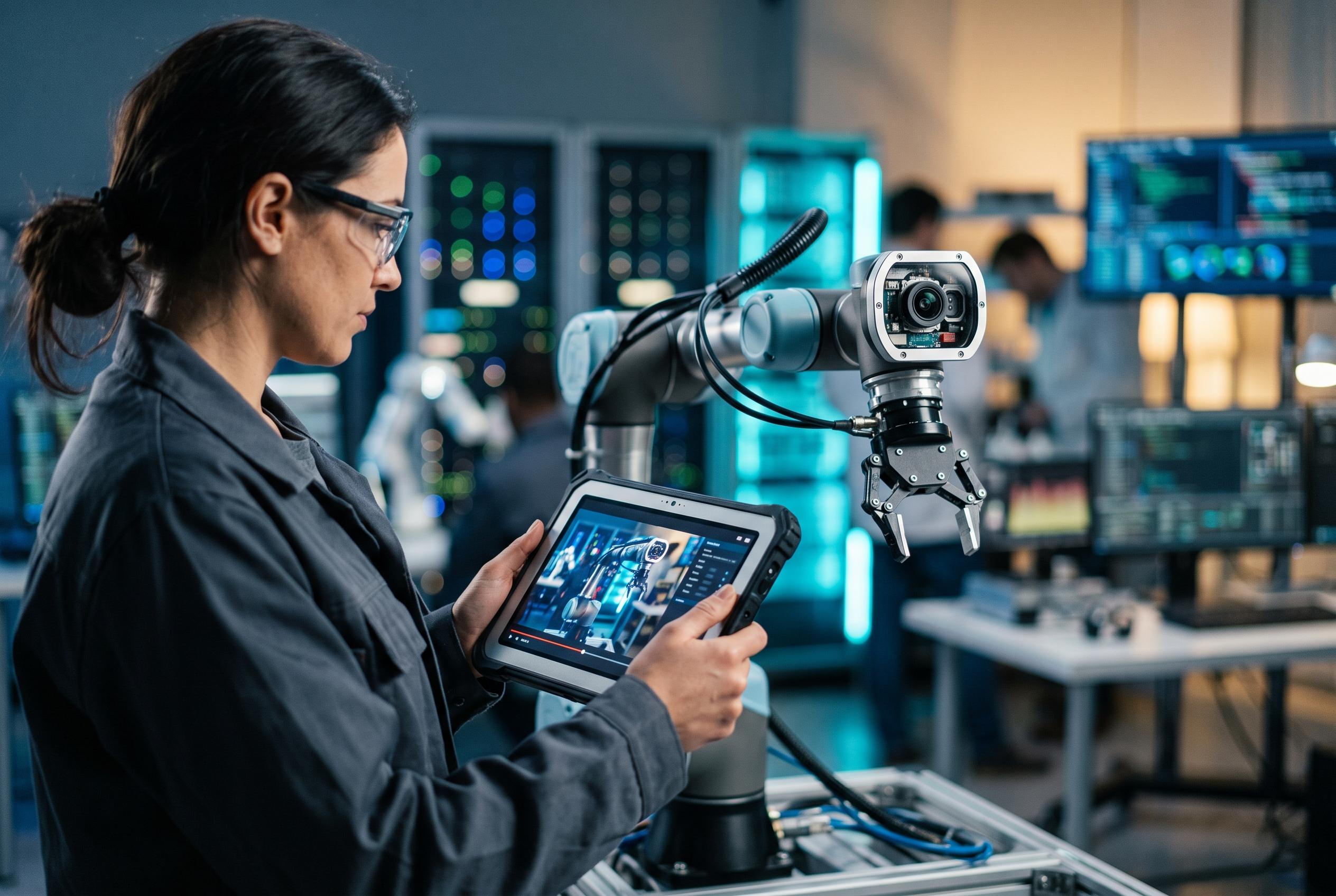
Robotics teams are watching Skild AI's new S1 model, which can learn unfamiliar industrial tasks from a single video demonstration. Built with NVIDIA technology, the system aims to help factories, warehouses and food operations adapt faster when layouts, products or workflows change.
Essential Takeaways
- - One video can guide a new task: S1 interprets a demonstration without task-specific retraining.
- - It targets changing workplaces: The model is designed for factories and other sites where processes regularly shift.
- - Multistep work is the focus: Examples include plant potting, coffee brewing, kit assembly and electronics installation.
- - The performance gap is notable: Skild reported roughly 66% success per step on new multistep tasks, versus 9% for a comparable system.
- - NVIDIA supplies the toolkit: Simulation, synthetic data, physics modelling and inference optimisation support the system.
A single demonstration could change the robot training routine
The most striking part of S1 isn't that it watches a video. It's what happens next: the robot tries to understand the sequence, recognise the objects and reproduce the actions in a new setting.
That matters because many industrial robots are excellent at repetition but less comfortable with surprise. Move a component, alter the workstation or introduce a new product, and the old routine may need fresh data, testing and programming. S1 is intended to make that transition feel less like rebuilding the machine from scratch.
NVIDIA's account of the launch describes the model as part of a broader push into physical AI, where robots learn from experience rather than relying only on rigid instructions. For operators, the appeal is easy to picture: record a skilled worker completing a job, then offer that example to the robot.
Why adaptable robots matter on the factory floor
Factories are becoming more varied, not necessarily more predictable. Product cycles are shorter, customised orders are more common and the same production area may be asked to handle several related jobs. A robot that can cope with those shifts could be considerably more useful than one that performs one perfect routine.
Skild says S1 can handle previously unseen tasks lasting up to 10 minutes, including sequences with many separate manipulation steps. Demonstrations cited around the launch include potting plants, making pancakes, preparing pour-over coffee and assembling kits. These sound almost playful, but they test a serious combination of skills: gripping, positioning, timing, sequencing and recovery.
TechTarget reported that the model is designed to learn without changing its core weights or undergoing separate post-training for every new assignment. That distinction could help reduce the slow handoff between a factory engineer's idea and a working robotic process.
The numbers suggest a smaller training burden
Skild reported that S1 succeeded on roughly two-thirds of individual steps in tests involving new multistep tasks. A similar system managed about 9%, according to the company's benchmark comparison. Those figures don't make the robot infallible, but they point to a potentially meaningful improvement when the environment is unfamiliar.
The company also estimated that one short video may offer information comparable to around 380 manually collected training examples. If that estimate holds in practical deployments, it could save dozens of hours of data gathering, especially for tasks that are awkward, costly or unsafe to stage repeatedly.
Still, buyers should look beyond the headline. A 66% step success rate isn't the same as completing an entire 10-minute job flawlessly, because errors can compound across a long sequence. The useful question for customers will be whether the system can detect mistakes, recover cleanly and meet the reliability standards of a real production line.
From coffee and potting to precision electronics
Skild says its technology has already moved into a demanding electronics assembly project with NVIDIA and Foxconn. The robotic workflow involves installing a busbar and limit block, tightening 16 screws and responding to disturbances during the sequence.
That sort of work is a much tougher test than a simple pick-and-place routine. The robot must maintain contact with parts, control force, track the order of operations and adapt when the physical scene doesn't match the original demonstration. In other words, the system needs to understand not just where an object is, but how the task feels through the robot's movements.
A report from Digital Neuron highlighted the partnership's focus on physical AI and industrial deployment. It also underlined why simulation matters: engineers can test variations before placing a robot beside expensive equipment or delicate components.
NVIDIA's simulation stack is doing the heavy lifting
S1's one-video promise rests on a much larger development pipeline. Skild is using NVIDIA tools for synthetic data, simulation, model training and deployment, including Omniverse libraries, Isaac Sim and Isaac Lab.
NVIDIA says its Cosmos models can help diversify training examples and turn video into structured descriptions. Its data tools are intended to help teams label, filter and organise the information used during development. Meanwhile, physics simulation aims to model contact, collision, pressure and grip more realistically, which is crucial when a robot has to handle solid objects rather than simply navigate around them.
There are also optimisation tools for the final stage. Skild is using NVIDIA Nsight to find training bottlenecks and TensorRT to speed up inference, so a deployed robot can respond quickly in the field. TechBeat described this as a connected path from data and simulation through to real-world execution.
What robot buyers should ask next
Skild says it has reached a $100 million annual revenue run rate within 10 months of its first commercial deployment and has more than 60 partnerships across areas including manufacturing, logistics, inspection, security and food preparation. Those claims suggest strong commercial interest, but deployment details will matter more than impressive totals.
Potential customers should ask how much setup a new video requires, what camera angles are acceptable, how the system handles safety boundaries and how often human oversight is needed. They should also ask whether data from their facility is used beyond their own operation, even though Skild says that depends on customer agreements.
The biggest shift may be cultural as much as technical. If robots can absorb a demonstration instead of waiting for a specialist to encode every variation, more workers could influence how machines operate. That's an appealing idea, provided the technology earns trust one careful task at a time.
A robot that learns from a video could make industrial automation far more flexible.
Disclaimer: This article may have been created with AI assistance and reviewed by our editorial team. It is provided for general informational purposes only. Readers should verify information independently before relying on this content.
