




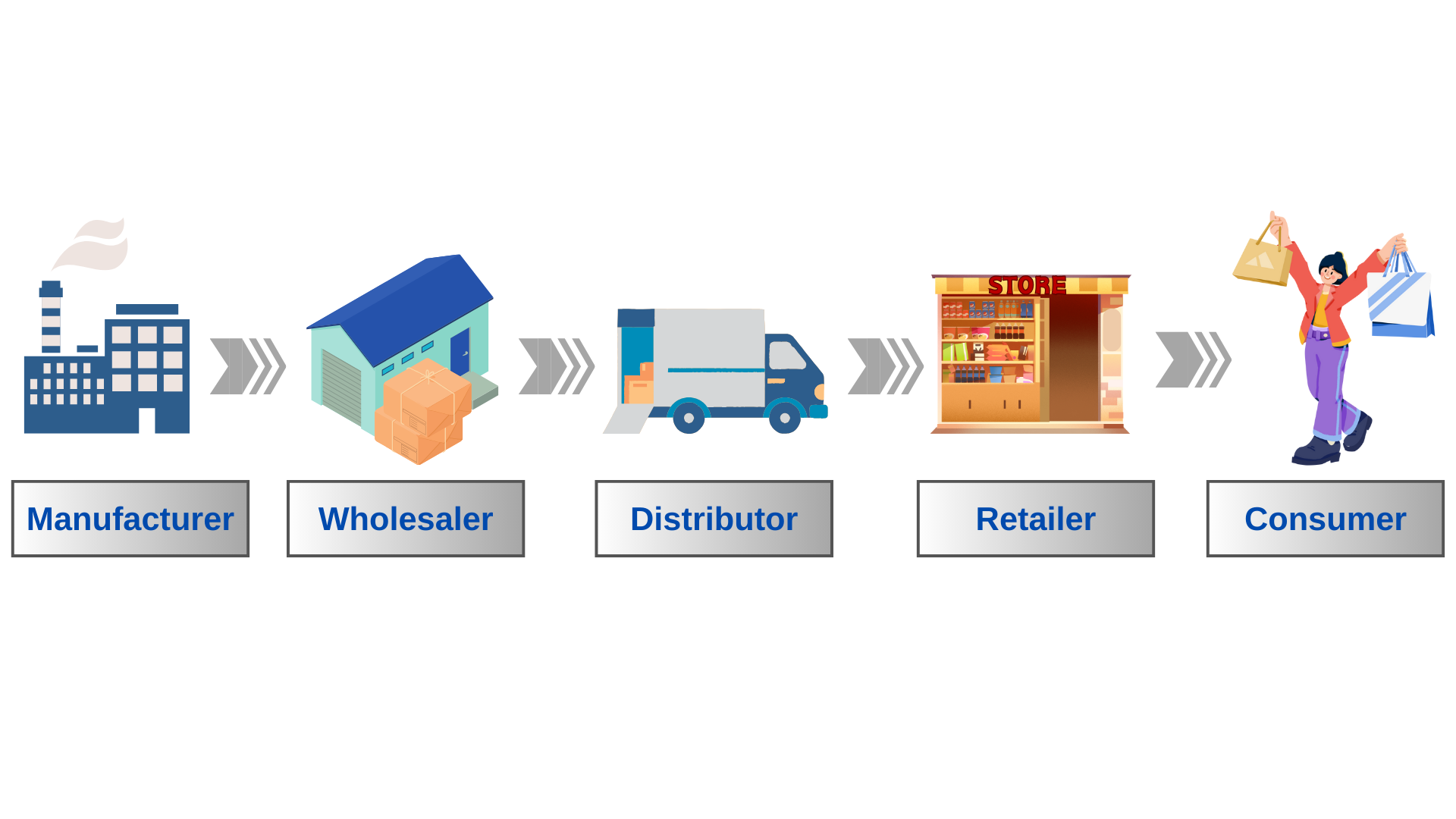
The supply chain that delivers products to customers includes manufacturers, distributors, wholesalers and retailers. Each of these entities has a unique role in the process of bringing goods from the producer to the final consumer.
This article will give you a firm understanding of what these four different kinds of business do and how they work together within the supply chain.
Are you familiar with the methods sellers on platforms like Amazon, Temu, Wish, eBay, Shein and Walmart use to find suppliers?
When it comes to major purchases, successful online sellers tend to establish long-term strategic partnerships with manufacturers while also meeting trusted wholesalers face-to-face at trade shows. Additionally, in the digital age, finding verified suppliers through online third-party B2B platforms has become a common and effective practice.
Table of Contents
Comparison Chart: Manufacturers vs. Distributors vs. Wholesalers vs. Retailers
Factors to Consider when Choosing a Supply Partner
6 Tips for Choosing the Right Partner for Your Business
Finding Manufacturers on Globalsources.com
FAQs: Manufacturers vs. Distributors vs. Wholesalers vs. Retailers
Comparison Chart: Manufacturers vs. Distributors vs. Wholesalers vs. Retailers
| Manufacturers | Distributors | Wholesalers | Retailers | |
|---|---|---|---|---|
| Definition | Companies that produce and sell goods directly to customers or through intermediaries. | Companies that purchase goods directly from manufacturers and sell them to retailers or end-users. | Companies that purchase goods in bulk from manufacturers and sell them to retailers or end-users. | Companies that purchase goods from manufacturers, distributors, or wholesalers and sell them directly to end-users. |
| Customers | Both businesses and end-users. | Other businesses, retailers or end-users. | Other businesses, retailers or end-users. | End-users. |
| Contract | Typically have contracts with suppliers and distributors, and may have contractual agreements with end-users. | Have contracts with manufacturers and retailers, and may have contractual agreements with end-users. | May have contracts with manufacturers, but typically don't have contractual agreements with end-users. | Typically have contracts with suppliers and may have contractual agreements with end-users. |
| Promotion | Focus on building brand awareness and reaching out to new customers. | Primarily focus on promoting their distribution services to manufacturers and retailers. | Primarily focus on promoting their wholesale services to retailers and end-users. | Primarily focus on promoting their retail services to end-users. |
| Competing Items | Typically only sell their own branded products or products made under license. | May sell competing products from different manufacturers. | May sell competing products from different manufacturers. | May sell competing products from different manufacturers. |
| Distribution channel | May sell directly to end-users or use intermediaries such as wholesalers, distributors or retailers. | Sell to retailers, end-users or both. | Sell to retailers, end-users or both. | Sell directly to end-users. |
| Business model | Often vertically integrated and handle everything from production to sales. | Act as middlemen between manufacturers and retailers/end-users. | Act as middlemen between manufacturers and retailers/end-users. | Focus on providing retail services to end-users. |
What is a Manufacturer?
A manufacturer is a person or organization that manufactures items, products or components. Whatever kinds of machinery and tools they may use, and whether they employ thousands of people or a mere handful, all manufacturers transform raw materials into final goods. They are in the business of designing, developing and producing products, such as consumables, equipment and machines, to ultimately be sold to consumers. Manufacturers play a key role in the economy by creating jobs and providing critical goods and services.
Producers provide manufacturers with the raw materials they need to make their items, and some manufacturers provide components and materials to other manufacturers. In some cases, a manufacturer hires other companies to act as subcontractors in order to have them produce components and parts of their final product. Manufacturers may also sell certain products directly to businesses and nonbusiness consumers alike. Some manufacturers focus on a single type of product or service while others make an assortment of things. A successful manufacturer must have exceptional production capabilities and efficient logistics systems in place. There are numerous steps in the manufacturing process, from design and production to quality control and distribution. Manufacturers must plan and arrange the production process to guarantee that the final product meets the industry's quality requirements and customer expectations. Additionally, they must ensure that the production process is efficient and cost-effective in order to maintain market competitiveness. Many manufacturers do R&D to enhance their products, make them more sustainable or efficient and adapt to fluctuating market demand.
Manufacturing is a key component of the global economy, as it contributes to the creation of jobs and the delivery of essential goods and services. Manufacturers offer employment opportunities to individuals with diverse talents and credentials, including engineers, designers, production employees and administrative personnel. In addition, they serve industries such as transportation, logistics and distribution by providing a market for them, contribute to innovation and develop new products and technology that are beneficial to society and the environment. They are an essential component of the supply chain, ensuring that commodities are produced to fulfill the needs of customers around the world.
Also, manufacturers play an important role in shaping the global economy. They engage in international trade, exporting their products to various regions of the world and importing raw materials and industrial components. They contribute to the expansion of various businesses and sectors, hence generating wealth and opportunity for individuals, communities and nations. In addition to influencing the social and environmental impact of their operations, manufacturers undertake sustainability measures and promote responsible conduct.
Despite the importance of manufacturing, every manufacturer faces a range of obstacles, including competition, fluctuations in market demand, regulatory compliance and technological advances. To remain competitive and relevant in the marketplace, manufacturers must continuously adapt and innovate. In addition, they must verify that their operations comply with different norms and standards, including safety and environmental regulations. Today, manufacturers that aim to stay at the forefront of their sector must utilize digital technologies such as automation, data analytics and artificial intelligence to keep up with technological breakthroughs and innovations in order to maintain efficiency and productivity.
What is a Distributor?
A distributor is an enterprise that acquires goods or services from manufacturers and producers, and resells them to retailers, wholesalers or other enterprises. Distributors are an integral component of the supply chain, ensuring that products and services are delivered to clients quickly and effectively. They are frequently referred to as ‘middlemen’ due to the role they play as intermediaries linking manufacturers with final consumers.
Generally, distributors purchase products in bulk – in amounts that qualify for an attractive discount rate from manufacturers. Therefore, they can pass these savings on to the final buyer as most retailers will pass along some or all of the savings to their customers. Distributors also help manufacturers reduce inventory risks and increase profitability. They operate in virtually every industry, notably in the food and beverage, electronics, healthcare and automotive sectors. Distributors offer a variety of value-added services, including warehousing, transportation, marketing and sales support. In addition, they serve as a buffer between manufacturers and retailers, assisting with inventory management and mitigating the risk of overstocking or understocking. In addition, distributors offer producers useful information about market trends, consumer behavior and competitor activity, which may be used to design new products and devise marketing strategies.
Establishing solid relationships with manufacturers, retailers and other players in the supply chain is crucial to a distributor's success. Distributors are responsible for assuring the timely delivery of products and services, so establishing trust and credibility with their clientele is vital. To remain competitive and relevant in the market, they must also keep abreast of industry trends, technological developments and changes in consumer preferences. Distributors can create value for all stakeholders, including manufacturers, retailers and end customers, by efficiently managing the supply chain.
A distributor's experience and resources are two of the most significant advantages of forming a business relationship with them. Distributors frequently possess specific knowledge of both the items and services they offer and the markets they serve. This enables them to provide customers with personalized offerings, such as individualized packaging, logistics solutions and technical assistance. Distributors also have established networks and contacts with suppliers, which can help streamline the procurement process and reduce expenses.
The flexibility a distributor offers in terms of order size and delivery timetables is another advantage of utilizing their services. Typically, distributors can accommodate smaller orders and make more regular shipments than manufacturers, which is especially advantageous for shops and small enterprises. It enables clients to more effectively manage their inventory levels and respond swiftly to fluctuations in demand. In addition, distributors can assist in reducing the time between order placement and delivery, thereby increasing customer happiness and loyalty.
What is a Wholesaler?
Wholesalers purchase products in bulk from manufacturers and sell them to retailers and other wholesalers. In essence, they serve as mediators between producers and merchants, making it easy and efficient for enterprises to source the products they require. This is beneficial because most wholesalers pass on the savings to their customers. Because wholesale companies purchase products in bulk quantities, they are able to negotiate reduced prices with the manufacturers. By reselling products in bulk, wholesalers can obtain a larger profit margin than they would if they sold each item individually.
Wholesalers play a crucial role in the supply chain in that they allow manufacturers to focus on production while the wholesaler handles distribution and sales. They purchase large quantities of items at a discount from producers and resell them for a profit. The markup covers the wholesaler's expenses, such as storage, handling and transportation.
Wholesalers operate in numerous industries, including food and beverage, apparel and electronics. They may specialize in a specific product type or provide a wide range of things. Some wholesalers offer additional services, such as packing and labeling, to enhance the appeal of their products to retailers.
One of the main advantages of working with a wholesaler is that because they buy in bulk, it becomes possible to purchase products at a lower price than you would get if you purchased a relatively small quantity directly from the manufacturer. This helps retailers to offer competitive prices to customers without compromising their profit margins. Wholesalers also help optimize the supply chain by combining orders and delivering products directly to retailers, which can save time and money on transportation.
Wholesalers may sell to other businesses, such as restaurants and hotels, in addition to working with retailers. Hospitality industry customers such as these represent a potentially lucrative market for wholesalers, as these enterprises frequently require products in large quantities.
To be successful, wholesalers must have a solid grasp of their sector and their customers' needs. They must also have a comprehensive logistics and distribution system in place to ensure that products are delivered on time and in optimum condition.
What is a Retailer?
Retailers are the companies that actually sell goods to end-consumers. These enterprises can take the form of brick and mortar stores, internet storefronts and even mobile pop-up stores. Retailers sell a vast array of products, including apparel, electronics and food. They have the largest presence in almost every community and may even compete with each other in shopping malls or other retail districts. Retailers purchase products from wholesalers and distributors, which then make their way to the retailer's location for sale. Customers are then able to, for example, try on shoes, ask questions about a TV set or play with a smartphone before making a purchase decision. Retailers also provide customers with quality guarantees such as warranties and product recalls that can save them money if anything goes wrong later on.
Retailers are essential to the economy because they provide access to goods and services for customers and generate revenue for manufacturers and producers. This is accomplished through the retail merchandizing process, which include selecting, purchasing and displaying products so as to appeal to consumers and boost sales.
Customer service orientation is one of the most important traits of successful retailers. Retailers are in the business of satisfying consumers' needs and desires, and they attempt to deliver a pleasant shopping experience that will encourage customers to return. This may involve delivering tailored advice, a clean and organized store environment, and a prompt response to client questions and complaints.
Another significant feature of retailers is their influence on consumer behavior. Retailers influence consumer decisions through advertising, product placement and pricing strategies, among other ways. By marketing specific products or brands, retailers can nudge consumer preferences in new directions and create trends.
With the rise of e-commerce and the growing popularity of online purchasing, the retail business has seen considerable changes in recent years. Businesses have had to adjust to shifting consumer preferences and behaviors. This has led to the development of new business models, such as click-and-collect and subscription services, as well as greater investment in digital technology and online marketing.
Ultimately, retailers are a vital component of the economy and play a crucial role in facilitating customer access to goods and services. They are continually evolving to satisfy the demands of their consumers and adapt to shifting market conditions, making them a significant and dynamic segment of the global business community.
Working with manufacturers
Some ways you might work with manufacturers include:
Purchasing from manufacturers
The purchasing department of a company is typically responsible for negotiating with manufacturers and placing orders for the products or services they need. You may also communicate directly with a manufacturer to ensure your company's requirements are met. This could involve selecting materials, overseeing the manufacturing process, and inspecting and packaging the finished product for delivery.
Supplying your company with inventory
If you work in the supply chain or inventory department of your company, you may be responsible for ensuring there is enough of a given product or resource to meet current and expected demand. This could involve placing orders with manufacturers and working with them to produce inventory that meets your standards. You may also track the inventory levels of each item in your warehouse to ensure there are enough to last until new items arrive or existing stock is sold.
Overseeing quality control
If you work in quality assurance or inspections, you may be responsible for ensuring the products sold by your company meet certain standards of quality. This could involve testing the finished product or simply visually inspecting it to identify any defects.
Managing vendors
If you work in procurement, you may be responsible for managing the suppliers who provide materials and services to your company. This includes helping those suppliers understand your product requirements and ensuring the products your suppliers deliver meet the specifications required by your company. It also includes monitoring the vendors' performance during the contract period, as well as tracking inventory and deliveries to ensure they comply with your company's needs.
Working with distributors
If you are working with a distributor, some of your responsibilities may include:
Evaluating new products or services
Given that distributors function as a link between manufacturers and customers, they are often responsible for selecting and marketing new products to retail outlets or other customers in the area where they operate. As such, working with a distributor may involve cooperating on research into consumer demand, evaluating new products and services, and taking action to introduce those products and services into the market.
Negotiating contracts
The contracts that distributors enter into with manufacturers and other suppliers often define their responsibility for the products or services they are providing. Since distributors may be responsible for the sales and distribution of multiple brands, they may also be responsible for ensuring legal compliance of each brand or contract. This could involve ensuring that contractual obligations are met, as well as monitoring their own and retailers’ performance against the terms of each contract to avoid any potential penalties.
Communication on price and quality
Distributors are often responsible for selecting and managing their own vendors, including selecting suppliers and verifying their performance during the contract period to ensure compliance with company needs. This may include managing price negotiations with vendors, as well as being responsible for arranging the purchase of stock and communicating with vendors to ensure they meet certain standards of quality.
Working with Wholesalers
If you're working with wholesalers, some of your work may include:
Evaluating new products or services
Wholesalers often have a unique perspective on new products or services given they often work with both manufacturers and customers to determine which products are likely to be most successful in the marketplace. This could involve researching long-term consumer trends, performing financial analysis and analyzing the future market environment for those items to determine opportunities for additional sales within the distribution chain – you can draw on this knowledge to help inform your own business development, as well as sharing your own data and feedback. This could involve encouraging manufacturers to provide additional features or benefits that might make their product more viable in the market.
Maintaining relationships and communication
Because wholesalers typically purchase products from multiple sources, they are often responsible for managing relationships with each vendor and supplier they work with. This includes coordinating logistics and delivery schedules, as well as negotiating price terms on behalf of the wholesaler.
Roles of Retailers
When you are working at a retailer, some of your responsibilities may include:
Evaluating new products or services
The primary responsibility of many retail buyers is to perform financial analysis to determine which products or services they should purchase from their wholesalers and distributors. This could involve tracking short- and long-term trends in the market, identifying buying needs based on customer needs, or performing financial analysis using data such as pricing information and sales volume for each item that has been sold.
Managing contracts
Retailers are often responsible for ensuring that their sales and distribution employees are aware of any contractual agreements they have with wholesalers or distributors. This could involve training sales staff on contractual obligations, or maintaining an inventory of contractual obligations to ensure they are adhered to.
Managing vendors
Many retailers face significant inventory turnover and may experience spikes in demand at certain times of the year, such as major holidays, which means they must have multiple sources for many items they sell. Retailers also have an interest in ensuring that the products or services they purchase are well-priced or meet corporate standards for quality, which means they often manage contracts with multiple vendors and suppliers.
Monitoring performance
Since retailers may be required to provide detailed financial information to various authorities and stakeholders, they are often responsible for managing the flow of this information from the sales and distribution departments. This could include monitoring sales levels and expenses to ensure that the department is meeting corporate goals, updating inventory levels for items that are in or out of stock, as well as coordinating with vendors to ensure that shipments arrive on time.
Factors to Consider when Choosing a Supply Partner
Below are the top nine factors to consider when selecting a supply partner:
Quality of Products/Services
The quality of products and services the supply partner provides is, or should be, the first thing that new business partners consider. However, quality can take many forms and can vary based on industry and regulatory standards.
Cost of Products/Services
The cost of products or services is often the second factor that business partners consider. While quality is essential, it's also important to ensure that the supply partner's products and services fit within your budget.
Reliability and Competence
The reliability and competence of the supply partner often correlates closely to cost, and both are important factors to consider when making a decision about a business deal. The quality of products or services can be measured based on delivery, quality and value but reliability and competence are often assessed based on past performance. A supply partner who has consistently provided high-quality products or services in the past may be worth the added expense, even if they are more expensive than their competition.
Capacity
If you are looking to make a long-term relationship with a particular supply partner, it's important to be sure that they have the capacity to handle expected future growth. This can include the ability to provide products or services at an increased rate or being able to cope with higher demand based on seasonal changes. The capacity of a supply partner is often tied to their financial strength and reputation, as well as their past performance.
Brand Recognition
Brand recognition can be an important factor to consider when choosing a supply partner. This is particularly true if the business partner has a strong brand or is looking to create long-term partnerships with one or more of its suppliers. The brand recognition of your supply partners often reflects the quality they offer, while also providing additional visibility to new customers looking for products or services in your industry.
Reputation and Experience
Experience, reputation and references are all important factors to consider when choosing a supply partner. Each of these factors has the potential to influence your decision for reasons such as efficiency, cost or quality. For example, if you choose a new business partner who is new to a specific industry or is relatively unknown in that industry, you may be taking on a riskier position since you may be less likely to get what you pay for and more reliant on word of mouth from customers who may be less likely to give good recommendations.
Communication
When considering your supply partner, it's important to take note of how effectively you communicate with them. Your partner will have an impact on your ability to complete your transactions, which means that the more effectively you communicate with them and vice versa, the more likely you are to meet deadlines and create successful business transactions.
Sustainability
Sustainability is becoming a more and more important factor to consider when choosing a business partner. For example, the carbon dioxide emissions level of a product is often a key question for companies who are interested in sustainability. Sustainability can also be an important factor in deciding which suppliers or partners to align with. If your company or organization focuses on sustainability, it is crucial to choose an environmentally aware supplier who will have similar values and concern for their ecological impact.
Location of Branch/Facility
Often, it is necessary that your business partners have physical locations that you can visit and inspect before agreeing to do business with them. This is especially true if you are working with companies that are based outside of your country. Other factors to consider when selecting a supply partner include the physical location of their facilities, as well as their customer base and reputation.
6 Tips for Choosing the Right Partner for Your Business
Here are six tips to help you choose the right partner for your business.
Shared values and goals
When choosing a business partner, it's essential that you establish whether they share the same values and goals as you. For example, if your vision is to create a small business success story and you find a supplier who shares that same vision, this can translate into greater customer value and savings.
Complementary skills and expertise
When choosing a business partner, it's important to ensure that they have complementary capabilities. This enables each enterprise to support one another, each filling in the gaps in the capabilities of the other.
Trust and honesty
While there are many reasons to consider a business partner, trust and honesty are two of the most important. When choosing a business partner, it's important to ensure that they will be honest and direct with you as your success is likely to rely on their ability to provide quality products or services. Honesty can also be an important factor in creating long-term relationships with your partners.
Compatible work styles
When choosing a business partner, it's important to ensure that their style works with your own. For example, if you are extremely particular about planning and efficiency, this may not be the best match for someone who relies on spontaneity or flexibility in their planning. Similarly, if you rely heavily on flexibility and impulsive decision-making processes, this may not be the best match for someone who relies on structure and planning ahead.
Financial stability
When choosing a business partner, it's important to ensure that they are financially stable. For example, if you find a supplier who has the same vision and goals as you do and then you realize they haven't paid their utility bills, this may be a red flag.
Strong work ethic
When choosing a business partner, it's important to ensure that they have a strong work ethic and that they will meet the deadlines you establish. This is especially true if your business partner relies heavily on your expertise and vice versa. For example, if you are working with a supplier and will need to rely on their products and services for your business, this can be a risky position to take on if they are less diligent then you.
Finding Manufacturers on GlobalSources.com
Global Sources is a renowned online marketplace that links global buyers and sellers. The platform offers an extensive array of products and services, such as sourcing information, trade fairs and online markets. With over 50 years of expertise in the industry, Global Sources has established itself as a reliable platform for locating manufacturers and suppliers of superior quality.

Global Sources is distinguished by its huge database of manufacturers and suppliers. With over 1.5 million suppliers from over 190 countries, this portal is one of the largest databases of its kind. Customers can search for suppliers by product category, country or company name, making it simple to locate the ideal provider. Global Sources is further distinguished from other platforms by its focus to quality. In addition to on-site inspections, product testing and background checks, the platform has a stringent supplier verification procedure. This ensures that users can trust the quality and dependability of the vendors they discover on the site.
Global Sources also provides a variety of tools and services to facilitate commercial transactions between buyers and sellers. They include trade exhibitions, which offer opportunity for face-to-face meetings and networking, and online marketplaces where buyers can explore and purchase products directly from vendors. The site also offers a variety of instructional materials and industry insights, allowing users to stay abreast of the most recent trends and best practices.
The RFQ (Request for Quote) system on Global Sources is one of its most valuable features. This enables buyers to submit their requirements simultaneously to various providers, saving time and optimizing the sourcing process. Suppliers can then react with price quotations and product details, allowing customers to compare and select the best alternative for their requirements.
Global Sources is a wide-ranging platform for locating manufacturers and suppliers of high quality. Its enormous database, dedication to quality, and variety of products and services make it a useful resource for both buyers and sellers. Global Sources is worth a visit whether you're seeking for a specific product or just want to explore your alternatives. Go to the Global Sources homepage at https://www.globalsources.com/ for more information.
Also Read:
- What is a Wholesaler?
- Wholesalers vs. Manufacturers: Key Differences
- Finding Reliable Wholesalers
- Choosing the Best Wholesaler Website
- Role of a Wholesaler Buyer
FAQs
Is the distributor also the manufacturer?
No. Many distributors are also retailers, but that does not mean they produce the product. Distributors will be able to sell products from one or a number of manufacturers and their primary role is to act as an agent for the manufacturer to help retailers promote and sell their product. The distributor may also handle the logistics, pricing, taxes and payments depending on the agreement between themselves and the manufacturer.
How does a distributor source from manufacturers?
The connection between a distributor and a manufacturer is one of interdependence, with both parties reliant on the other for the success of their respective enterprises. The manufacturer makes the product and relies on the distributor to get it to clients, while the distributor depends on the manufacturer to provide them with competitively priced, high-quality products.
Typically, the producer determines the price of the product and sells it to the distributor at a discount. The distributor then increases the price and sells the product to retailers or other distributors. In addition to marketing, sales and logistics, the distributor may offer additional services to promote and distribute the product. In exchange, the manufacturer gains higher sales and more market share. Effective communication, trust and cooperation are vital for the success of a distributor and manufacturer partnership. Both sides must collaborate to guarantee that the end-user receives the product efficiently, on time and at a reasonable cost. A solid relationship between a distributor and a manufacturer can enhance revenue, brand recognition and customer satisfaction.
What is the difference between a manufacturer and a wholesaler?
A wholesaler typically enters into an arrangement with a manufacturer after receiving an order from a retailer or end-user. The retailer can take advantage of bulk discounts offered by the wholesaler. A wholesaler is also called a reseller because they buy products at wholesale and sell them at retail level prices.
What is the difference between a manufacturer, a wholesaler, a distributor and a retailer?
These four terms are not interchangeable. In general, wholesalers or distributors are the middlemen between the manufacturer and the retailer. They purchase products from manufacturers and sell them to retailers who, in turn, sell the product to end-users. A distributor is an organization or individual that purchases goods from a producer and resells them to retailers, other distributors or end-users. While manufacturers focus on production of goods and services, distributors usually offer additional services such as marketing, sales and logistics.
Also Read:
- Best Websites for Manufacturers 2024
- What Is MSRP?
- Find Indian Manufacturers 2024
- Find a Manufacturer in China 2024
- Best Clothing Manufacturers in China 2024
- Manufacturers vs. Distributors
- Supplier vs. Manufacturer
- Clothing Manufacturers for Startups
- Buy a Car Direct from Manufacturers
- What Is an OEM?
- Buy Products Direct from Manufacturers
- Find a Manufacturer or Supplier

