
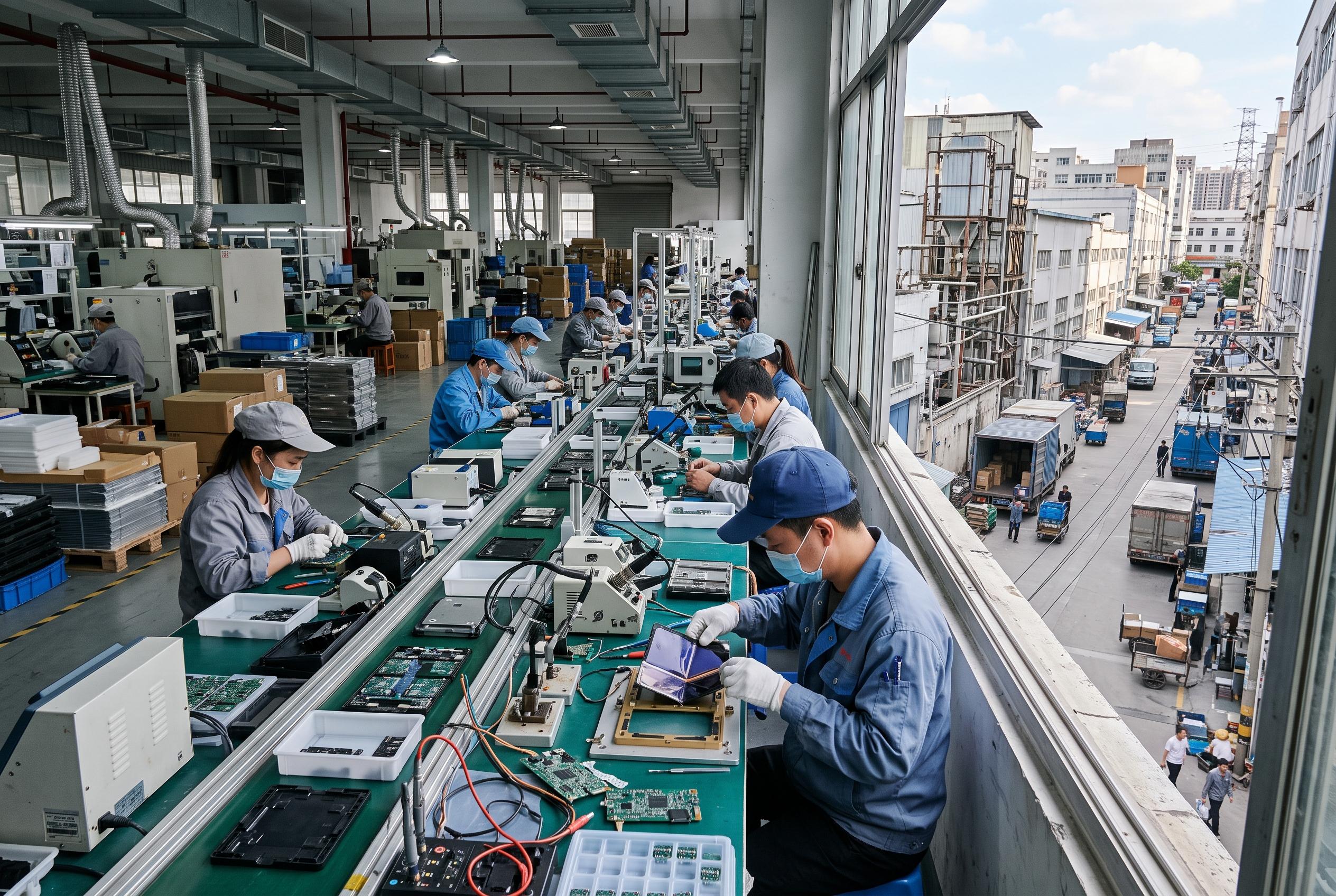
Apple’s latest China visit has spotlighted more than a new foldable iPhone. It has shown how Chinese companies are moving deeper into Apple’s hardware and software ecosystem, from machine-learning quality checks and flexible displays to the local rollout of Apple Intelligence. The opportunity is real, but the most advanced components remain elsewhere.
Apple’s AI Supply Chain Story Starts on the Factory Floor
Tim Cook offered a surprisingly tangible picture of artificial intelligence during his China visit. Rather than describing AI as a distant transformation, Apple’s executive chairman pointed to production lines where machine learning is taking over inspection work once handled largely by people.
That matters because manufacturing quality often lives in tiny differences. A slightly uneven finish or mismatched color can turn into a major problem when millions of phones are produced. According to reports from the Financial Times and Caixin, Apple now uses machine-based inspection to help ensure that devices look consistent at scale.
The change is easy to miss because consumers don't see it in a product launch video. Still, it's the kind of quiet factory upgrade that can influence yield, costs, and delivery speed long after the spotlight moves on.
The iPhone Duo Gives Chinese Suppliers a Bigger Role
The iPhone Duo, Apple’s first foldable iPhone, began pre-orders at 15,999 yuan and reportedly sold through its initial allocation quickly. Publicly available supply-chain information indicates that Chinese companies are involved across several important production stages.
Foxconn handles assembly, while Lens Technology supplies ultra-thin flexible glass. Lixun Precision, Eontec, and Jingyan Technology are associated with hinge and metal structural parts, and PCB components come from suppliers including Zhen Ding Tech and Dongshan Precision. Rongcheer is linked to process inspection, while Crystal-Optech contributes optical components, according to coverage from National Business Daily and Securities Times.
That list makes Cook’s comments feel less like corporate scenery and more like a production update. Machine-learning inspection has a direct place in the phone’s manufacturing chain, while Chinese suppliers are participating in the complicated collection of parts needed to make a thin, foldable device feel sturdy rather than fragile.
Where China Still Isn’t Leading the Most Critical Components
The supplier map is broad, but it isn't complete. Samsung Display reportedly remains the exclusive supplier for the iPhone Duo’s inner and outer screens, while Apple and Corning are jointly developing the cover glass. TSMC is producing the 2-nanometer A20 Pro chip, and memory remains supplied by Micron, Samsung, and SK hynix.
That distinction is important for anyone trying to understand Apple’s manufacturing strategy. Chinese companies have gained ground in assembly, materials, modules, testing, and optical parts, but the highest-barrier technologies still sit with established global specialists.
Apple’s reported decision to increase iPhone Duo orders by about 30 percent adds another layer of interest. The total is still expected to remain below 10 million units, and other iPhone models are reportedly seeing mixed adjustments. In other words, demand looks encouraging, but it doesn't automatically mean every supplier will enjoy a runaway boom.
Apple Intelligence Takes a Different Route Into China
Hardware suppliers enter Apple’s ecosystem through parts, factories, and production qualification. Artificial intelligence in China is arriving through partnerships and regulatory approvals.
Apple’s local model reportedly completed filing and licensing steps before a test release, with Alibaba providing model capabilities and Baidu supporting Siri and visual intelligence. Early features are expected to include Genmoji, notification summaries, writing assistance, and photo editing tools, according to Interface News and 21st Century Business Herald.
This is a notable arrangement because the partners aren't simply selling components to Apple. They're helping provide the intelligence layer behind system features across Apple’s platforms in China. The consumer-facing result may feel seamless, but underneath it sits a distinctly local collaboration shaped by regulation, model capability, and distribution.
ChangXin Could Change the Supplier List, But Not Yet
Memory is the most obvious unresolved piece of the story. Apple has reportedly been seeking permission to buy chips from ChangXin, a Chinese memory producer that has been gaining share in the global DRAM market.
ChangXin’s progress is significant, with reports placing its global DRAM share at around 8 percent in the first quarter of 2026 and noting that LPDDR6 has entered commercial production. But its first reported smartphone deployment is the Xiaomi 18 Fold, not an Apple device. Interface News has reported that the obstacle is procurement approval from the US government, rather than a lack of technical readiness.
That makes ChangXin a potential future supplier, not a confirmed one. For now, the more useful question is whether approval arrives and whether Apple can qualify the chips at the reliability and scale its products demand.
Three Signals Worth Watching Next
The first test will be whether the iPhone Duo’s reported order increase turns into sustained shipments after its retail launch. A strong opening weekend is encouraging, but supply chains are judged over months, not just one noisy reservation count.
The second is Apple Intelligence. Once the full local rollout begins, Alibaba and Baidu could gain a deeper role if Apple expands beyond the first batch of features. The third is ChangXin’s approval process, which remains the clearest possible route for a mainland Chinese memory company to enter Apple’s storage chain.
There’s also a useful caution for investors and shoppers alike. When a component maker talks about rising AI-related revenue, that doesn't necessarily mean the growth comes from Apple; it may instead reflect data centers, servers, or optical networking. The AI label is everywhere now, so the customer and product category still matter.
Apple’s China supply chain is becoming more deeply local in places, but the picture is layered rather than complete. It’s a story of expanding participation, not full technological replacement.
Explore the supply chain closely, and the real shift becomes easier to see.
Disclaimer: This article may have been created with AI assistance and reviewed by our editorial team. It is provided for general informational purposes only. Readers should verify information independently before relying on this content.
