
Investors are pouring billions into physical AI, but the robotics industry still looks more like a box of promising parts than a finished machine. From factory floors to autonomous vehicles, the gap between impressive demonstrations and dependable, scalable products matters for businesses, workers, and anyone watching the next big technology race.
Robotics has plenty of money, but not enough maturity
The robotics industry is attracting enormous attention, yet the machines themselves can still feel oddly unfinished. The promise is sleek and cinematic. The reality often involves a robot struggling with dexterity, battery life, integration, or the simple act of handling an unpredictable object.
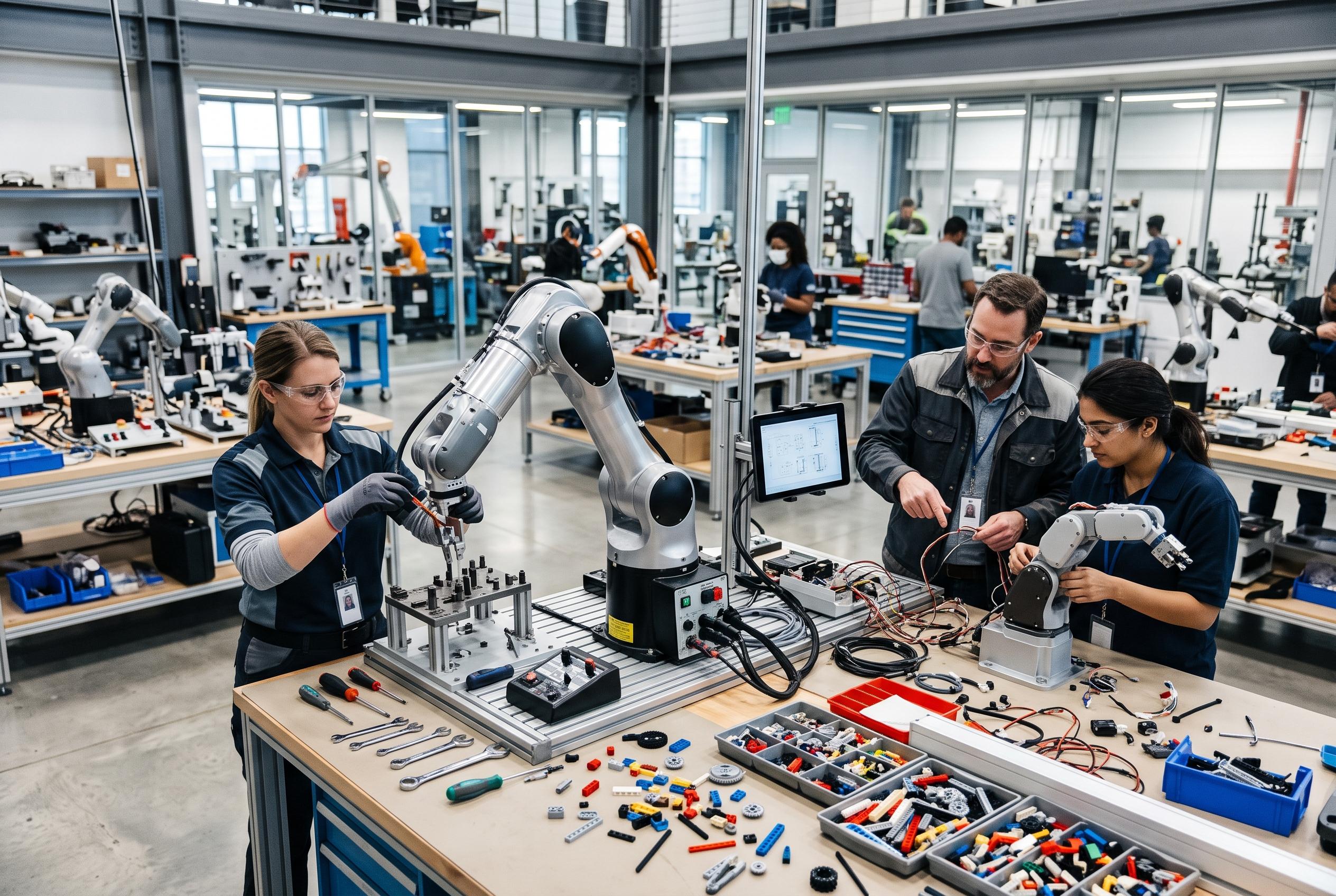
Amulya Vishwanath, a former Nvidia robotics executive and founder of Techable VC, described the sector as being in a "Lego era" during TechCrunch's Equity podcast. Her point is that the core pieces exist, but they haven't yet come together into a broadly useful, reliable platform.
That distinction matters. A robot can walk impressively across a stage and still be a poor fit for a busy warehouse. Businesses need equipment that works for long shifts, handles variation, connects with existing systems, and earns its keep without a heroic maintenance budget.
Humanoids face a steep factory-floor test
Gartner's outlook is a useful reality check. The firm predicts that fewer than 100 companies will use humanoid robots beyond testing by 2028, with fewer than 20 reaching production in manufacturing and supply-chain operations.
The obstacles are familiar but stubborn: limited hand control, high integration costs, and short operating times between charges. Gartner analyst Abdil Tunca said the technology remains immature despite the appeal of humanoid machines. In other words, looking like a worker doesn't necessarily make a robot useful in the workplace.
IDC's shipment figures tell a similar story. The research firm counted more than 18,000 humanoid robot shipments globally in 2025, with Chinese manufacturers accounting for roughly 95 percent. Yet about 85 percent of those units went to demonstrations, education, entertainment, data collection, and guided tours rather than factory production.
Traditional industrial robots still have the advantage
The comparison with conventional automation is revealing. The International Federation of Robotics reported 542,000 industrial robot installations in 2024, while the global operational stock reached about 4.7 million machines.
Those figures aren't directly interchangeable with humanoid shipments, but they show how much further established industrial robotics has traveled. Factory automation doesn't need to resemble a person. A robotic arm that repeats a precise task for years may be less exciting to watch, but it can be far more valuable to a manufacturer.
That's why the most practical robotics investments may continue flowing toward focused systems. A machine designed for welding, picking, inspection, or transport can solve one expensive problem without taking on the enormous challenge of becoming a general-purpose worker.
Physical AI is already proving itself in narrower roles
The strongest commercial evidence may be coming from specialized autonomy rather than humanoids. Waymo, for instance, completed 15 million rides in 2025, demonstrating that a carefully defined physical AI problem can move from research into everyday service.
The broader funding picture also needs some perspective. Crunchbase counted $47.4 billion across 521 physical AI deals in the first half of 2026, but that category includes autonomous vehicles, defense technology, drones, sensors, and other systems. Waymo led the group with $16 billion, while Anduril, Shield AI, and Saronic also attracted substantial backing.
That makes the market look less like a single humanoid race and more like a sprawling technology ecosystem. Generalist's funding round, reported at roughly $600 million with a valuation near $3 billion, shows that investors are also betting on the intelligence layer behind physical machines.
What businesses should watch next
For companies considering robotics, the sensible approach is to start with the job rather than the shape of the robot. Ask whether the system can perform a measurable task safely, connect to current software, and deliver a clear return on investment. A human-like design may help with environments built for people, but it can also add weight, complexity, and cost.
Gartner has identified physical AI agents as one of several trends reshaping warehouses. That points to a more practical near-term path, built around proven automation, better sensors, faster computing, and software that helps machines respond to changing conditions.
The long-term humanoid opportunity is still real, but the timetable is less certain than the marketing suggests. As Vishwanath's Lego comparison implies, the industry may need to improve the individual pieces before anyone can reliably build the finished set.
The next big robotics winners may be the companies making the invisible parts work smoothly.
It's a small distinction, but it could decide which robots actually make it onto the factory floor.
Disclaimer: This article may have been created with AI assistance and reviewed by our editorial team. It is provided for general informational purposes only. Readers should verify information independently before relying on this content.
