
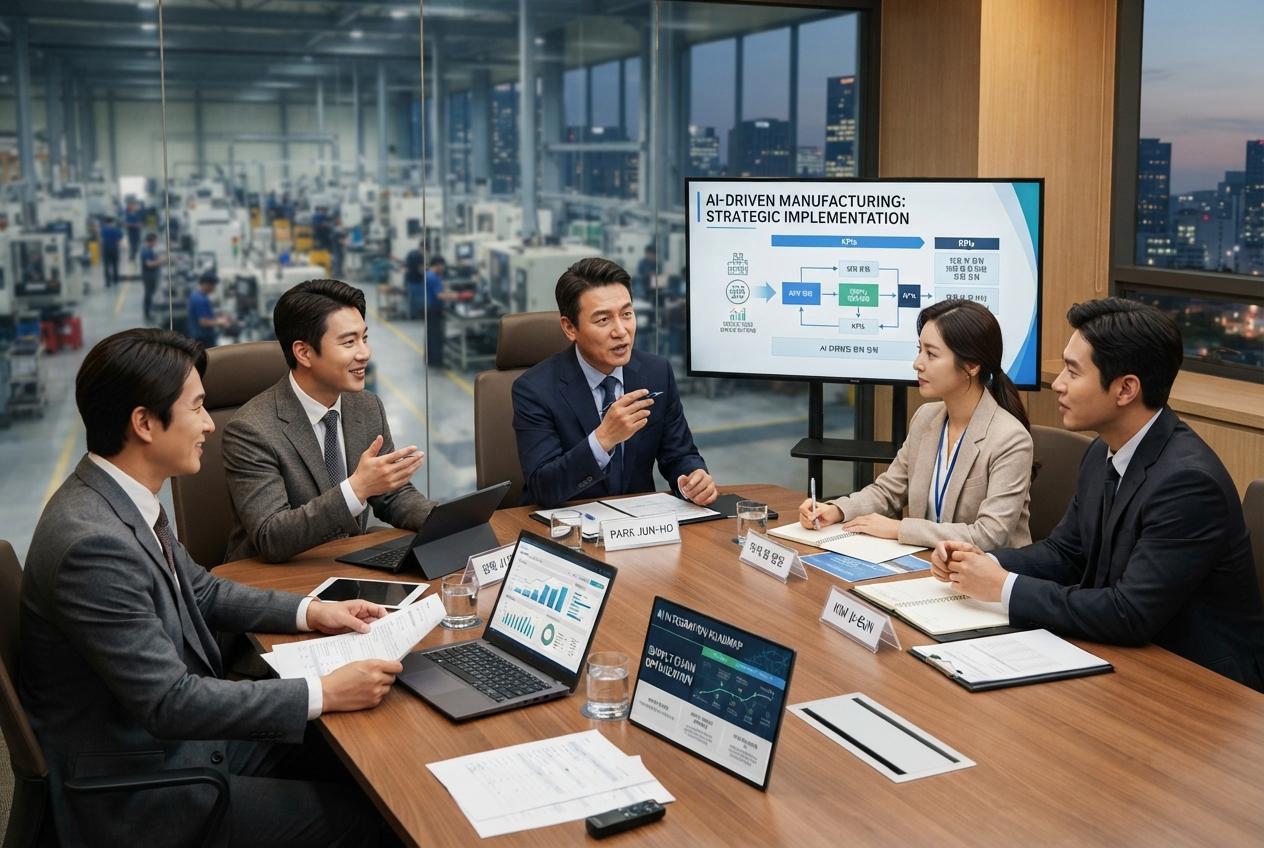
- Most South Korean manufacturers see AI as essential for a comprehensive supply-chain strategy
- Nearly half are actively helping suppliers adopt AI, with pilot projects underway
- Barriers include poor infrastructure among suppliers and the need for supportive government funding
South Korean Manufacturers Are Recasting AI as a Supply-Chain Strategy, Not Just a Factory Tool
Artificial intelligence, it seems, is being viewed more and more by South Korean manufacturers not merely as a standalone tool inside factories but more like a key part of a bigger supply-chain game plan. There’s a recent industry survey that shows most of the major producers believe that transforming their supply networks with AI isn’t just a good idea but pretty much essential for staying competitive.
According to the Korea Economic Association, around 91.5% of the 200 manufacturing companies they checked out see AI-driven change, what they call supply-chain-wide AX, as pretty important. And even among those firms that haven’t yet created detailed support programs for their suppliers, 82.3% confirmed they see the need clearly. So, the message is loud and clear.
And yeah, these concerns are already leading to tangible actions. The association pointed out that about 45% of those surveyed are actually helping their suppliers bring AI into play in some way. That includes nearly 40% who are doing pilot projects, and a smaller group, around 5.5%, who’ve taken it a step further and expanded those projects across different divisions or even the entire company. Plus, there’s another 24% who said they haven't begun doing anything yet but already have plans on the table to support suppliers.
As for what the firms expect to gain from all this, the biggest benefit they’re chasing is higher productivity , that topped the list at nearly 49%. Next is managing risks better at 23%, then cutting costs at about 20%, and finally, about 6% mentioned compliance with regulations.
The Korea Economic Association commented that these findings suggest manufacturers are viewing supplier AI adoption not just as a societal or ethical move but as a way to stabilize quality, speed up delivery, and make their whole supply chain more resilient. It’s really about improving the flow, or at least that’s how it looks.
Of course, the biggest roadblock now seems to be the suppliers themselves. Around 43% of those surveyed said that poor digital infrastructure and limited AI capability among partners are the main issues. Meanwhile, about 23% pointed out the difficulty in standardizing and linking data, along with cybersecurity concerns. And another 17.5% mentioned cost as a big hurdle for suppliers trying to get into AI.
When asked what kind of support from the government would help the most, 43.7% said direct funding to help cover the costs of AI implementation at the supplier level. About a quarter, 25.5%, wanted tailored solutions for specific industries and standard models. The association suggests that a division of labor makes sense here: government could step in with funds and make standard models, while companies focus on data integration and testing things out together.
The survey was carried out in two weeks, from June 9 to June 22, using phone, fax, and email. They say the margin of error is about plus or minus 6 percentage points at a 95% confidence level.
What makes this shift especially interesting is how it stretches beyond the factory floor. In manufacturing, AI has often been associated with machine vision, predictive maintenance, robotic inspection, and production-line automation. But supply-chain-wide AX asks a much bigger question: what happens when sourcing, procurement, logistics, quality control, and supplier communication all become part of the same digital system? That is where the real strategic value begins to show up.
For many companies, the sourcing process is no longer just about finding the lowest-cost vendor. It is about finding suppliers that can operate within data-driven workflows, respond quickly to changes, and maintain consistent standards across a network that may span multiple regions. In that sense, AI becomes less of a gadget and more of a coordination layer. It helps companies make better decisions faster, especially when demand changes suddenly, parts become scarce, or shipping timelines shift.
That matters a great deal in electronics, where component shortages, product cycles, and quality requirements can create serious pressure. If a supplier cannot share accurate data or adapt to changing specifications, even a small delay can ripple across the entire production chain. AI-enabled supplier support can help detect those bottlenecks earlier, streamline communication, and improve planning. For sectors like mobile device assembly and consumer electronics, where timing and precision are critical, the ability to coordinate suppliers through common digital standards can be just as important as automation on the line.
Logistics is another area where this broader AI approach could make a major difference. When manufacturers use AI to monitor supplier performance, forecast material flows, and flag disruptions, they can better align production schedules with transportation realities. That is especially useful when shipping routes are uncertain, delivery windows are tight, or inventory levels need to stay lean. In practical terms, a smarter logistics network can reduce delays, improve fulfillment, and make the overall supply chain more responsive.
The lifestyle angle is worth noting too, even if it is less obvious at first glance. Consumers increasingly expect products to arrive faster, work reliably, and meet consistent standards. That expectation puts pressure on manufacturers to build more resilient supply chains behind the scenes. AI can help companies maintain that reliability by improving visibility across vendors and making it easier to respond to shifting demand patterns. In other words, the everyday experience of buying and using products is tied more closely than ever to how well manufacturers manage their supplier ecosystems.
There is also a cultural and organizational dimension here. Supporting supplier AI adoption is not simply a technical upgrade; it is a change in how companies collaborate. Instead of treating suppliers as disconnected outside partners, manufacturers are starting to see them as part of a shared digital operating model. That means more data sharing, more standardized processes, and more joint testing. It also means greater trust, because a supply chain built on AI cannot function well if the participants are unwilling to align their systems and goals.
Still, the survey makes clear that enthusiasm alone is not enough. Poor infrastructure, limited expertise, and cost concerns can slow everything down. Smaller suppliers may not have the budget or technical staff to deploy advanced systems on their own. That is why the combination of public funding, standardized models, and direct company support could be so important. The most effective path forward may be one where larger manufacturers help pull suppliers into the digital transition rather than waiting for everyone to catch up independently.
There is a strategic reason for that, too. Supply chains are only as strong as their weakest link. If one supplier cannot track materials properly, share data securely, or adapt to demand swings, the benefits of AI at the lead manufacturer level may be limited. A more connected ecosystem creates the possibility of shared visibility, earlier warning signals, and better long-term planning. That can help manufacturers move from reactive problem-solving to proactive management.
In that sense, South Korea’s manufacturing sector may be offering a useful blueprint for others watching from abroad. The message is not that factories should replace human judgment with software. It is that AI can help organize the entire chain of decisions that surround production, from sourcing and procurement to delivery and quality assurance. When used this way, AI becomes a strategic tool for resilience, not just efficiency.
For companies considering this path, the lesson is straightforward: the real value of AI may come not from isolated experiments but from coordinated adoption across the supply chain. Pilot projects matter, but scaling them requires data readiness, supplier alignment, and practical support. The firms that can connect those pieces will likely be better positioned to handle disruption, control costs, and keep products moving to market.
Frequently Asked Questions
Q1: What is supply-chain-wide AX? It refers to using AI-driven transformation across the entire supply chain, not just inside the factory.
Q2: Why are manufacturers focusing on supplier AI adoption? They want better productivity, lower risk, reduced costs, and more resilient operations.
Q3: What is the biggest obstacle to supplier AI use? Poor digital infrastructure and limited AI capability among suppliers.
Q4: Why does this matter for electronics and mobile sectors? Because those industries depend on fast sourcing, precise logistics, and reliable supplier coordination.
Q5: What kind of support do companies want most? Direct funding for supplier-level AI implementation.
Source Reference Map
Inspired by the headline at: [1]
Sources by paragraph: - Paragraph 1: [2], [3] - Paragraph 2: [2], [4] - Paragraph 3: [3], [5] - Paragraph 4: [1], [2], [6]
